
The Lion of Britain
A Life of War, Words, and Unyielding Leadership

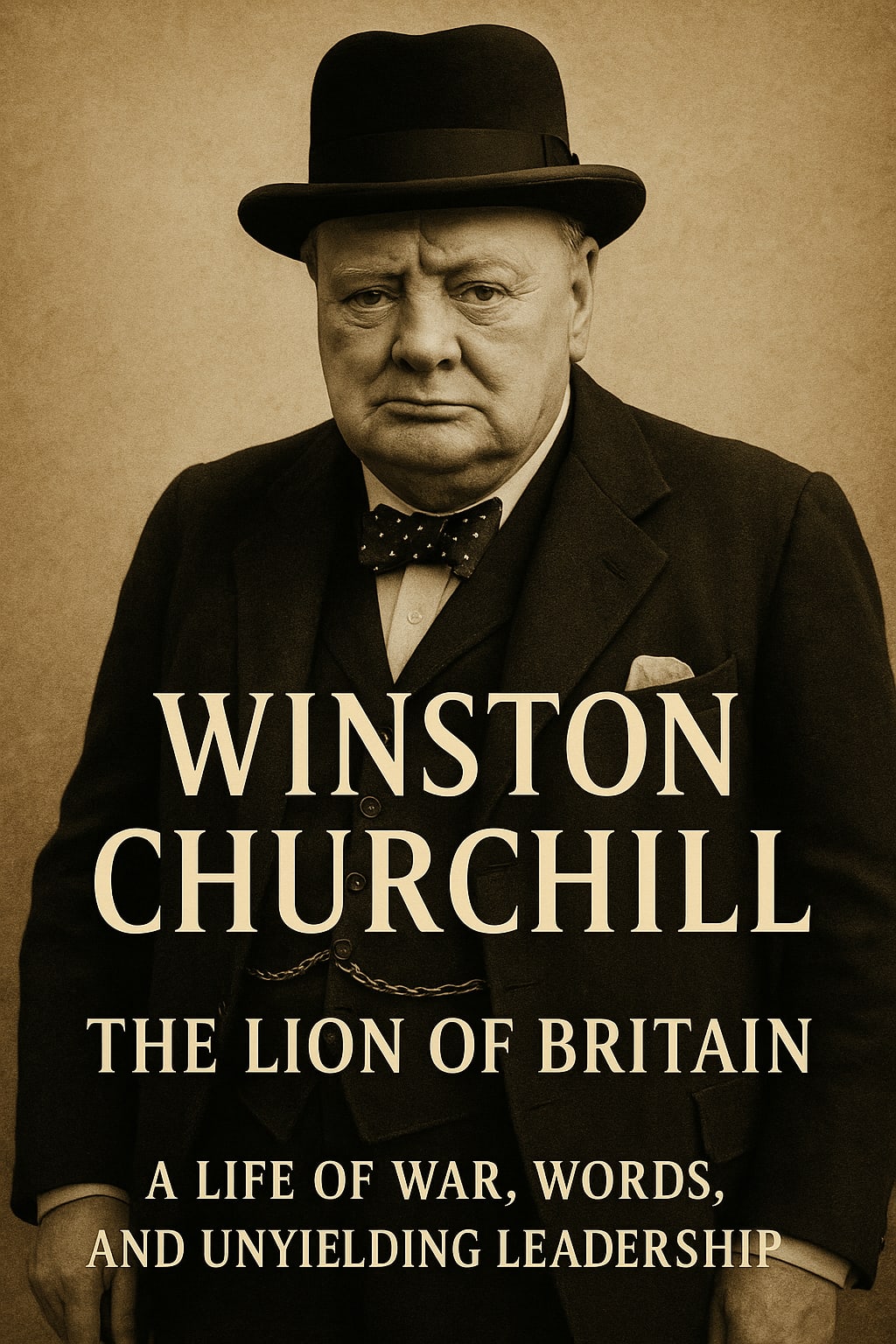
Sir Winston Leonard Spencer Churchill, often remembered as the indomitable “Lion of Britain,” led a life defined by extraordinary resilience, rhetorical mastery, and a tenacious commitment to his nation. Born on November 30, 1874, at Blenheim Palace in Oxfordshire, England, Churchill came from aristocratic lineage. His father, Lord Randolph Churchill, was a prominent Conservative politician, and his mother, Jennie Jerome, was an American socialite. From a young age, Churchill was determined to forge his own path, often at odds with tradition and expectation.
Despite early academic struggles—particularly at Harrow and Sandhurst—Churchill’s tenacity prevailed. He entered the British Army and embarked on a series of adventures that would shape his worldview and public persona. As a war correspondent and soldier, he saw action in Cuba, India, Sudan, and most famously in the Second Boer War in South Africa. His daring escape from a prisoner-of-war camp during that conflict made him a national hero and launched his political career.
Churchill entered Parliament in 1900 as the Conservative MP for Oldham. However, his restless intellect and independent spirit soon led him to switch allegiance to the Liberal Party in 1904. This move shocked many, but it was emblematic of a lifelong pattern: Churchill’s loyalty was to principle and country rather than to party. As a Liberal, he held several significant posts, including President of the Board of Trade and Home Secretary. He championed progressive reforms such as labor rights, prison reform, and unemployment insurance, laying the groundwork for the modern welfare state.
In 1911, Churchill was appointed First Lord of the Admiralty, where he oversaw naval readiness on the eve of the First World War. His role in the disastrous Gallipoli Campaign in 1915, however, nearly ended his political career. Resigning his post, he rejoined the Army and served on the Western Front in France—a rare move for a politician of his rank and status. The experience humbled him but did not break his spirit.
Churchill returned to government in various roles throughout the 1920s and rejoined the Conservative Party. His career, however, was riddled with controversy. During the 1930s, as the world plunged into economic depression and the specter of fascism loomed, Churchill found himself increasingly isolated. His vocal opposition to Indian independence alienated progressives, and his warnings about Adolf Hitler’s ambitions were largely dismissed as outdated warmongering.
These wilderness years proved pivotal. While others sought appeasement, Churchill remained vigilant. His relentless speeches in the House of Commons, warning of the Nazi threat, were often ignored but proved prescient. When Hitler invaded Poland in 1939, and war was declared, Churchill was vindicated. In 1940, following Neville Chamberlain’s resignation, Churchill became Prime Minister at Britain’s darkest hour.
What followed was one of the most extraordinary periods of leadership in modern history. With Europe under Nazi control and Britain standing alone, Churchill galvanized the nation. His speeches—“We shall fight on the beaches,” “Their finest hour,” and “Never was so much owed by so many to so few”—did more than boost morale. They became timeless calls to courage and resistance.
Churchill’s leadership extended beyond oratory. He forged critical alliances with the United States and the Soviet Union, maintained a strong military strategy, and worked tirelessly behind the scenes to keep Britain in the war. His resolve never wavered, even during the Blitz when German bombs rained down on London. For Churchill, surrender was never an option. “Victory at all costs,” he proclaimed, “for without victory, there is no survival.”
In 1945, as the war ended in triumph, Churchill was voted out of office in a general election that ushered in a Labour government. It was a shocking reversal for the man who had just led Britain through its gravest trial. Yet Churchill accepted the verdict with grace, famously saying, “The people have the right to be wrong.”
He returned as Prime Minister in 1951, though age and illness had begun to take their toll. Still, he managed significant foreign policy contributions, particularly in navigating the early years of the Cold War. He resigned in 1955, leaving behind a legacy few could rival.
Churchill was not without flaws. His views on empire, race, and class were shaped by a Victorian mindset that often clashed with emerging liberal values. His role in the Bengal Famine of 1943 and his opposition to Indian independence remain deeply controversial. Yet these criticisms, while valid, exist alongside his immense achievements.
He was also a man of remarkable talents beyond politics. A Nobel Prize-winning writer, Churchill authored numerous books, including his six-volume history of the Second World War. He was a gifted painter, an amateur bricklayer, and a lover of animals. These pursuits offered him solace during times of personal and political strife.
Churchill passed away on January 24, 1965, at the age of 90. His state funeral, attended by leaders from around the world, marked the end of an era. He was buried at St. Martin’s Church in Bladon, near his birthplace at Blenheim.
Today, Churchill’s legacy endures as a symbol of courage, defiance, and eloquence. He is remembered not only for leading Britain through its most perilous time but also for embodying the indomitable spirit of a nation that refused to yield. His life was a testament to the power of conviction, the impact of words, and the importance of unwavering leadership.
In the darkest days of war, Churchill stood as a beacon of hope and strength. His voice, rich with determination and historical resonance, rallied millions to believe in victory. He was not a perfect man, but he was the right man for a perilous time—a lion whose roar still echoes through history.
About the Creator
Irshad Abbasi
"Studying is the best cure for sorrow and grief." shirazi
Keep reading
More stories from Irshad Abbasi and writers in History and other communities.
The Chrysanthemum and the Throne
Emperor Hirohito, known posthumously as Emperor Shōwa, reigned over Japan during one of the most turbulent periods in its history, from 1926 until his death in 1989. His life bridged feudal traditions and modern geopolitics, imperial divinity and democratic symbolism, devastating war and remarkable recovery. As a figure cloaked in mystery and contradiction, Hirohito remains both a symbol of continuity and a subject of enduring debate.
By Irshad Abbasi 8 months ago in History
Stanislav Kondrashov Oligarch Series: Echoes of Influence in Southern Italy
Oligarchy isn’t always written into the laws of a country. Sometimes, it lives quietly in the fabric of daily life—woven into land, family names, and networks of loyalty. Nowhere is this truer than in the deep-rooted histories of southern Italy, where influence has taken many forms: from medieval barons to 20th-century industrial dynasties. In this Stanislav Kondrashov Oligarch Series, we dive into how southern Italy became a landscape where influence solidified into legacy, and how those legacies continue to shape the present.
By Stanislav Kondrashova day ago in History
Vlad Țepeș
Vlad Țepeș: Sovereignty Written in Blood History remembers kings by their victories, saints by their sacrifices, and tyrants by their cruelties. Vlad Țepeș is remembered by all three and understood by none. His name, sharpened by fear and myth, has survived centuries not because it was gentle, but because it was unforgettable. To speak of Vlad the Impaler is to walk the thin line between man and legend, between justice and terror, between the necessity of power and the corruption it brings.
By Pure childabout 22 hours ago in History


Comments
There are no comments for this story
Be the first to respond and start the conversation.