
The Chrysanthemum and the Throne
The Life and Legacy of Japan’s Wartime Emperor


Emperor Hirohito, known posthumously as Emperor Shōwa, reigned over Japan during one of the most turbulent periods in its history, from 1926 until his death in 1989. His life bridged feudal traditions and modern geopolitics, imperial divinity and democratic symbolism, devastating war and remarkable recovery. As a figure cloaked in mystery and contradiction, Hirohito remains both a symbol of continuity and a subject of enduring debate.
#### **Early Life and Rise to Power**
Born on April 29, 1901, Hirohito was the first son of Crown Prince Yoshihito (later Emperor Taishō) and Empress Teimei. As a child of the imperial house, Hirohito was raised in strict seclusion and educated under a rigid and traditional curriculum designed to instill loyalty, discipline, and reverence for the imperial institution. At a young age, he was separated from his parents and groomed for the role of emperor through military and moral training.
In 1921, Hirohito embarked on a groundbreaking journey to Europe, becoming the first Japanese crown prince to travel abroad. The trip exposed him to Western political systems, modern science, and the fragility of colonial empires. These observations would later influence his interest in marine biology and possibly his cautious engagement with modernity.
Hirohito became regent in 1921 due to his father's illness and formally ascended the throne on December 25, 1926, upon Emperor Taishō’s death. His reign was named "Shōwa," meaning “Enlightened Peace,” a title that would prove ironic given the events that would follow.
#### **The Road to War**
The early years of Hirohito’s reign were marked by economic instability, the rise of ultranationalism, and an increasingly assertive military. Japan, seeking resources and geopolitical stature, expanded aggressively into Asia. In 1931, the military staged the Mukden Incident, leading to the occupation of Manchuria. Though nominally the sovereign, Hirohito did not oppose the army’s actions. This pattern of passive endorsement or subtle acquiescence would characterize his wartime role.
By the late 1930s, Japan was fully engaged in the Second Sino-Japanese War. The emperor continued to receive military briefings and issued imperial rescripts encouraging perseverance, but he maintained a careful distance from operational decisions. Critics argue this allowed him to preserve the imperial institution while avoiding responsibility for atrocities such as the Nanjing Massacre. Supporters contend his power was constrained by a militaristic bureaucracy acting in his name but without his direct consent.
#### **World War II and the Crisis of the Throne**
Japan's alliance with Nazi Germany and Fascist Italy in 1940 marked its entry into the global axis of aggression. On December 7, 1941, Japanese forces attacked Pearl Harbor, drawing the United States into the conflict. Hirohito's role in approving this act remains contested. While he did not initiate the decision, his final endorsement lent imperial legitimacy to a war that would devastate Asia and eventually Japan itself.
As the war turned against Japan, Hirohito reportedly began seeking a way to end the conflict. Yet, it wasn’t until the atomic bombings of Hiroshima and Nagasaki in August 1945 and the Soviet Union’s declaration of war that he took decisive action. On August 15, 1945, in an unprecedented radio broadcast, Hirohito announced Japan’s surrender, citing the "new and most cruel bomb" as a reason for ending the war.
The broadcast, known as the *Gyokuon-hōsō* ("Jewel Voice Broadcast"), stunned the Japanese public. It was the first time they had heard the emperor’s voice. His dignified and ambiguous tone preserved the myth of divine infallibility while acknowledging the reality of defeat.
#### **Postwar Transformation and the American Occupation**
Japan's defeat brought the Allied Occupation, led by General Douglas MacArthur. One of the first and most significant decisions was to preserve the emperor, transforming him from a divine sovereign to a constitutional monarch. This decision aimed to maintain order and legitimize the sweeping reforms of democratization, demilitarization, and reconstruction.
In 1946, Hirohito issued the "Humanity Declaration," renouncing his divinity—a moment that marked a profound shift in the imperial role. Though many Japanese still venerated him, the declaration opened the path to a more symbolic, non-political monarchy.
Hirohito cooperated with American authorities, supported the new constitution, and largely withdrew from political affairs. He dedicated himself to ceremonial duties and his personal passion—marine biology. In doing so, he helped preserve the imperial institution during a time when many called for its abolition.
#### **A Reign of Continuity and Controversy**
The Shōwa era came to symbolize both the horror of war and the miracle of recovery. Japan emerged from devastation to become one of the world’s leading economies. Hirohito was an enduring presence, visiting disaster zones, opening national events, and receiving foreign dignitaries. His quiet demeanor and scholarly interests gave him a statesmanlike image, especially in the West.
However, controversies persisted. Many questioned why Hirohito was never tried for war crimes, especially as key military leaders were executed. Declassified documents and historical research have revealed that he was kept deliberately insulated from prosecution by the Occupation authorities, who saw him as vital to Japan’s stability.
Public perception within Japan evolved over time. While older generations revered him, younger people viewed him more as a historical figure than a divine one. His role during the war remained a topic of scholarly debate, theatrical depiction, and political protest.
#### **Death and Legacy**
Emperor Hirohito died on January 7, 1989, ending the longest reign in Japanese history—62 years. His death marked the end of the Shōwa era and the beginning of the Heisei era under his son, Akihito.
Hirohito’s legacy is as complex as the century he helped shape. He is remembered variously as a symbol of Japan’s wartime aggression, a passive monarch who failed to stop the military, a modernizing figure who helped his country navigate profound transformation, and a constitutional monarch who ushered in peace.
Today, his life remains a lens through which to understand Japan’s 20th-century journey—from empire to ashes, from devastation to democracy.
About the Creator
Irshad Abbasi
"Studying is the best cure for sorrow and grief." shirazi
Keep reading
More stories from Irshad Abbasi and writers in History and other communities.
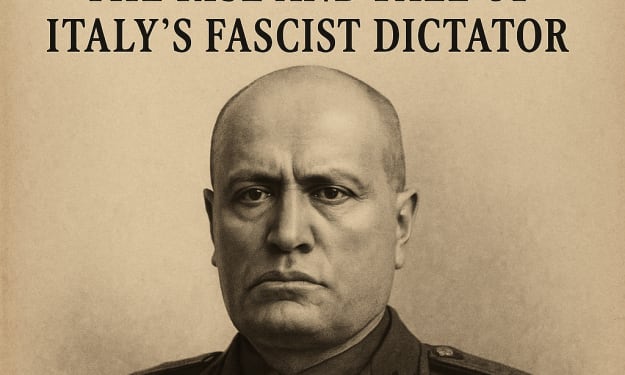
The Rise and Fall of Italy’s Fascist Dictator
Benito Mussolini, one of the 20th century's most controversial and influential figures, rose from humble beginnings to become the founder of Italian Fascism and dictator of Italy. His rule, which spanned over two decades, left an indelible mark on Italy and the world, shaping the trajectory of Europe between the World Wars. Ultimately, his ambitions led Italy into ruin and himself to a grim demise.
By Irshad Abbasi 8 months ago in History
Marsala
Marsala is a name that resonates with more than one meaning. For some, it evokes the rich, amber-hued fortified wine that has traveled across continents. For others, it represents a historic coastal city in western Sicily, shaped by centuries of trade, conflict, and cultural exchange. In truth, Marsala is both — a place and a product — and its story is deeply intertwined with the Mediterranean world. Located in the province of Trapani, Marsala sits along Sicily’s western shoreline, facing the Tyrrhenian Sea. Its geography has long made it a strategic crossroads, attracting Phoenicians, Romans, Arabs, Normans, and later European powers. Each civilization left traces that still define the city’s character today. Ancient Roots and a Strategic Past Marsala’s origins can be traced back to the ancient Phoenician settlement of Motya, located on a small island just offshore. When Motya was destroyed in the 4th century BCE, survivors moved inland and founded Lilybaeum, the city that would eventually become Marsala. Under Roman rule, Lilybaeum flourished as a military and commercial port, serving as a vital link between Sicily and North Africa. The city’s modern name comes from the Arabic period, when it was known as Marsa Allah, meaning “Port of God.” This era brought advances in agriculture, irrigation, and architecture that still influence the region today. Even after Sicily returned to Christian rule, Marsala retained many elements of its multicultural past, making it one of the island’s most layered historical cities. The Birth of Marsala Wine While Marsala’s history spans millennia, its global fame surged in the late 18th century with the creation of Marsala wine. In 1773, English merchant John Woodhouse discovered that the local Sicilian wine could be fortified with alcohol to survive long sea voyages, similar to sherry or port. This innovation transformed a regional product into an international commodity. Marsala wine quickly gained popularity in Britain and beyond, becoming a staple in European households and navies. Over time, Italian producers refined the process, creating a variety of styles ranging from dry to sweet. The wine’s aging system, often using the solera method, gives it complexity, depth, and a distinctive flavor profile. Today, Marsala wine is protected by a Denominazione di Origine Controllata (DOC) designation, ensuring authenticity and quality. Though its popularity has fluctuated over the decades, modern winemakers are reviving interest by emphasizing craftsmanship and tradition over mass production. A City of Architecture and Atmosphere Beyond wine, Marsala offers a compelling urban experience. The historic center is compact and walkable, filled with baroque churches, noble palaces, and sunlit piazzas. Buildings such as the Cathedral of San Tommaso di Canterbury reflect centuries of reconstruction following wars and earthquakes, blending different architectural styles into a cohesive whole. Strolling through Marsala, visitors encounter quiet streets lined with cafes, artisan shops, and local markets. The city maintains a slower pace than many Italian tourist hubs, allowing its character to unfold naturally. This sense of authenticity is one of Marsala’s greatest strengths. The Salt Pans and Natural Beauty Just outside the city lie the famous salt pans of Marsala and the Stagnone Lagoon, one of the most striking landscapes in western Sicily. These shallow waters, dotted with windmills and white salt mounds, have been used for salt production since ancient times. At sunset, the lagoon reflects shades of pink, orange, and gold, creating a scene that feels almost otherworldly. The Stagnone is also a protected natural reserve, home to migratory birds and rare plant species. Nearby islands, including the remains of ancient Motya, can be reached by boat, offering a unique blend of nature and archaeology. Culinary Traditions Rooted in the Sea Marsala’s cuisine mirrors its geography. Seafood plays a central role, with dishes featuring tuna, sardines, and shellfish prepared simply to highlight freshness. Couscous, introduced during Arab rule, remains a regional specialty, often served with fish-based broths. Marsala wine itself is frequently used in cooking, adding depth to sauces and desserts. Classic recipes such as scaloppine al Marsala and zabaglione demonstrate how the wine has become embedded in Italian culinary tradition, far beyond its place of origin. Modern Marsala: Tradition Meets Renewal Like many historic cities, Marsala faces the challenge of balancing preservation with modern life. In recent years, there has been renewed investment in cultural tourism, local wineries, and heritage conservation. Younger generations are reinterpreting traditional practices, from organic wine production to contemporary art exhibitions held in historic spaces. Marsala is no longer just a name on a wine label. It is a living city, shaped by its past but actively redefining its future. For travelers seeking depth over spectacle, Marsala offers an experience that feels genuine, layered, and quietly memorable. Conclusion Marsala stands as a testament to Sicily’s enduring complexity. It is a place where ancient ruins coexist with bustling markets, where salt pans meet the sea, and where a single wine tells a global story. Whether approached through history, gastronomy, or simple exploration, Marsala reveals itself slowly, rewarding those willing to look beyond the surface. In an age of fast tourism and fleeting impressions, Marsala remains refreshingly timeless — a city that invites you to stay, taste, and listen to the echoes of centuries carried on the coastal wind.
By Saboor Brohi 7 days ago in History


Comments
There are no comments for this story
Be the first to respond and start the conversation.