
The Light of Andalusia
How Knowledge and Faith Blossomed in the Golden Age of Islam


In the heart of southern Spain, where the Guadalquivir River flowed gently through fertile lands, stood the great city of Córdoba — jewel of Al-Andalus, and beacon of light in a world that had fallen into darkness.
The year was 970 CE, and Córdoba had become the most advanced city in Europe. Its streets were lined with lamps that burned through the night, its markets hummed with traders from distant lands, and its libraries overflowed with knowledge that spanned the ages.
At the center of this vibrant city stood a young scholar named Yusuf ibn Khalid, a student of philosophy, astronomy, and Qur’anic sciences. Every morning, Yusuf walked through the narrow, jasmine-scented alleys toward the Great Mosque of Córdoba, its red and white arches glowing in the morning sun. There, beneath the cool marble floors, hundreds of students gathered to learn — Muslims, Christians, and Jews sitting side by side, united by their thirst for knowledge.
Yusuf’s teacher, Imam Al-Zahrawi, was a physician renowned across the Muslim world. He was compiling a book that would one day become the foundation of modern surgery — Al-Tasrif. Yusuf, eager and curious, often stayed after class to assist him, grinding herbs, mixing ointments, and recording notes by lamplight.
One evening, as Yusuf worked, the Imam spoke softly, “Do you know why knowledge is light, my son?”
Yusuf looked up. “Because it guides us?”
Al-Zahrawi smiled. “Yes, but also because it reveals the signs of Allah in His creation. Every star you chart, every remedy you discover, is an act of worship if your heart is sincere.”
Those words stayed with Yusuf. He realized then that in Al-Andalus, learning was not separate from faith. Science was a way to understand the wisdom of the Creator.
The following year, the Caliph Al-Hakam II opened a new library — a magnificent building that housed over 400,000 books, copied by skilled calligraphers and bound in fine leather. Scholars came from Damascus, Baghdad, and even faraway Constantinople to study its treasures.
Yusuf spent countless hours within those walls, surrounded by manuscripts of Aristotle, Galen, and Ibn Sina. He translated texts, compared ideas, and discovered that Islam had not come to erase the past, but to illuminate it — to preserve and expand upon human knowledge.
Córdoba became a symbol of coexistence. In its universities, Muslim astronomers debated with Jewish mathematicians and Christian translators. Together they charted the heavens, calculated the circumference of the earth, and refined medicine and engineering.
At night, Yusuf would stand on the mosque’s rooftop, gazing at the stars. He mapped their paths using instruments perfected by Muslim scientists — the astrolabe and the quadrant. One night, as he adjusted the brass device, he whispered the verse from the Qur’an:
“It is He who made the sun a shining light and the moon a derived light and determined for it phases — that you may know the number of years and calculation.”
(Surah Yunus, 10:5)
He felt an immense peace. Every discovery, every observation, was a way of reading the universe’s divine script.
But the peace of Al-Andalus would not last forever. In the decades to come, political turmoil and wars would threaten the harmony of Córdoba. Many of its books would be lost, its scholars scattered.
Before leaving his beloved city, Yusuf gathered what he could of his teacher’s writings and carried them eastward — through deserts, over mountains — until he reached Cairo, where he continued to teach. There, under the shade of the Al-Azhar Mosque, he told his students about Córdoba: a city where the pursuit of knowledge was an act of worship, and where faith inspired science, not opposed it.
Years later, as an old man, Yusuf wrote in his journal:
“The ink of the scholar is more sacred than the blood of the martyr. For knowledge preserves what swords cannot. When we seek truth with faith, we honor Allah’s command to reflect upon His signs — in the heavens, on the earth, and within ourselves.”
Even after Córdoba’s glory faded, its light did not die. The books and ideas carried from Al-Andalus would later ignite the European Renaissance — a gift born from Islamic civilization’s golden age.
And though centuries have passed, the message endures:
True knowledge is light — a light that begins with faith, guided by reason, and destined to illuminate hearts across generations.
About the Creator
Nusuki
I am a storyteller and writer who brings human emotions to life through heartfelt narratives. His stories explore love, loss, and the unspoken, connecting deeply with listeners and inspiring reflection.
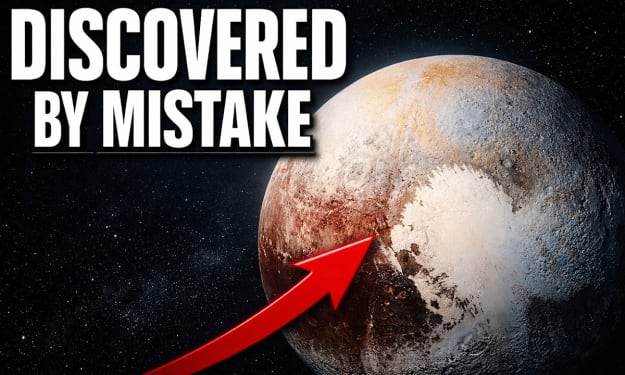
How Pluto was Discovered By Mistake
Pluto’s discovery wasn’t a planned success — it was actually the result of a mathematical mistake that shocked the world. Astronomers were searching billions of kilometers away for a powerful “cosmic predator” that seemed to be pulling planets out of their paths. But when they finally reached their target, they didn’t find a massive hunter — they found a tiny traveler.
By Imran Ali Shah7 days ago in History



Comments (1)
This article could easily be shared in classrooms to inspire students about the Golden Age of Islam. The way you humanize Yusuf and Al-Zahrawi transforms abstract history into something deeply relatable and inspiring.