
The Life Story of Sitka Spruce (Picea sitchensis)
From Coastal Fog to Timber Fame – The Remarkable Journey of North America’s Tallest Conifer

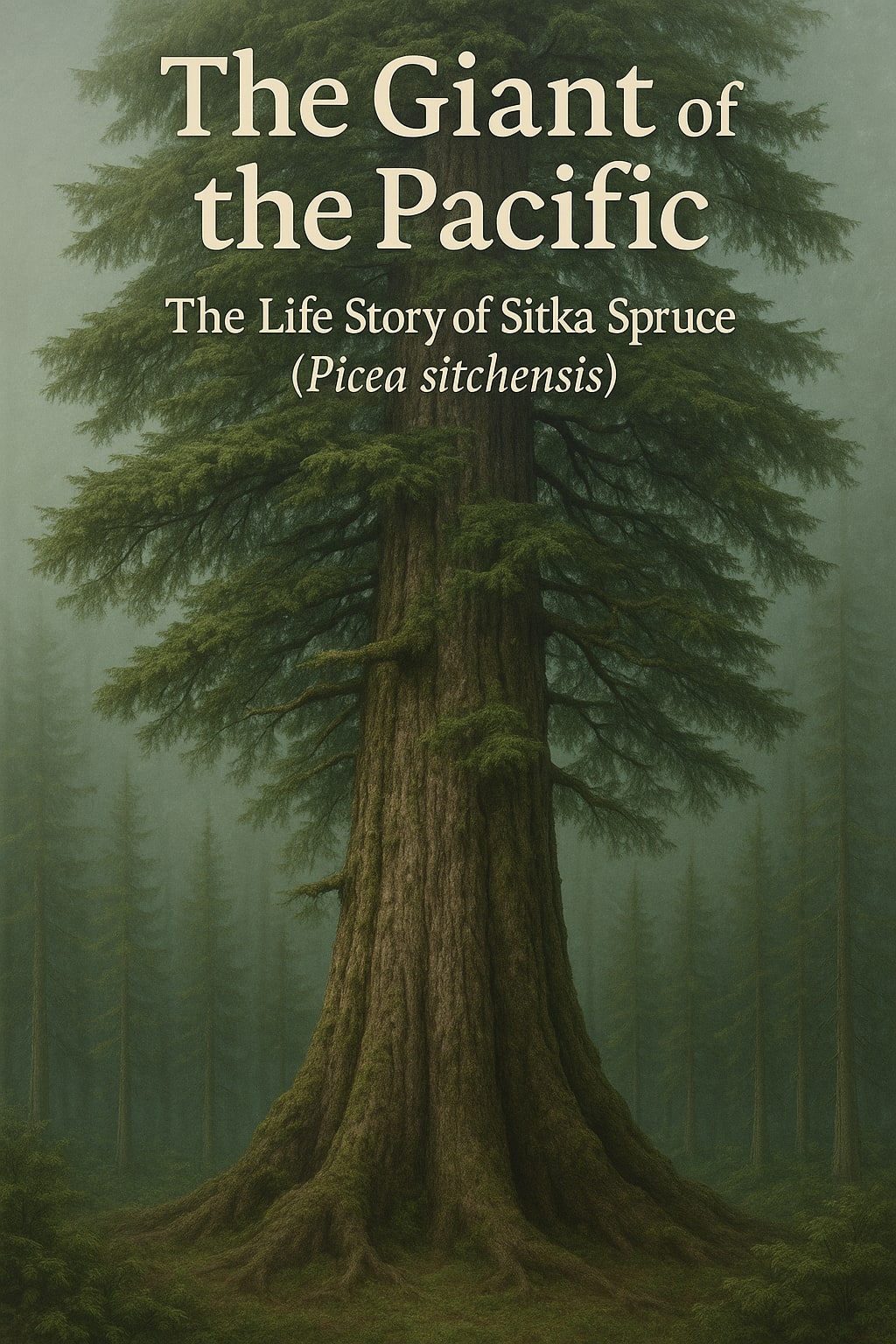
In the mist-laden forests of the Pacific Northwest, where land meets sea and ancient giants loom high into the sky, stands one of nature’s most extraordinary trees — the Sitka spruce (Picea sitchensis). This towering evergreen is not just a botanical marvel but a silent witness to centuries of ecological change, human use, and climatic resilience. Named after Sitka, Alaska, this tree is revered for its height, longevity, and importance to both ecosystems and industries.
⸻
Origins and Evolution
The story of Sitka spruce begins in the aftermath of the last Ice Age, roughly 10,000 years ago, when glaciers retreated from North America’s Pacific Coast. As the ice melted, new land became available for colonization. Sitka spruce, with its affinity for moist, cool climates, quickly established itself from northern California to the Gulf of Alaska. Over millennia, this species evolved thick, scaly bark and sharp, stiff needles to survive the rainy, foggy coastal climates it now dominates.
It is one of the largest species in the Pinaceae family, often reaching 200 to 300 feet (60 to 90 meters) in height. Some individuals can live over 700 years, with immense trunks that seem to defy gravity. Fossil records suggest its ancient lineage dates back to the Miocene epoch, making it a tree with both modern grandeur and ancient roots.
⸻
Botanical Characteristics
Picea sitchensis is easily recognized by its bluish-green, stiff, needle-like leaves and thin, flaky bark. Its cones are slender and hang downward, unlike the upright cones of fir trees. The root system is shallow yet expansive, making the tree susceptible to windthrow, especially in old age. Yet in groups, these giants protect each other, forming impenetrable green cathedrals of silence and strength.
Its wood is lightweight yet strong, with a fine grain that resonates beautifully, making it prized for musical instruments such as violins, guitars, and pianos. This unique combination of strength and flexibility also made it a key material in aircraft construction during both World Wars.
⸻
Cultural Significance
For Indigenous peoples of the Pacific Northwest — including the Tlingit, Haida, and Coast Salish — the Sitka spruce has long been sacred. Its roots were split and woven into baskets, its pitch used as a medicine and sealant, and its strong wood carved into canoes, totem poles, and ceremonial items. In these cultures, trees were not simply resources but living beings — ancestors, protectors, and storytellers.
The tree also entered Western awareness during the age of exploration. In 1792, Archibald Menzies, a botanist aboard Captain George Vancouver’s ship, formally recorded the tree in science. Its botanical name honors the location of its identification — Sitka Sound in southeastern Alaska.
⸻
The Spruce in Industry
The rise of logging in the 19th and 20th centuries brought Sitka spruce to global prominence. As the American West industrialized, this tree became one of the most heavily harvested species due to its straightness and quality of lumber. Its light weight and strength made it ideal for airplane frames, ship masts, and railroad ties.
During World War I and II, it was considered a “strategic material.” The U.S. government even established the Spruce Production Division in 1917, enlisting thousands of workers and soldiers to harvest Sitka spruce for aircraft production. This militarization of logging is a rarely told but critical chapter in the biography of the tree.
⸻
Ecological Importance
Beyond human utility, the Sitka spruce plays an essential role in coastal ecosystems. These trees anchor fragile soils, provide habitat for countless species — from the marbled murrelet to the northern spotted owl — and help maintain the humidity and temperature balance of rainforests. Under their shade, mosses, ferns, and lichens thrive, while salmon-bearing streams flow quietly nearby.
Their fallen trunks, known as nurse logs, support new life for centuries, hosting fungi, insects, and even new saplings. The Sitka spruce is not just an individual organism but a keystone species — a living pillar of its ecosystem.
⸻
Challenges and Conservation
Despite its historical resilience, the Sitka spruce faces modern threats. Climate change, habitat fragmentation, and invasive species all challenge its survival. Warmer temperatures have begun to shift the tree’s viable range northward, while stronger storms uproot ancient giants.
Logging has also taken its toll. Though the tree regenerates easily in managed forests, old-growth Sitka spruce — those trees hundreds of years old — are increasingly rare. Conservationists now fight to protect the remaining old-growth stands, particularly in places like the Tongass National Forest in Alaska and Olympic National Park in Washington.
Efforts to reforest and manage Sitka spruce populations responsibly are gaining momentum. Sustainable timber practices, education programs, and Indigenous-led conservation initiatives are playing a growing role in ensuring that future generations will walk among these giants.
⸻
Sitka Spruce in the Modern World
Today, Sitka spruce continues to inspire awe. Nature lovers visit the Hoh Rainforest in Washington State or the coastal trails of British Columbia to see these living skyscrapers. Instrument makers still seek Sitka spruce soundboards for their unparalleled tonal quality. Architects and designers look to this tree’s wood for its aesthetic and structural properties.
It has also become a symbol of endurance. Where storms rage and waves crash, the Sitka spruce stands — tall, steady, and quietly magnificent. Some trees bear the scars of lightning, wind, and time, yet they continue to grow, adding new rings each year like pages in a living book.
⸻
Conclusion
The biography of the Sitka spruce is not just a tale of botanical achievement or economic value — it is a chronicle of deep time, ecological interdependence, and cultural reverence. From ancient forests to modern instruments, from Indigenous traditions to global commerce, the story of Picea sitchensis is a story of life itself — growing, adapting, and reaching ever skyward.
In every towering trunk and every cone dropped to the mossy forest floor, the Sitka spruce reminds us of nature’s quiet majesty — and the responsibility we share in protecting it.
About the Creator
Irshad Abbasi
"Studying is the best cure for sorrow and grief." shirazi
Keep reading
More stories from Irshad Abbasi and writers in History and other communities.
The Witch of Wall Street and the Woman Who Outsmarted a Nation
In an era when women were expected to manage households, not fortunes, Hetty Green defied every social convention to become one of the richest and most formidable financiers in American history. Nicknamed “The Witch of Wall Street”, Hetty’s story is not just about money—it’s about resilience, strategy, and an unshakeable will to succeed in a world that underestimated her at every turn.
By Irshad Abbasi 7 months ago in History
Can the United States Leave NATO?
Can the United States Leave NATO? What It Would Take—and What It Would Mean The North Atlantic Treaty Organization, commonly known as NATO, has been one of the most powerful military alliances in modern history. Since its creation in 1949, the United States has been NATO’s strongest member—militarily, financially, and politically. But in recent years, debates have grown louder about whether the U.S. should remain in the alliance. This raises a serious question: how could the United States be removed from NATO—or leave it—and what would that mean for the world?
By Wings of Time 7 days ago in History




Comments
There are no comments for this story
Be the first to respond and start the conversation.