
The life of George Washington
Who was the American founding father?

George Washington, often referred to as the "Father of His Country," was a pivotal figure in American history. His leadership, both as a military commander and as the first President of the United States, shaped the nation's foundation and set a precedent for future generations. Born on February 22, 1732, in Westmoreland County, Virginia, Washington's life was marked by significant achievements, personal challenges, and a steadfast dedication to the principles of liberty and democracy.
Early Life and Background
George Washington was born into a moderately wealthy family of planters. His father, Augustine Washington, owned several plantations, and George was the eldest of six children from his father's second marriage to Mary Ball Washington. The young Washington's education was limited, but he developed skills in mathematics, surveying, and mapmaking, which would later serve him well.
After the death of his father in 1743, Washington's older half-brother, Lawrence Washington, became a significant influence in his life. Lawrence's connections with the Fairfax family, one of the most influential families in Virginia, provided George with opportunities to learn about leadership and the workings of colonial society.
Early Military Career
Washington's military career began in 1753 when he was appointed as a major in the Virginia militia. His mission was to deliver a message to the French, demanding they vacate the Ohio Valley, which they had occupied in defiance of British claims. This mission marked the beginning of the French and Indian War (1754-1763), during which Washington distinguished himself as a capable and courageous leader.
Despite initial setbacks, including a defeat at Fort Necessity, Washington's reputation grew. He served as an aide to British General Edward Braddock and played a crucial role in organizing the retreat after Braddock's defeat. These experiences laid the groundwork for his later leadership during the American Revolutionary War.
The American Revolutionary War
Washington's most significant role came during the American Revolutionary War (1775-1783). In June 1775, the Second Continental Congress appointed him as the Commander-in-Chief of the Continental Army. Washington faced enormous challenges, including limited resources, a lack of training among his troops, and the formidable British military.
Washington's leadership was marked by several key moments:
The Siege of Boston (1775-1776): Washington's first major victory, forcing the British to evacuate the city.
Crossing the Delaware River (1776): A daring and strategic move that led to victories at Trenton and Princeton, boosting American morale.
The Winter at Valley Forge (1777-1778): A period of immense hardship where Washington's leadership and the training provided by Baron von Steuben transformed the Continental Army into a more effective fighting force.
The Battle of Yorktown (1781): Washington's collaboration with French forces led to the decisive victory that effectively ended the war and secured American independence.
The Constitutional Convention and Presidency
Following the war, Washington retired to his plantation, Mount Vernon. However, he soon realized that the fledgling nation faced significant challenges under the Articles of Confederation. In 1787, Washington was persuaded to attend the Constitutional Convention in Philadelphia, where he was unanimously elected as its president. His support was crucial in the drafting and ratification of the United States Constitution.
In 1789, Washington was unanimously elected as the first President of the United States. His presidency set many precedents, including the formation of a Cabinet and the two-term limit. Washington's leadership helped establish the principles of federalism, the separation of powers, and the rule of law.
Challenges and Achievements as President
George Washington's presidency was marked by several significant events and policies:
The Establishment of the National Bank: Under the guidance of Secretary of the Treasury Alexander Hamilton, Washington supported the creation of a national bank to stabilize the young nation's economy.
The Jay Treaty (1794): A controversial treaty with Great Britain that helped prevent another war and facilitated ten years of peaceful trade.
The Whiskey Rebellion (1794): Washington's response to this domestic uprising demonstrated the federal government's authority and willingness to enforce its laws.
Farewell Address (1796): In his farewell address, Washington advised against political parties and foreign alliances, emphasizing national unity and the importance of the Constitution.
Later Years and Legacy
After completing two terms in office, Washington retired to Mount Vernon in 1797. He spent his final years managing his plantation and engaging in correspondence with friends and political leaders. George Washington passed away on December 14, 1799, at the age of 67.
Washington's legacy is profound. He is remembered not only for his leadership during the Revolutionary War and his presidency but also for his character, integrity, and commitment to democratic principles. His willingness to relinquish power set a powerful example for future leaders and helped ensure the success and stability of the new republic.
Conclusion
The life of George Washington is a testament to the impact of strong, principled leadership. From his early days as a young Virginian surveyor to his role as the Commander-in-Chief and the nation's first President, Washington's contributions to the United States are immeasurable. His legacy continues to inspire and guide future generations, underscoring the enduring importance of courage, dedication, and a commitment to the greater good.
About the Creator
M. R.
Just a random guy with a lot of interests, including writing and experimenting with AI.
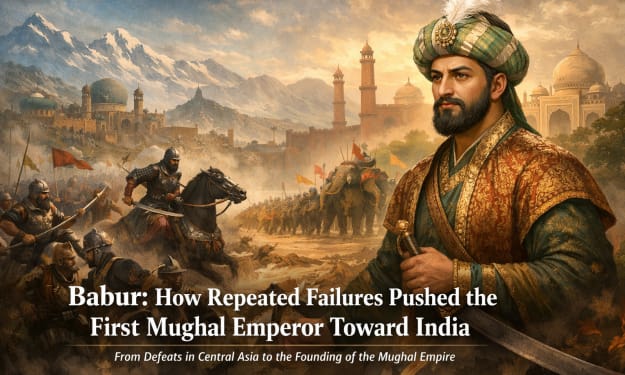
How Repeated Failures Pushed the First Mughal Emperor Toward India
History often remembers great rulers for their victories, but behind many success stories lie years of struggle and disappointment. One such remarkable story is that of Zahir-ud-Din Muhammad Babur, the founder of the Mughal Empire in the Indian subcontinent. Long before establishing one of the most influential dynasties in South Asian history, Babur faced repeated failures in his homeland of Central Asia. Ironically, these setbacks became the very reason he eventually turned his attention toward India.
By Irshad Abbasi a day ago in History



Comments
There are no comments for this story
Be the first to respond and start the conversation.