
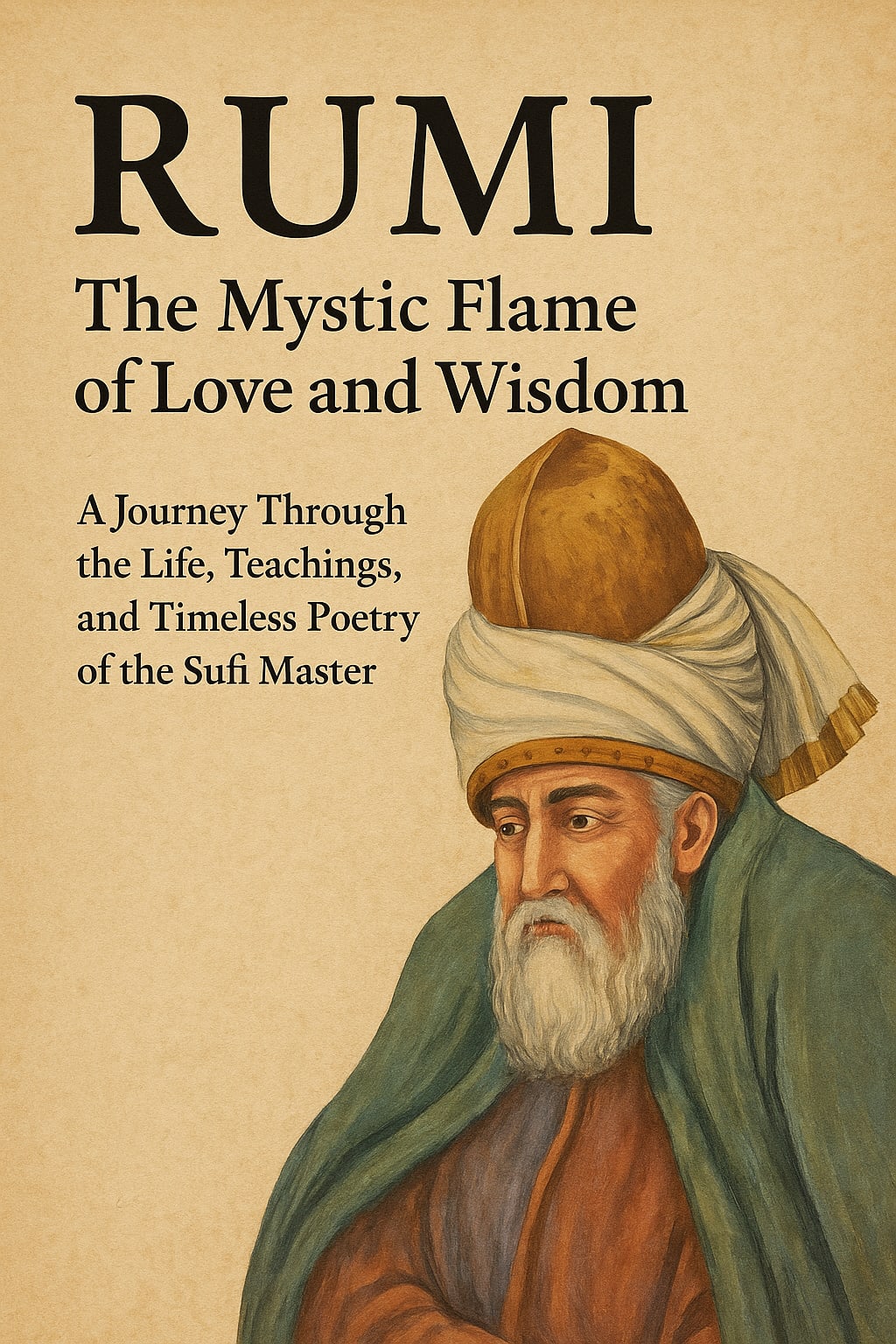
The Life and Legacy of Maulana Rumi
A Journey Through the Life, Teachings, and Timeless Poetry of the Sufi Master

## Introduction
Jalaluddin Muhammad Rumi, more commonly known simply as Rumi, remains one of the most profound spiritual voices in human history. A 13th-century Persian poet, theologian, and Sufi mystic, Rumi's words transcend religion, culture, and time. His poetry, infused with divine longing, love, and unity, continues to inspire millions across the globe. This biography seeks to illuminate the path of his life—a journey marked by devotion, loss, transformation, and the eternal flame of wisdom that he left behind.
---
## Early Life and Heritage
Rumi was born on September 30, 1207, in the city of Balkh, located in present-day Afghanistan. His father, Bahauddin Walad, was a renowned theologian and mystic in his own right. Early in Rumi’s life, political instability and the looming threat of Mongol invasions compelled his family to migrate westward. They traveled extensively through cities like Nishapur and Baghdad before eventually settling in Konya (modern-day Turkey), then part of the Seljuk Empire.
From an early age, Rumi was immersed in both Islamic scholarship and spiritual discourse. His father's influence and his own deep intellectual curiosity led him to master Arabic, Persian, Islamic jurisprudence, theology, and philosophy. By the time Bahauddin died in 1231, Rumi had already taken up his father’s position as a revered religious teacher and scholar.
---
## Spiritual Awakening and Meeting Shams of Tabriz
Although Rumi had a solid foundation in formal religious teaching, it was not until he met the wandering mystic **Shams of Tabriz** that his inner flame was fully ignited. Their meeting in 1244 marked a radical turning point in Rumi’s life. Shams, unconventional and fearless, stirred something deep within Rumi’s soul. Their bond transcended the norms of master-disciple relationships; it was an intense, soul-deep friendship that awakened Rumi’s heart to divine love.
Rumi abandoned much of his formal teaching to spend time with Shams, much to the disapproval of his followers and even family. This period of intense spiritual transformation is when Rumi began composing the mystical poetry for which he is now renowned. Shams challenged him to seek God not in the texts alone, but within the self and in the heart of all creation.
Tragically, Shams disappeared—believed by many to have been murdered due to growing jealousy within Rumi’s circle. This loss plunged Rumi into deep sorrow, yet it became the crucible from which his most powerful verses emerged.
---
## The Whirling Dervishes and the Path of Love
In his grief, Rumi turned to music, dance, and poetry as spiritual practices. He founded the **Mevlevi Order**, more commonly known as the Whirling Dervishes. Their iconic dance, the **Sema**, is not mere performance but a sacred ritual symbolizing the soul’s journey toward divine union. The spinning motion represents the movement of the universe and the soul's progression toward the One.
For Rumi, **love** was the ultimate path to God. Unlike dry theological discourses, his writings pulse with longing and ecstasy. To him, God was not a distant judge, but the Beloved—immanent, intimate, and ever-present. His poetry invites the reader to dissolve the ego, embrace the divine presence, and taste the sweetness of surrender.
---
## Works and Legacy
Rumi's literary output is vast and multi-faceted. His most famous work is the **Masnavi-i Ma’navi** (Spiritual Couplets), often referred to simply as the *Masnavi*. Comprising six volumes, it is a spiritual text that weaves together stories, parables, and wisdom from Islamic teachings and everyday life, aimed at guiding seekers on the path of divine love.
He also composed the **Divan-e Shams-e Tabrizi**, a collection of lyric poems (ghazals and rubaiyat) written in the voice of ecstatic longing for Shams, but ultimately directed toward the Divine.
Rumi's language of love transcended religious boundaries. Though deeply rooted in Islamic spirituality, his words have been embraced by people of all faiths. In the West, he has become the best-selling poet, his work translated into dozens of languages, often quoted in literature, music, and philosophy.
---
## Philosophy and Teachings
Central to Rumi’s thought is the idea of **Tawhid**, or oneness. He believed all beings are threads woven into a single divine tapestry. Every joy, sorrow, encounter, and loss is a thread leading us back to the Source.
Some core teachings include:
* **Divine Love**: Love is not merely emotion; it is the energy of creation, the bridge between the soul and the Creator.
* **Unity**: The universe is a reflection of God’s presence. Every being contains a spark of the divine.
* **Transformation through Pain**: Suffering is not to be avoided but embraced as a tool for awakening. “The wound,” he wrote, “is the place where the Light enters you.”
* **Silence and Listening**: Words often fail where silence speaks. Rumi emphasized inner listening and contemplation.
* **Non-attachment**: The spiritual seeker must let go of ego, identity, and even conventional religious boundaries to truly know God.
---
## Death and Immortal Influence
Rumi passed away on December 17, 1273, in Konya. His funeral was attended not only by Muslims but by Christians and Jews as well—a testament to his universal appeal. His tomb, located in the Mevlana Museum, remains a place of pilgrimage to this day.
His passing is celebrated annually as **"Şeb-i Arus"** (The Wedding Night), symbolizing his union with the Beloved. To Rumi, death was not an end but a return to the eternal.
---
## Conclusion
More than 750 years after his death, Rumi’s flame still burns brightly. His message of love, unity, and divine longing speaks to the deepest needs of the human soul in a fractured world. In his verses, we find comfort, wisdom, and a map back to the center of our being.
Rumi is not merely a poet or mystic of the past—he is a voice for today, reminding us that beneath all our differences lies the same longing: to love and be loved by the Divine.
As he wrote:
**“Come, come, whoever you are. Wanderer, worshiper, lover of leaving. It doesn't matter. Ours is not a caravan of despair.”*
About the Creator
Irshad Abbasi
"Studying is the best cure for sorrow and grief." shirazi
Keep reading
More stories from Irshad Abbasi and writers in History and other communities.
The Rise and Fall of Libya's Revolutionary Ruler
Muammar Gaddafi, known to the world through various spellings — including Karnel Kadafi — was a soldier, ideologue, autocrat, and revolutionary whose rule over Libya spanned more than four decades. His life was a collision of idealism and authoritarianism, marked by dramatic transformations and a final, violent downfall. From his rise as a young army officer to his fall during the Arab Spring, Gaddafi’s story is one of contradiction, ambition, and controversy.
By Irshad Abbasi 8 months ago in History
Venezuela’s President Under Pressure: Arrest Calls, Indictments, and a Nation at a Crossroads
How the Arrest Narrative Began The idea of arresting Venezuela’s president did not appear out of nowhere. It stems from years of accusations that range from human-rights abuses to corruption and drug-related activities. U.S. authorities have filed formal charges against Nicolás Maduro, linking him to cocaine trafficking networks and large-scale financial misconduct. These cases place him among the few sitting leaders facing active international legal pressure.
By Muhammad Islam khan swati7 days ago in History
How I Learned That Aircraft Structures Are as Critical as Engines
When I first started studying aviation, I believed that engines and avionics defined an aircraft’s reliability. Over time, as I explored aerospace history and manufacturing records, I realized how incomplete that understanding was. Aircraft safety does not depend solely on thrust or navigation systems. It is deeply rooted in structural engineering, certified manufacturing, and the disciplined production of components that passengers never see.
By Beckett Dowhan3 days ago in History


Comments (1)
Rumi's life is truly fascinating. His early exposure to different cultures during his family's migrations likely broadened his perspective. Meeting Shams seems like it was a game-changer. I wonder how different his work would be if he hadn't had that spiritual awakening. It makes me think about the unexpected moments that can shape a person's entire creative output.