
The Life and Legacy of a Master Grammarian and Qur’anic Exegete
The Andalusian Grammarian: Abu Hayyan’s Journey Through Language and Faith

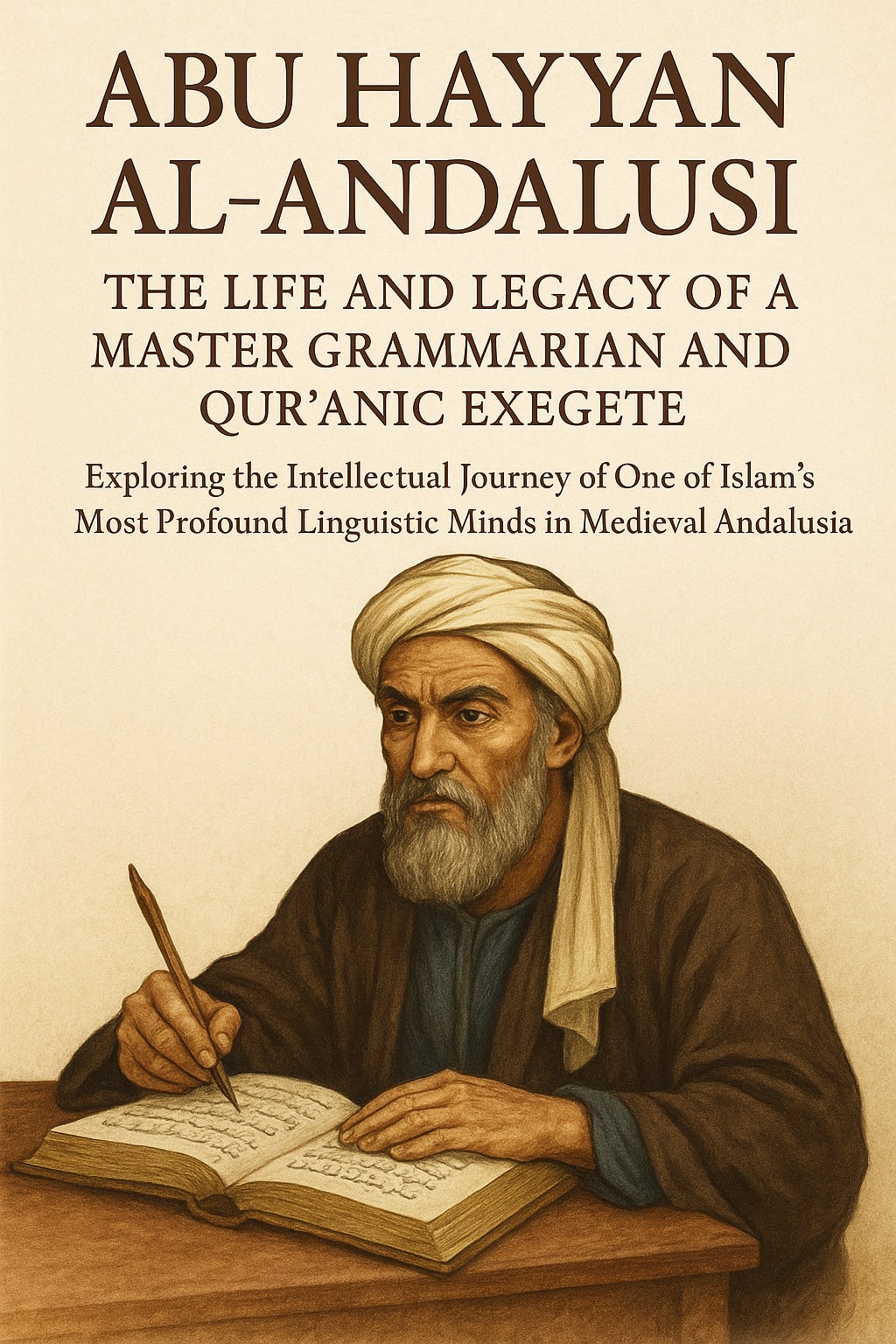
Abu Hayyan al-Andalusi (1256–1344 CE), born in the city of Jaén in the Andalusian region of present-day Spain, is widely regarded as one of the most accomplished Arabic grammarians and Qur’anic exegetes of the medieval Islamic world. His full name was Muhammad ibn Yusuf ibn Ali ibn Hayyan al-Gharnati, and he is often referred to simply as Abu Hayyan. He lived during a period of great cultural and intellectual ferment, both in al-Andalus and in the broader Islamic world, and his works continue to exert a lasting influence on the fields of linguistics, tafsir (Qur’anic exegesis), and philology.
Early Life and Education
Abu Hayyan was born into a Berber family in Jaén during a time of political fragmentation and social upheaval. His early years were marked by a deep immersion in Islamic sciences, particularly Arabic grammar, Qur’anic studies, and jurisprudence. From a young age, he exhibited an extraordinary aptitude for language and was known for his ability to memorize large volumes of texts. Seeking advanced knowledge, he traveled extensively through al-Andalus and the Maghrib (North Africa), studying under some of the most esteemed scholars of the era.
Eventually, Abu Hayyan moved to Cairo, where he found a vibrant scholarly environment that allowed his intellectual pursuits to flourish. Cairo was then under Mamluk rule, and its institutions of learning were among the finest in the Islamic world. It was here that Abu Hayyan produced his most influential works and solidified his reputation as a master of Arabic grammar and tafsir.
Scholarly Contributions
Abu Hayyan’s scholarship is distinguished by its breadth and depth, but he is best remembered for his pioneering work in two fields: Arabic grammar and Qur’anic exegesis.
Arabic Grammar
Abu Hayyan’s contributions to Arabic linguistics are monumental. He was deeply engaged with the grammatical traditions of both the Basran and Kufan schools, synthesizing their insights while also offering his own critical perspectives. His magnum opus in this field is Tafsīr al-Baḥr al-Muḥīṭ (“The Oceanic Commentary”), which, despite being a tafsir, includes comprehensive linguistic and grammatical analysis that stands as a testament to his mastery of the Arabic language.
In addition to this work, Abu Hayyan authored al-Tadhkira fi al-Nahw and Kitab al-Irtishaf, both of which reflect his concern with grammatical precision and clarity. He was also known for his criticism of certain aspects of Sibawayh’s foundational grammar text, al-Kitab, showing an intellectual independence that set him apart from many of his contemporaries.
Abu Hayyan’s linguistic philosophy was notable for its descriptive rigor and avoidance of excessive theorization. He emphasized the practical use of Arabic and insisted on grounding grammatical rules in actual linguistic usage rather than speculative logic. This pragmatic approach helped preserve the integrity and purity of the Arabic language during a time when linguistic errors were increasingly common in spoken and written forms.
Qur’anic Exegesis
Abu Hayyan’s contributions to tafsir are no less remarkable. His most famous exegetical work is also Tafsīr al-Baḥr al-Muḥīṭ, a voluminous commentary on the Qur’an that combines grammatical, rhetorical, and theological analysis. Unlike many of his predecessors, Abu Hayyan gave special attention to the grammatical structure of Qur’anic verses, thereby helping readers to appreciate the linguistic subtleties of the divine text.
What distinguishes his tafsir from many others is its methodical approach and inclusivity. Abu Hayyan cited numerous earlier exegetes, including al-Tabari, al-Zamakhshari, and Fakhr al-Din al-Razi, comparing their interpretations and often offering critiques. He also incorporated perspectives from various Islamic schools of thought, including Ash‘ari theology and Maliki jurisprudence, demonstrating a breadth of knowledge and tolerance for scholarly diversity.
Moreover, Abu Hayyan showed a rare openness to non-Arabic languages. In al-Baḥr al-Muḥīṭ, he frequently referenced Hebrew and Syriac terms to explain certain Qur’anic words, an approach that reflected both his erudition and his belief in the interconnectedness of Semitic languages. This comparative linguistic method was unusual for his time and revealed a deep intellectual curiosity that transcended cultural and religious boundaries.
Personal Ethics and Character
Despite his scholarly rigor, Abu Hayyan was known for his humility, asceticism, and piety. He lived a simple life, avoided the courts of rulers, and remained devoted to teaching and writing. His students described him as both patient and exacting—a teacher who demanded intellectual integrity but was also deeply concerned with the moral and spiritual development of his pupils.
Abu Hayyan was also vocal in his opposition to political corruption and social injustice. Although he lived under Mamluk rule, he refrained from seeking patronage from the state and often spoke out against scholars who compromised their integrity for material gain. His independence gave his voice a certain moral authority that further cemented his legacy.
Legacy
Abu Hayyan’s influence extends far beyond his lifetime. His grammatical works became standard references for later scholars, and his tafsir remains a vital resource for students of the Qur’an. Notably, his linguistic methodologies were adopted by later grammarians and helped shape the development of Arabic linguistics for centuries.
In modern times, scholars have rediscovered Abu Hayyan’s work as an important link between classical Arabic philology and contemporary approaches to language and hermeneutics. His insistence on grounding interpretation in linguistic analysis, his openness to comparative language studies, and his ethical commitment to truth and intellectual honesty make him a timeless figure in the Islamic intellectual tradition.
Today, Abu Hayyan al-Andalusi is remembered not only as a master of Arabic grammar and Qur’anic exegesis but also as a model of intellectual integrity and scholarly independence. His works continue to inspire students of the Arabic language, the Qur’an, and the rich intellectual heritage of Islamic civilization.
About the Creator
Irshad Abbasi
Ali ibn Abi Talib (RA) said 📚
“Knowledge is better than wealth, because knowledge protects you, while you have to protect wealth.
Keep reading
More stories from Irshad Abbasi and writers in History and other communities.
The Father of the Atomic Age
J. Robert Oppenheimer, a name etched into the annals of history, was a man of brilliance, contradiction, and moral complexity. As the scientific director of the Manhattan Project and one of the key figures behind the development of the atomic bomb, Oppenheimer is remembered as both a pioneering physicist and a haunted architect of destruction. His life tells the story of a man who stood at the intersection of science and politics, war and peace, creation and annihilation.
By Irshad Abbasi 9 months ago in History


Comments (1)
Abu Hayyan sounds like a remarkable scholar. His work in Arabic grammar and exegesis is impressive. Wish I could study under him!