
The Father of the Atomic Age
J. Robert Oppenheimer and the Birth of the Nuclear Era

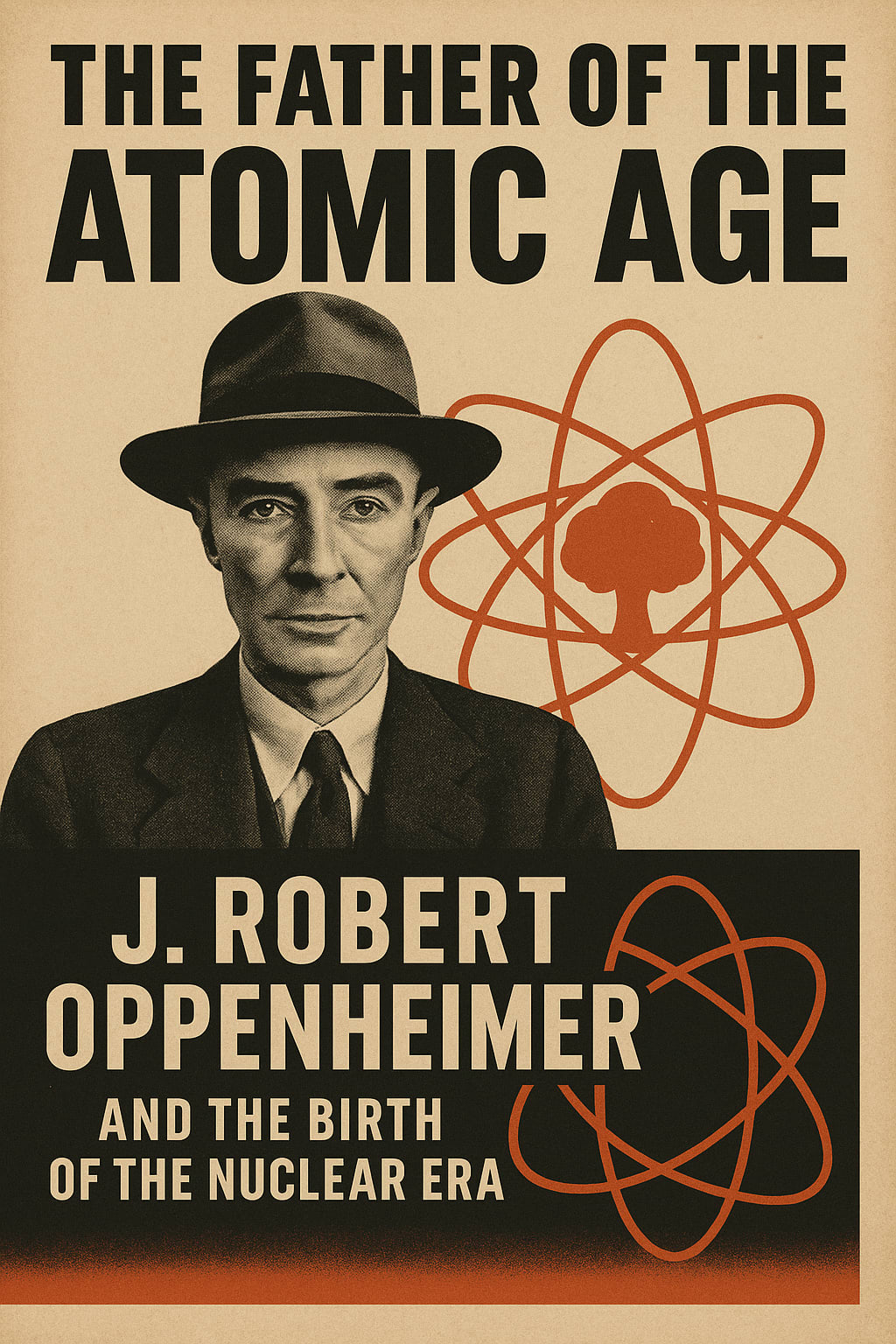
J. Robert Oppenheimer, a name etched into the annals of history, was a man of brilliance, contradiction, and moral complexity. As the scientific director of the Manhattan Project and one of the key figures behind the development of the atomic bomb, Oppenheimer is remembered as both a pioneering physicist and a haunted architect of destruction. His life tells the story of a man who stood at the intersection of science and politics, war and peace, creation and annihilation.
Early Life and Education
Born on April 22, 1904, in New York City, Julius Robert Oppenheimer came from a wealthy, cultured family of German-Jewish immigrants. His father, a textile importer, and his mother, a painter, nurtured a household steeped in literature, art, and high intellectual standards. Oppenheimer was a precocious child—deeply curious, introspective, and socially awkward.
He studied at the Ethical Culture School, where his passion for science and literature blossomed. Oppenheimer then attended Harvard University, excelling in physics, chemistry, and philosophy. After graduating summa cum laude in just three years, he went on to pursue postgraduate work in Europe, studying under legendary physicists such as Max Born at the University of Göttingen. It was during this time that he became fluent in quantum mechanics and began laying the groundwork for what would become a historic scientific career.
Academic Career and Rise to Prominence
In the 1930s, Oppenheimer held teaching positions at the University of California, Berkeley, and the California Institute of Technology. He gained a reputation not only for his extraordinary intellect but also for his poetic temperament and ability to inspire students. Though he never won a Nobel Prize, his work in quantum theory, cosmic rays, and quantum electrodynamics earned him great respect among his peers.
Politically, Oppenheimer began leaning left during the Great Depression. He supported various progressive causes, developed ties with Communist-affiliated organizations, and formed relationships with people involved in radical politics. These affiliations would later haunt him during the Red Scare, but at the time, they reflected his growing concern for social justice and anti-fascist ideals.
The Manhattan Project and the Birth of the Bomb
With the outbreak of World War II and the threat of Nazi Germany developing an atomic bomb, the U.S. government launched a top-secret endeavor known as the Manhattan Project. In 1942, Oppenheimer was appointed scientific director of the project, despite initial concerns about his lack of administrative experience and political affiliations.
Working at the remote site of Los Alamos, New Mexico, Oppenheimer assembled a team of the world’s greatest physicists to tackle one of the most complex scientific challenges ever attempted: harnessing nuclear fission to build a weapon of unprecedented power.
Under intense pressure and secrecy, the team made rapid progress. On July 16, 1945, the first atomic bomb was successfully tested in the New Mexico desert. The test, code-named “Trinity,” unleashed a force equivalent to 20,000 tons of TNT. As Oppenheimer watched the fireball rise into the sky, he famously recalled a line from the Hindu scripture Bhagavad Gita: “Now I am become Death, the destroyer of worlds.”
This moment marked the dawn of the nuclear era—and the beginning of Oppenheimer’s moral reckoning.
Hiroshima, Nagasaki, and Aftermath
Less than a month later, the U.S. dropped atomic bombs on the Japanese cities of Hiroshima and Nagasaki, killing over 200,000 people and forcing Japan’s surrender. While some in the scientific community and military hailed the success as a means to end the war quickly, others—including Oppenheimer—felt a deep sense of ambivalence and guilt.
After the war, Oppenheimer became a public figure, advising the U.S. government on nuclear policy. He advocated for international arms control and opposed the development of the hydrogen bomb, a weapon far more powerful than the one used in Hiroshima.
His dissent put him at odds with political figures like Edward Teller and Lewis Strauss, as well as the shifting national mood during the Cold War. Oppenheimer’s earlier associations with communism were resurrected during the Red Scare, and in 1954, he was subjected to a humiliating security hearing.
Stripped of his security clearance, Oppenheimer was effectively exiled from the inner circles of government science. The hearing, widely regarded as unjust and politically motivated, marked the end of his direct influence on U.S. policy and the beginning of a quieter phase of his life.
Later Years and Legacy
After his fall from political grace, Oppenheimer returned to academic life, serving as director of the Institute for Advanced Study in Princeton, New Jersey. There, he mentored young physicists and continued writing and speaking on science, philosophy, and ethics.
In 1963, President Lyndon B. Johnson awarded him the Enrico Fermi Award as a gesture of political rehabilitation. Though Oppenheimer accepted, he never fully recovered from the emotional wounds of his security trial.
He died of throat cancer in 1967 at the age of 62.
The Moral Physicist
Oppenheimer remains one of the most complex figures in modern history—a man of science who brought the world into the nuclear age and spent the rest of his life grappling with the consequences. His story raises enduring questions about the role of scientists in society, the ethics of war, and the limits of human knowledge.
He was a paradox: a pacifist who built a bomb, a patriot accused of disloyalty, a genius tormented by the implications of his work. For some, he is a tragic hero; for others, a cautionary tale.
What cannot be denied is the magnitude of his impact. Oppenheimer changed the world—not only by helping to end a global war, but by altering the very nature of warfare, geopolitics, and human survival.
Conclusion
J. Robert Oppenheimer was not just a man of science—he was a man of consequence. His legacy is etched in both the brilliance of discovery and the shadow of destruction. As the “Father of the Atomic Age,” he left a mark that is as terrifying as it is awe-inspiring. In a world still living under the threat of nuclear weapons, Oppenheimer’s life and legacy serve as a profound reminder of the double-edged power of human ingenuity.
About the Creator
Irshad Abbasi
Ali ibn Abi Talib (RA) said 📚
“Knowledge is better than wealth, because knowledge protects you, while you have to protect wealth.
Keep reading
More stories from Irshad Abbasi and writers in History and other communities.
Shadows of Valor: A Life Shaped by World War II
The story of Thomas “Tom” Whitaker begins not on the battlefield, but in a quiet Midwestern town in the United States. Born in 1918 in rural Iowa, Tom grew up in the long shadow of World War I, with a father who served in the trenches of France and never quite returned in spirit. The Whitaker household was one of silence, resilience, and unspoken grief. That grief, however, forged in young Tom a quiet strength and an unwavering sense of duty.
By Irshad Abbasi 9 months ago in History
Year 1952 in Review: Fun Facts, Trivia, and Historic Highlights
This quick read is a collection of fun facts, trivia, and historical events from the year 1952. Discover the year’s top news stories, most influential people, sports facts, U.S. economic trends, historic firsts, entertainment news, and much more.
By Gregory DeVictor4 days ago in History


Comments
There are no comments for this story
Be the first to respond and start the conversation.