
The Library of Alexandria: Did It Hide the Secrets of the Universe?
A Treasure Lost in Flames: The Hidden Truth of Alexandria’s Library
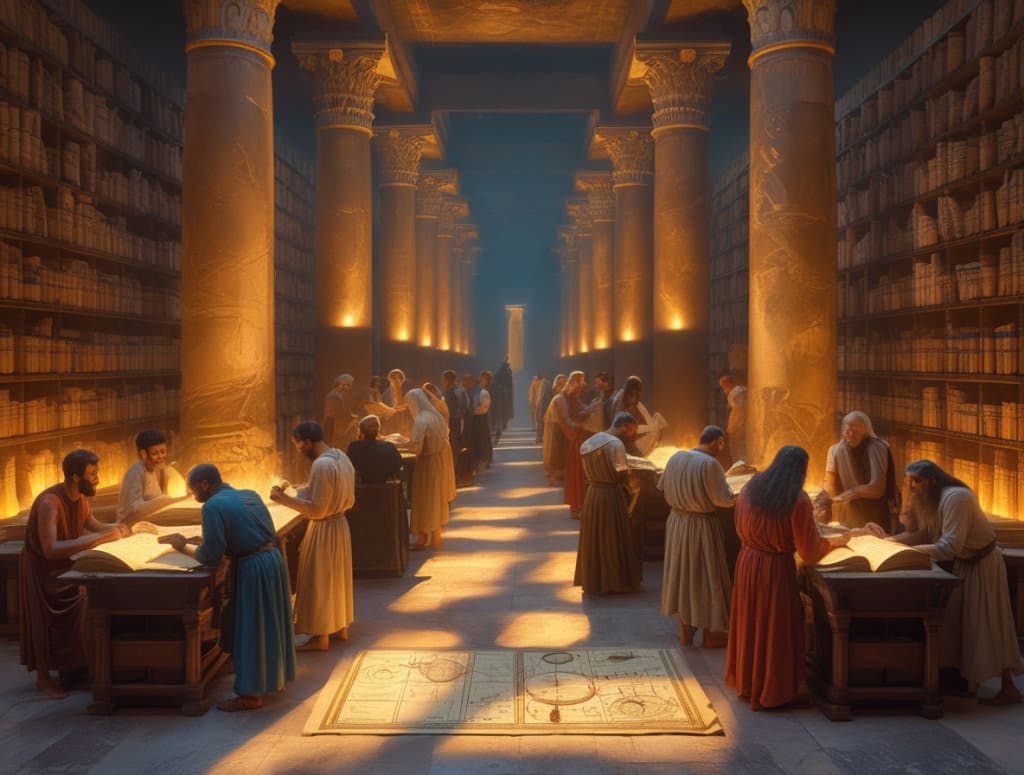
Imagine a place where the greatest minds of the ancient world gathered, a sanctuary of wisdom filled with scrolls that could have unlocked the mysteries of the universe. This was the Library of Alexandria, one of the most famous libraries in history. Built in the 3rd century BCE in Egypt, it housed knowledge from all over the world—mathematics, astronomy, medicine, and philosophy. But one of history’s greatest tragedies is its mysterious destruction. What if it contained secrets that could have changed the course of human history? Did it hold answers about the cosmos, advanced technology, or even lost civilizations? Let’s uncover the mystery of this legendary library and what might have been lost forever.
The Rise of the Library: A Hub of Ancient Knowledge
The Library of Alexandria was one of the greatest centers of knowledge in human history. Founded by either Ptolemy I or his son Ptolemy II, it was inspired by Alexander the Great’s dream of uniting the world through learning. This grand institution had a bold mission to collect, preserve, and expand all human knowledge in one place. Over time, it is believed that the library housed up to 700,000 scrolls, covering a vast range of subjects that shaped the foundations of modern science, mathematics, and philosophy.
A Treasure Trove of Knowledge
The Library of Alexandria was not just a place to store books; it was a center of discovery and learning. Scholars from Egypt, Greece, India, Mesopotamia, and beyond gathered here to exchange ideas and push the boundaries of human understanding. Some of the most remarkable subjects studied included:
Astronomy – Ancient Greek astronomers theorized that the Earth revolved around the Sun long before Copernicus proved it centuries later.
Mathematics – The legendary mathematician Euclid developed the foundations of geometry here, shaping the field for generations to come.
Medicine – Early breakthroughs in surgery, anatomy, and herbal medicine were recorded, forming the basis for future medical advancements.
Philosophy – The works of Socrates, Plato, and Aristotle were preserved within the library’s walls, influencing intellectual thought for centuries.
A Global Center for Innovation
The Library of Alexandria wasn’t just for reading it was a hub for groundbreaking research and intellectual exchange. Thinkers from around the world traveled to Alexandria to study, debate, and contribute to scientific progress. It was a melting pot of ideas, where theories were tested, knowledge was expanded, and new discoveries were made. Many historians believe that crucial knowledge from this era was centuries ahead of its time. Some even argue that scientific advancements, such as early theories of steam power, medical techniques, and astronomical observations, were made here long before they were rediscovered in the modern world.
The Legacy of the Library
Though the Library of Alexandria was tragically lost, its influence remains. It set a precedent for modern research institutions, libraries, and universities. The dream of collecting and sharing knowledge lives on in today’s digital age, with the internet acting as a modern equivalent of Alexandria’s great library.
The destruction of the library is often seen as one of history’s greatest tragedies. What secrets were lost forever? Could humanity have advanced faster if its knowledge had survived? These questions continue to fuel curiosity and speculation.
Did the Library Hide the Secrets of the Universe?
The Library of Alexandria remains one of history’s greatest mysteries. Many believe it held scientific knowledge so advanced that it could have transformed humanity forever. But was this just a myth, or did the library truly contain secrets about the universe that were lost to time? Let’s explore some fascinating theories.
Space Science: Did the Library Hold Knowledge of the Cosmos?
Some historian Ancientns and theorists suggest that the library contained texts hinting at an understanding of the cosmos far beyond what was officially recorded. Could it be that ancient scholars had already grasped the concepts of black holes, cosmic expansion, or even the possibility of extraterrestrial life?
The ancient Greeks were already making impressive strides in astronomy. Aristarchus of Samos proposed that the Earth revolved around the Sun nearly 2,000 years before Copernicus. Could there have been even more advanced discoveries hidden in the scrolls of the Alexandria Library?
Lost Inventions: Was Advanced Technology Conceived Too Early?
The idea that the Library of Alexandria housed blueprints for revolutionary machines is a popular theory. Some speculate that early steam engines, complex mechanical devices, or even rudimentary computers could have been designed there. Imagine if steam power had been widely developed in ancient times—the Industrial Revolution could have happened centuries earlier, drastically changing the course of human history.
One compelling piece of evidence is the Anti Kythera Mechanism, an ancient Greek device discovered in a shipwreck. This intricate mechanism, often called the world’s first analog computer, could predict astronomical positions with remarkable accuracy. If such technology existed, what else might have been stored within the library’s walls?
The Missing Scrolls: Were They Saved from Destruction?
One of the most intriguing questions is whether all knowledge from the Library of Alexandria was truly lost. Some historians believe that important texts were secretly removed before the library’s destruction.Theories suggest that monks, scholars, or even secret societies may have hidden scrolls in underground vaults or transported them to distant locations. The Vatican Library, the Middle Eastern archives, or undiscovered tombs could still hold remnants of this lost knowledge.
The Impact of the Library’s Loss on Human Civilization
The destruction of the Library of Alexandria is often seen as one of the greatest setbacks in human history. Imagine if we had access to lost medical research, unknown mathematical formulas, or scientific discoveries that could have pushed humanity forward much faster. Could diseases have been cured centuries earlier? Could space exploration have started long before the modern era?
Even today, researchers and historians continue searching for lost scrolls and remnants of ancient knowledge. If one of these long-lost texts were to be found, it could reshape what we know about history, science, and the universe itself.
Thoughts: A Mystery Waiting to Be Solved
The Library of Alexandria remains a symbol oF lost knowledge and human curiosity. Whether hidden scrolls exist or not, its legacy continues to inspire researchers and dreamers. Could the secrets of the universe be buried somewhere, waiting to be rediscovered? Perhaps one day, we will uncover the truth.
If this article intrigued you, don’t keep it to yourself! Like, share, and comment below with your thoughts. What do you think was hidden in the Library of Alexandria?
About the Creator
Power's Sake
When it comes to gaining power, bad people use it to gain more They never gain power to do something with it, they gain power to have it, relish in it, double it down on itself so it grows exponentially and never goes anywhere. Even if you see the people in power commit an atrocity, that is never the true goal. It is a deplorable action for sure but the action itself usually doesn't matter it's the outcome.
By Donny Foley5 days ago in History
How Case Documents Are Maintained in Philadelphia County
Case documentation forms the backbone of judicial accountability in Philadelphia County. Every filing, order, transcript, and judgment plays a defined role in preserving procedural accuracy and historical reference. The methods used to preserve these materials reflect long-standing legal standards combined with structured administrative practice. This article explains how case documents are created, organized, stored, reviewed, and preserved within Philadelphia County, with a clear focus on factual processes rather than commentary or promotion.
By Owen Perryabout 6 hours ago in History




Comments
There are no comments for this story
Be the first to respond and start the conversation.