
The Library Ladder
Where sunlight becomes a staircase, and forgotten words reshape a life

I’ve always believed that old libraries have their own kind of weather. Not rain or wind, but something gentler—like a hush that settles between the shelves, carrying the scent of dust, paper, and the thousands of hands that once turned those pages. On the morning everything changed, the library felt storm-still, as if it had been waiting for someone to open its doors and let the light in.
That someone happened to be me.
I wasn’t there for anything profound. I’d only stepped inside the town’s historic library because the bus was late and I needed somewhere warm to wait. My life at the time felt like a string of almosts—almost stable, almost happy, almost moving forward. I didn’t know what I was searching for, but I knew it wasn’t on my cracked phone screen or inside the stack of ignored job applications on my kitchen table.
I wandered the aisles with no intention, touching the spines of books I wouldn’t check out. Then, as I stepped into the farthest wing—a part of the building that looked like it hadn’t been repainted since the 1940s—I noticed something strange on the floor.
A perfect beam of white-gold sunlight poured through a fractured window in the ceiling, illuminating the dust like crushed diamonds. But it wasn’t the light that stunned me.
It was the shape.
The beam fell in straight, ladder-like segments across the wooden floor—exact angles, exact spacing—as if someone had sketched a staircase made of light directly onto the room.
A ladder. A literal ladder of sunlight.
I laughed softly to myself, thinking it was the kind of strange, beautiful coincidence that only happens when you’re too exhausted to question magic. But as the dust flickered around it, something in me—some quiet, childlike piece—felt nudged.
Climb it.
The thought wasn’t mine, not really. It was more like an invitation, warm and curious.
So I did something I hadn’t done in months: I acted on instinct instead of fear.
I stepped into the first square of light.
My foot tingled, as if I were stepping onto something warm and waking. Then the next step. Then the next. And with each one, the sunlight grew brighter—not blinding, but encouraging—guiding me toward the very top shelf of the tallest bookcase in the old wing.
That shelf should’ve been empty. It always had been, according to the librarian who later confirmed it. But that morning, tucked neatly into the corner, was a row of thin, cloth-bound books. Each one had a handwritten year on the spine.
1942.
1943.
1944.
My pulse quickened.
I climbed the remaining sunlight-steps and reached for the first book. The cover felt fragile, as if it were made of the same dust that drifted in the air.
Inside was a letter.
Not a story. Not a diary entry.
A letter—addressed simply: To the next reader.
The handwriting was elegant, looping, unmistakably old-fashioned. The message was short but deliberate.
If you are reading this, then you found the light. I believe every reader is chosen by the story they stumble upon. My name is Eleanor Faye, librarian during the war. I write these “future letters” because the world is heavy, and we need reminders of our ability to carry each other. If you can, do one small good thing today. Pass the light forward.
I froze.
Not because of the request, but because of the date at the bottom:
November 12th, 1943 — For whoever needs this most.
There were more books. More letters. More years. Each one contained a similar message—some hopeful, some grieving, some reflecting on the war’s darkest days—but all ending with a simple instruction:
Do one good thing. Leave the world better than you found it.
I don’t know how long I stood there in the ladder of light, flipping through those fragile pages. Maybe minutes. Maybe hours. All I know is that when I climbed back down, something inside me felt rearranged—subtly, gently, but undeniably.
For months I’d been drifting, waiting for direction that never came. And here, from a librarian who’d lived eighty years before me, was a direction so simple I couldn’t argue with it.
One small good thing.
I went home and thought about what that could be. I thought about Eleanor Faye writing her letters during blackouts and air-raid drills, believing that someone decades later would need them. I thought about the sunlight that formed a ladder only when I happened to walk past.
The next morning, I walked into the local shelter. My hands were shaking, but I signed up. I gave two hours. Then two more the next week. Then a Saturday. Then a few evenings after work.
I started learning names.
I started remembering stories.
I started caring again—more than I’d believed I was still capable of.
The funny thing is, volunteering didn’t solve my life. It didn’t hand me a miracle or erase the past. But it anchored me. It made me feel useful. And when you feel useful, hope grows in places it hasn’t lived in a long time.
Sometimes, when I’m putting away food donations or helping someone find warm clothes for the winter, I imagine Eleanor Faye somewhere—tucked between the shelves of time—smiling.
Her letters didn’t fix the world.
But they fixed something in me.
And maybe that’s enough.
About the Creator
Jhon smith
Welcome to my little corner of the internet, where words come alive
Keep reading
More stories from Jhon smith and writers in History and other communities.
Ashes of the Eternal City
Rome was a city that breathed fire long before flames ever touched its walls. Its people lived with a confidence that bordered on destiny, believing nothing could shake the stones of the Eternal City. The streets bustled with merchants shouting prices, children weaving between crowds, and senators in crisp white togas drifting like ghosts toward the Forum. But underneath the marble and noise lived a truth Rome never wanted to face—greatness is fragile, and even eternal things can burn.
By Jhon smith3 months ago in History
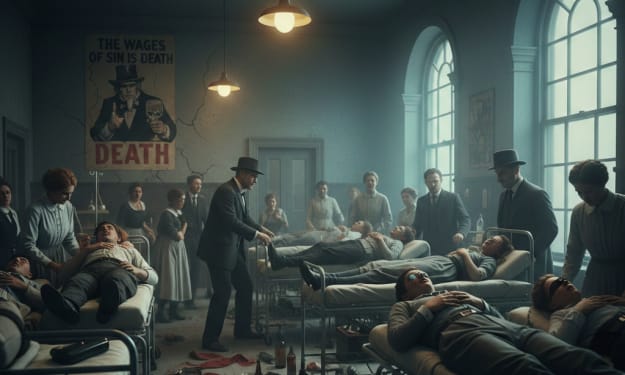
The Christmas Day Massacre
Imagine it’s Christmas Eve, 1926. New York City is glowing under a light dusting of snow, the air is thick with the sound of upbeat jazz, and behind a few nondescript basement doors, the party of the century is in full swing. This was the height of Prohibition, a time when being a "dry" nation only seemed to make everyone thirstier. But while the flapper girls were dancing and the champagne was flowing, something dark was creeping into the glasses of unsuspecting revelers.
By KWAO LEARNER WINFRED6 days ago in History

Comments
There are no comments for this story
Be the first to respond and start the conversation.