
The Letter That Was Never Sent — But Still Reached Allah
In a war-torn land where hope had burned to ash, a little girl's unsent letter stirred a miracle that no one saw coming — except the One who sees everything.


The wind carried ashes more than it carried air.
In the ruins of what was once a school in a small Middle Eastern village, a twelve-year-old girl named Nura sat cross-legged on a piece of broken concrete, clutching a dull pencil and a torn sheet of paper. Around her, buildings stood like silent skeletons. The sky, stained gray by smoke, hung low, as if it too mourned with the people.
Her fingers trembled, not from the cold, but from the fear of forgetting her mother's voice.
Her name was Nura, which meant "light," but even light can flicker in times of endless darkness.
She hadn't prayed the way grown-ups did. Her mother used to pray beautifully, whispering words that floated like perfume in their small home. But that home was gone. Her mother was gone. And all she had now was this letter.
She began to write:
"Dear Allah,
I don't know if You read letters. I'm not good at praying. I forget the words. But I remember my mama's voice when she talked to You. I miss her. I miss how her hands smelled like soap and sugar. If You can, can You please let her visit me in my dream? Just once? I promise I won't ask for anything else."
She paused, tears smudging the pencil lines. She folded the letter gently, as if it were made of glass. There was no envelope, no stamp. No post office anymore.
She walked to what used to be the masjid. It had burned in the second airstrike. All that remained was the blackened outline of the mihrab, the prayer niche, now filled with debris.
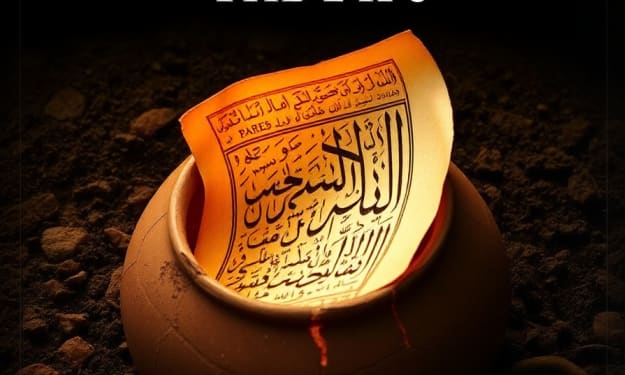
She bent down, placed the letter under a cracked tile near the edge, and whispered, "Please find Him. He listens, right?"
Then she walked away.
Two winters passed. Snow fell once again on scorched earth. Aid workers from a faraway land arrived to assess the remains of the village.
One of them, a young man named Idris, stepped into the broken masjid, hoping to salvage a Quran someone claimed had survived. As he lifted shattered stone and melted metal, his fingers brushed against paper.
He pulled it out.
It wasn't the Quran. It was a child's letter.
He read the trembling words. He stopped. Then read them again.
Idris wept.
Not the loud, cinematic kind of weeping. The quiet, reverent kind—as if he had been handed something sacred.
"Ya Allah," he whispered. "How did this survive?"
He showed it to his team. No one spoke for a long time.
That night, Idris couldn’t sleep. He sat outside the village under a broken lamp post, holding the letter, asking the stars for guidance. And then, something happened.
The village’s only surviving elder came to him, slowly, with a walking stick carved from olive wood.
"I know who wrote that," the old man said. "She used to bring me dates when I was sick. Her name was Nura."
"Where is she now?" Idris asked.
The old man closed his eyes. "She’s alive. Lives near the river now, in the shelter camp. She still doesn't talk much."
Two days later, Idris found her.
She was taller now. But the same eyes. The same silence.
He knelt before her like one would before something holy and handed her the letter. Her letter.
Nura stared at it, confused.
"I... I left this..." she said softly. "In the masjid... I didn’t think..."
"It survived everything," Idris said. "Even fire. Maybe because some words are not written in ink. Maybe your words were written in light."
That night, Nura dreamed.
And in her dream, her mother sat beside her on their old prayer mat, brushing her hair gently and humming an old lullaby.
She didn’t speak. She didn’t need to.
Nura awoke with her pillow damp from tears, and a strange peace in her chest. A calm she hadn't felt since the war began.
She looked at the sky.
It was finally blue.
Months passed. Idris made copies of the letter and included it in reports, newsletters, even speeches. People all over the world read Nura's words. Some cried. Some prayed. Some came forward to help rebuild.
A foreign woman sent funds for a new masjid. A boy in Turkey painted the letter in calligraphy and gifted it to an orphanage. An imam in London recited the letter in a Friday khutbah.
Nura didn’t understand why people cared so much.
She had just written to Allah.
But maybe that’s the point.
Because Allah listens even when no one else does.
Because a child’s broken words can become wings.
Because some letters don’t need stamps.
Because when the heart writes with sincerity, the ink survives fire.
And because the One who sees everything...
...never misses a letter.
THE END
About the Creator
rayyan
🌟 Love stories that stir the soul? ✨
Subscribe now for exclusive tales, early access, and hidden gems delivered straight to your inbox! 💌
Join the journey—one click, endless imagination. 🚀📚 #SubscribeNow
Is NATO Facing Its Biggest Crisis Yet?
Is NATO Facing Its Biggest Crisis Yet? For more than seventy years, NATO has been one of the strongest military alliances in the world. Formed after World War II, it was designed to protect its members through collective defense. An attack on one was considered an attack on all. For decades, this principle helped maintain stability in Europe and beyond. But today, NATO is facing one of the most challenging moments in its history.
By Wings of Time 3 days ago in History


Comments
There are no comments for this story
Be the first to respond and start the conversation.