
The Legendary Founding of Rome
From the Fall of Troy to the Reign of Romulus
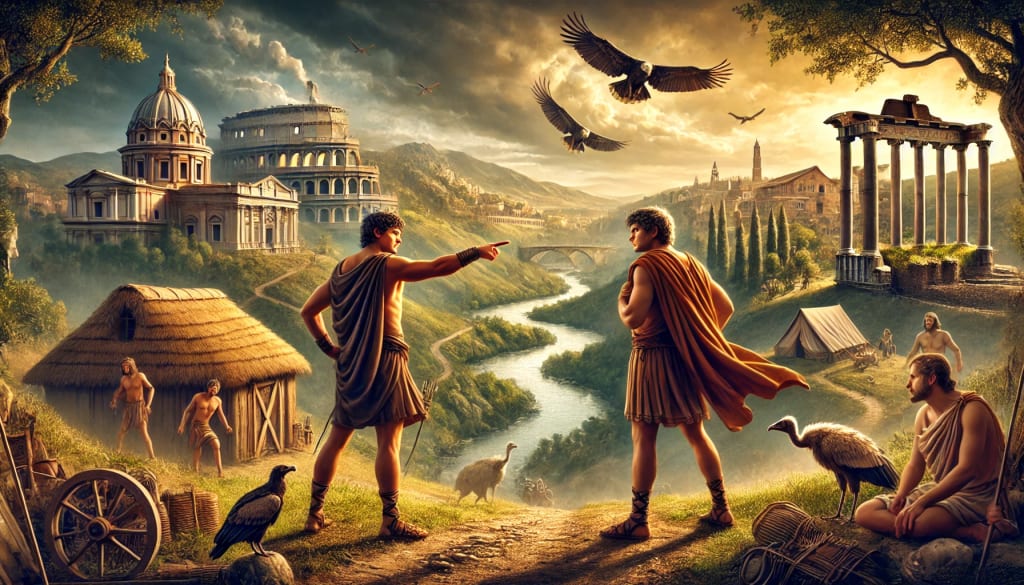
After the brutal war between the Trojans and the Greeks ended with the fall and sack of Troy, the Trojan hero Aeneas, son of Venus and Anchises, gathered the surviving Trojan people and set out on a long and arduous journey in search of a new homeland. Guided by destiny and the will of the gods, Aeneas and his followers endured many hardships, sailing across the seas and encountering various lands before finally arriving in Italy. Along the banks of the Tiber River, Aeneas took Lavinia, the daughter of Latinus, king of the Latins, as his wife. To honor his new bride and cement his place in the land, Aeneas founded a city, which he named Lavinium after her.
Aeneas and Lavinia had a son named Ascanius, who would later become instrumental in continuing his father’s legacy. As Ascanius grew into manhood, he longed to establish a city of his own. He eventually led a group of settlers southward, searching for a suitable place to build. At the foot of the Alban Hills, he found an ideal location and there established the city of Alba Longa, which would become the heart of the Latin people. After Ascanius passed away, his son, Aeneas Silvius, took the throne, beginning a long line of rulers who would govern Alba Longa for generations. The descendants of Aeneas bore the name “Silvius” as a mark of their royal lineage.
This dynasty ruled in succession until the time of King Proca, who had two sons, Numitor and Amulius. According to custom, the elder son, Numitor, was chosen to inherit the throne. However, Amulius, driven by greed and ambition, was unwilling to accept his brother’s rule. He overthrew Numitor, usurping the throne of Alba Longa for himself. To secure his position, Amulius ordered the execution of all of Numitor’s male heirs and forced Numitor’s daughter, Rhea Silvia, into the service of the goddess Vesta as a Vestal Virgin. By taking this oath, Rhea Silvia was bound to remain celibate for life, ensuring that she would bear no sons who might challenge Amulius’ rule.
However, fate had other plans. The god Mars took notice of Rhea Silvia and, moved by divine will, came down from the heavens. From this union, Rhea Silvia became pregnant, eventually giving birth to twin sons—Romulus and Remus. Aware of the danger that these children posed to his throne, Amulius was furious when he discovered their existence. He imprisoned Rhea Silvia and ordered that the infants be placed in a reed basket and cast into the waters of the Tiber River, hoping they would perish.
But destiny intervened once more. The basket carrying the twins floated down the river until it became lodged near the riverbank. There, a she-wolf, drawn by their cries, discovered the helpless infants. Instead of harming them, she nursed them, offering her milk as if they were her own cubs. A shepherd named Faustulus, in service to King Amulius, soon found the two boys being cared for by the wolf and took them home to his wife, Laurentia. Together, they raised Romulus and Remus as their own sons.
Under their foster parents’ care, the twins grew into strong and courageous young men. They spent their youth hunting in the forests, learning to fight, and protecting the local shepherds from robbers. Their bravery and sense of justice earned them great respect among the people. Over time, they attracted a loyal band of followers. However, fate soon brought them into conflict with Amulius.
During the festival of Pan, Remus was captured by a group of Amulius’ men, who accused him of raiding Numitor’s lands. He was taken before Numitor, who, upon questioning the young man, began to suspect that he might be of royal blood. Meanwhile, Faustulus, who had long suspected the twins’ true origins, finally revealed the truth to Romulus. Determined to free his brother and claim their rightful heritage, Romulus gathered his followers and stormed Amulius’ palace. Remus, having learned of his identity from Numitor, joined him. Together, the brothers and their men overthrew Amulius, slaying the tyrant and restoring their grandfather Numitor to the throne of Alba Longa.
Though they could have remained in Alba Longa and inherited its rule after Numitor, Romulus and Remus longed to establish a city of their own. They returned to the Tiber River, near the place where they had been raised, and decided to build a new settlement. However, a dispute soon arose between the brothers—Romulus wished to build on the Palatine Hill, while Remus favored the Aventine Hill. Seeking divine guidance, they looked to the sky for an omen. Remus claimed victory.
About the Creator
Ahmed mohsin
As a passionate history enthusiast, I weave captivating tales inspired by real events, with a love for movies, dramas, manga, and anime, where every story carries the echoes of history with the excitement of the fictional worlds I adore.
Keep reading
More stories from Ahmed mohsin and writers in History and other communities.
The Hidden Tomb of Genghis Khan: A Legacy of Secrecy and Bloodshed
While such occurrences are shocking, they pale in comparison to a historical event involving Genghis Khan. In 1227, the infamous Mongol ruler ensured the secrecy of his burial by ordering the massacre of everyone who attended his funeral. This was not mentioned in any invitation, of course. To further protect the secret, even the soldiers who carried out the killings were slain by another group of soldiers, ensuring no witnesses remained to betray the location of his tomb. This ruthless bloodshed aimed to keep the precise whereabouts of Genghis Khan’s final resting place hidden from the world. Given that he was responsible for the deaths of around 40 million people during his brutal conquests, this additional loss of life seemed almost insignificant by his standards, reflecting the extreme lengths to which he would go to preserve his legacy.
By Ahmed mohsin12 months ago in History
Stanislav Kondrashov Oligarch Series: Wealth, Culture, and the Architecture of Enduring Societies
Across history, periods of cultural intensity have often coincided with moments when wealth became concentrated in the hands of a limited group. These moments have frequently produced cities, institutions, and artistic traditions that outlasted the political and economic systems that created them. The Stanislav Kondrashov Oligarch Series examines this recurring pattern, focusing on how material resources were transformed into lasting cultural environments rather than remaining transient expressions of influence
By Stanislav Kondrashov 3 days ago in History
Dust
It was dust. Dust had weight there. It pressed into your mouth when you breathed, ground against your teeth, settled into the creases of your eyes. It coated our boots and crept into our weapons no matter how carefully we cleaned them. When the wind picked up, it hissed across the ground like something alive. Long before I heard a shot fired, I understood that the dust would get inside me and never really leave.
By Gaofeng Wang4 days ago in History



Comments
There are no comments for this story
Be the first to respond and start the conversation.