
The Legend of Lord Parashurama: The Avenger of the Earth
Hindu god
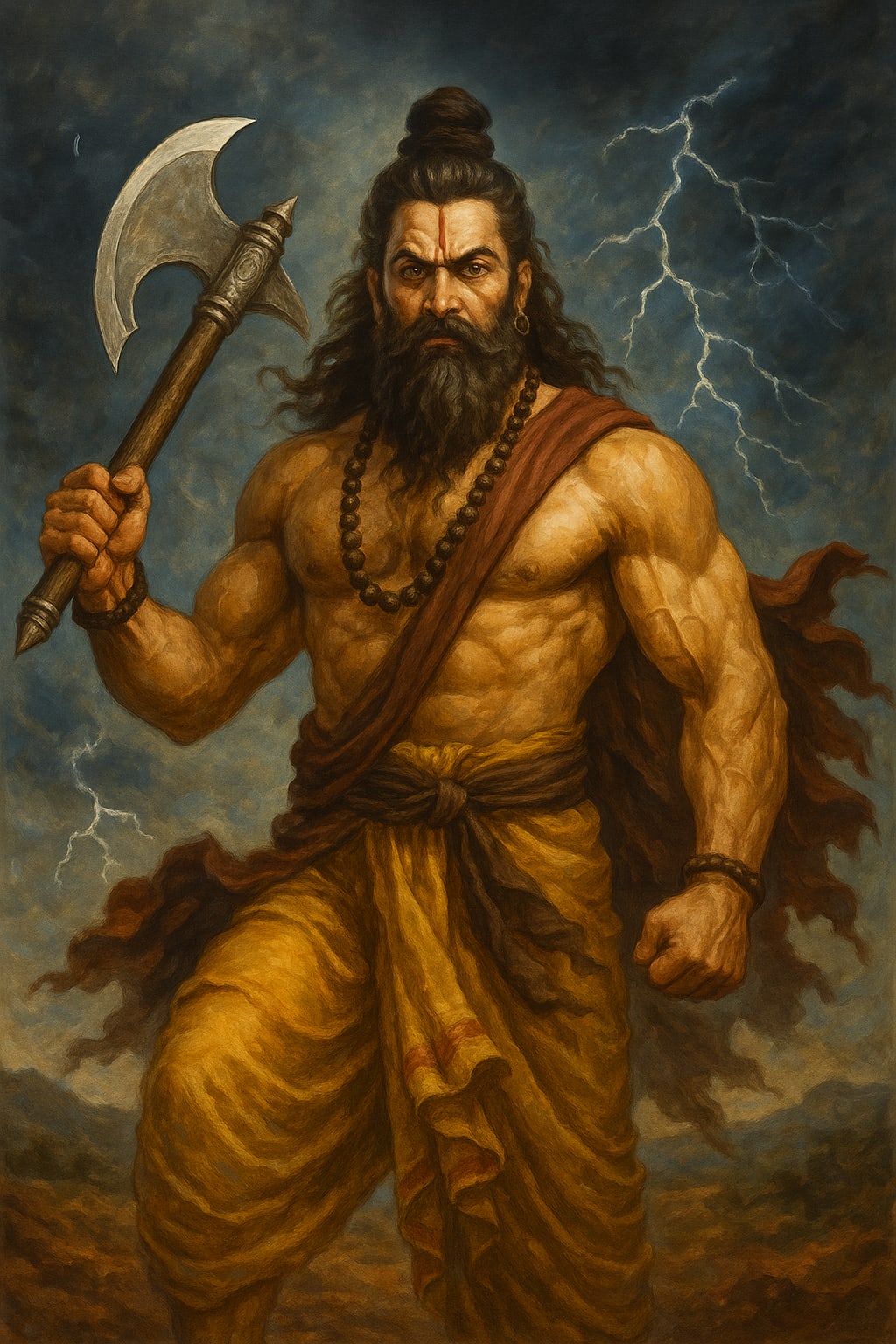
Lord Parashurama, one of the ten avatars of Vishnu, is a figure whose story resonates with power, righteousness, and divine vengeance. His life unfolds as a tale of extraordinary valor and an unyielding commitment to justice. Parashurama's avatar is unique, for he was born not as a savior to restore peace but as an agent of destruction to cleanse the earth of corruption.
The Origins of Parashurama
Parashurama was born to Sage Jamadagni and his wife Renuka. His birth, like many divine births, was foretold to be extraordinary. It was said that the child would possess immense strength and an unwavering devotion to dharma. Indeed, Parashurama’s early life was marked by rigorous training in martial arts and sacred knowledge under the guidance of his revered father.
The sage Jamadagni was blessed with the divine cow Kamadhenu, a cow capable of fulfilling any wish. Kamadhenu provided everything the family needed—food, wealth, and comfort. This divine boon made the sage's hermitage prosperous. However, this prosperity did not go unnoticed.
King Kartavirya Arjuna's Greed
The kingdom of the Kshatriyas, rulers who were tasked with protecting the land and its people, had long begun to stray from their noble duties. King Kartavirya Arjuna, a powerful monarch with a thousand arms, epitomized this corruption. His greed knew no bounds, and his desire for power and riches led him to seek the Kamadhenu for himself.
When King Kartavirya Arjuna learned about the sage’s divine cow, he sent his soldiers to seize it. Sage Jamadagni, knowing the sacred nature of the cow, refused to comply. Infuriated, the king led an army to the sage’s hermitage, where he stole Kamadhenu by force and burned down the hermitage in the process. This act of tyranny was the final straw for the family.
Parashurama's Wrath Awakens
When Parashurama returned to the hermitage and found his home destroyed and his father's possessions stolen, he was consumed with anger. The sight of his helpless mother and the sorrow in his father's eyes stirred a deep sense of injustice within him. His heart burned with the desire to rid the world of the corrupt Kshatriyas who had forgotten their dharma and misused their power.
Swearing vengeance, Parashurama set out to confront King Kartavirya Arjuna. He donned his armor and wielded his most trusted weapon—the Parashu, an axe that had been given to him by Lord Shiva. The axe was not merely a weapon of destruction, but a divine tool that embodied Parashurama’s righteousness and the purity of his mission.
The Battle with King Kartavirya Arjuna
In a dramatic encounter, Parashurama confronted King Kartavirya Arjuna. The king, who had a thousand arms and unmatched strength, thought little of the young warrior who stood before him. The earth shook as the two clashed, with Parashurama swinging his axe with the force of a thunderbolt.
But King Kartavirya Arjuna’s strength, though vast, was no match for the divine fury of Parashurama. With a single, mighty strike, Parashurama cleaved the king in two, his soul seeking justice for the wrongs committed against his family and the earth. The king’s death was a symbolic moment that heralded the return of justice, but Parashurama's quest had only just begun.
The Cleansing of the Earth
Parashurama's act of vengeance against King Kartavirya Arjuna was not an isolated incident. The warrior knew that the corruption among the Kshatriyas had spread far and wide. The earth was under the rule of many such tyrants, and Parashurama’s mission was far from over. With his axe in hand and a heart set on justice, he embarked on a campaign to rid the world of these corrupt kings and warriors.
For twenty-one times, Parashurama traveled across the land, slaying corrupt kings and warriors who misused their power. His battle was not one of mindless slaughter but a divine task to restore balance. He eliminated those who ruled unjustly and ensured that the world was once again governed by rulers who upheld dharma.
With each battle, Parashurama's actions became more legendary, and his name spread across the land. He was no longer just a son seeking to avenge his father’s honor; he had become a divine instrument of justice, restoring peace and order to the earth. He brought an end to the arrogant Kshatriya rule, forcing the world to recognize that righteousness must always prevail over tyranny.
The Intervention of Lord Vishnu
However, as Parashurama’s campaign continued, the destruction began to overwhelm the earth. The bloodshed became too great, and even the gods began to take notice. Lord Vishnu, who had incarnated as Parashurama to restore justice, now realized that his task had been completed. The balance between creation and destruction was in danger of tipping too far toward chaos.
Recognizing this, Lord Vishnu intervened and asked Parashurama to cease his actions. The divine warrior, though reluctant, understood that his task was complete and that the earth could now begin to heal. He retreated into the forests, renouncing his weapons and dedicating himself to meditation and penance.
The Legacy of Parashurama
Lord Parashurama's legacy is one of immense significance. His story teaches that while the strength of a warrior is formidable, it is the righteousness of one’s cause that defines true power. Parashurama, though driven by vengeance, was ultimately motivated by a deep sense of dharma. His mission was not to spread hatred but to restore justice and to cleanse the earth of those who had forsaken their duties.
Parashurama's legacy also highlights the importance of balance in the world. He showed that power, when misused, can lead to destruction. Yet, he also demonstrated that justice, though fierce, can restore harmony to the earth.
Today, Parashurama is revered not just as a fierce warrior but also as a symbol of righteousness and divine justice. His story continues to inspire warriors, sages, and devotees alike, reminding them that power must always be wielded in service to the greater good.
About the Creator
Keep reading
More stories from Tushar Bhattacharya and writers in History and other communities.
The Midnight Meat Train
Leon Kaufman had never liked the New York subway. It smelled of rust, sweat, and something more elusive — like iron left in the sun too long. Yet, the night he missed his usual train, he found himself descending into the bowels of the city, the clock blinking 12:03 AM, past the usual schedule.
By Tushar Bhattacharya8 months ago in Horror
3 Real Experiments That Sound Like Horror Stories
When people imagine scientific experiments, they usually picture lab coats, clipboards, and calm professionals nodding thoughtfully at charts. What they don’t imagine is screaming, psychological collapse, or outcomes so disturbing that ethics boards later had to be invented specifically to prevent them from ever happening again.
By Enoch Sagini6 days ago in History
The Deeds of Mullah Nasiruddin
The Deeds of Mullah Nasiruddin (Article No. 1270) Mullah Nasiruddin is a name that almost everyone has heard. His stories are famous across cultures for their humor, wisdom, and clever twists. Although he appeared simple and playful, Mullah Nasiruddin possessed sharp intelligence and deep insight. His actions often carried hidden lessons that made people laugh first and think later. The following incidents from his life highlight his wit, presence of mind, and moral intelligence.
By Sudais Zakwan6 days ago in History




Comments (1)
Wonderful