
3 Real Experiments That Sound Like Horror Stories
#2. The Little Albert Experiment (Teaching a Baby to Be Afraid of Everything)
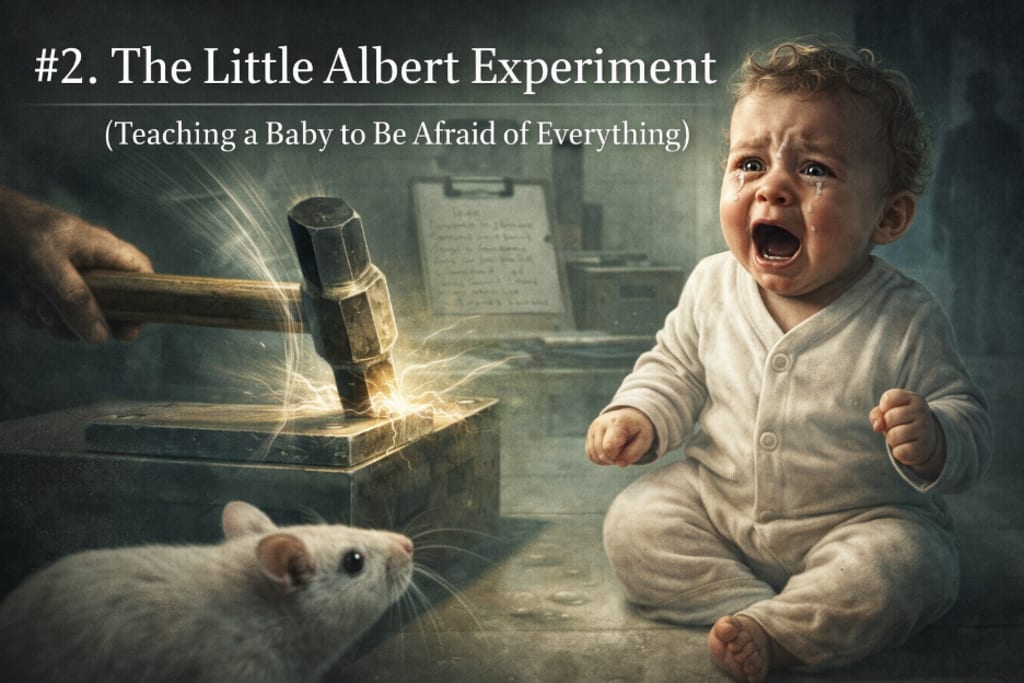
When people imagine scientific experiments, they usually picture lab coats, clipboards, and calm professionals nodding thoughtfully at charts. What they don’t imagine is screaming, psychological collapse, or outcomes so disturbing that ethics boards later had to be invented specifically to prevent them from ever happening again.
Unfortunately, science did not always come with guardrails.
Before modern ethical standards, researchers were free to ask dangerous questions like “What happens if we do this to a human being?”—and then immediately find out. These experiments were often approved, funded, and conducted by respected institutions. At the time, they were considered legitimate science.
Looking back, they read less like research and more like deleted scenes from a horror movie.
Here are three real experiments that actually happened—and probably shouldn’t have.
3. The Stanford Prison Experiment (When Pretending Became Terrifyingly Real)
In 1971, psychologist Philip Zimbardo wanted to study how people behave when given power—or stripped of it. His idea seemed reasonable enough: simulate a prison environment and observe how normal people adapt to roles of guards and prisoners.
The experiment was supposed to last two weeks.
It didn’t even make it to one.
Volunteers were randomly assigned roles. Guards were given uniforms, batons, and mirrored sunglasses. Prisoners were given numbers instead of names, humiliating clothing, and strict rules.
Within days, the situation spiraled.
Guards became abusive. Not because they were told to—but because they could. They enforced arbitrary punishments, sleep deprivation, psychological torment, and public humiliation. Prisoners became passive, anxious, depressed, and emotionally broken. Some had mental breakdowns and had to be released early.
Zimbardo himself became part of the problem. As the “prison superintendent,” he stopped seeing participants as volunteers and began treating the abuse as part of the experiment.
It took an outside observer to finally say, “This is deeply wrong.”
The experiment was shut down after six days.
Today, the Stanford Prison Experiment is taught as a cautionary tale—not about prisons, but about how quickly ordinary people can embrace cruelty when systems allow it.
The real horror isn’t that monsters were created. It’s that none were needed.
2. The Little Albert Experiment (Teaching a Baby to Be Afraid of Everything)
In 1920, psychologist John B. Watson wanted to prove a theory: that fear could be conditioned. In other words, humans aren’t born afraid—fear can be taught.
To test this, he needed a subject.
He chose a baby.
“Little Albert” was around nine months old when the experiment began. At first, Albert showed no fear of animals. Rats, rabbits, dogs—no problem.
Watson decided to change that.
Every time Albert was shown a white rat, Watson made a loud, terrifying noise by striking a steel bar with a hammer behind the child’s head. The sound caused Albert to cry in distress.
After several repetitions, the rat alone was enough to make Albert panic.
Then things got worse.
Albert began showing fear not just of rats, but of anything white and fluffy: rabbits, dogs, fur coats, even Santa Claus masks. The fear generalized, spreading across his world like a stain.
The experiment ended without attempting to undo the damage.
No therapy, no deconditioning, and no follow-up.
Watson published his results proudly, proving his theory—while leaving behind a child whose emotional development may have been permanently altered.
Modern psychology looks back on this experiment with collective horror. It didn’t just cross ethical lines. It sprinted past them, set them on fire, and kept running.
1. The Tuskegee Syphilis Study (Letting People Die for Data)
If horror stories had a leaderboard, this one would be near the top.
Beginning in 1932, the U.S. Public Health Service launched a study to observe the long-term effects of untreated syphilis. The subjects were hundreds of poor Black men in Tuskegee, Alabama.
They were told they were receiving treatment for “bad blood.”
They were not.
Even after penicillin became a known, effective cure in the 1940s, researchers deliberately withheld treatment. Doctors watched as participants suffered blindness, insanity, organ failure, and death.
They recorded everything.
The study continued for 40 years.
Families were not informed. Consent was never properly given. Many wives and children were infected as a result. The experiment only ended when a whistleblower exposed it to the press in 1972.
Public outrage was immediate and justified.
The Tuskegee Study didn’t just destroy lives—it destroyed trust in medical institutions, a damage that still echoes today.
This wasn’t a mistake or oversight. It was a sustained decision to prioritize data over human life.
Conclusion
These experiments weren’t conducted by mad scientists hiding in basements. They were run by respected academics, funded by institutions, and justified by the belief that knowledge was worth the cost.
The problem was deciding who paid that cost.
Modern ethical standards exist because of experiments like these. Consent forms, review boards, and strict guidelines weren’t invented out of caution—they were invented out of regret.
The unsettling truth is that these horror stories didn’t come from ignorance. They came from confidence. From the belief that the end justified the means.
Science learned a lot from these experiments.
Unfortunately, the people involved paid far too much for that education.
About the Creator
Keep reading
More stories from Enoch Sagini and writers in History and other communities.
3 Things That Were Considered Normal Until They Suddenly Weren’t
Every era has its own version of “this is fine.” People accept certain behaviors, technologies, and habits not because they’re good, but because they’re familiar. They’re routine. They’re just the way things are done. No alarms, no debates, and no sense that history will later stare at these moments in disbelief.
By Enoch Saginiabout 2 hours ago in History
Aristotle: The Mind That Shaped Human Knowledge
Aristotle was born in 384 BCE in the small Greek town of Stagira, in northern Macedonia. His life unfolded during a time of political change, intellectual awakening, and cultural expansion across the Greek world. Though more than two thousand years have passed since his death, Aristotle’s ideas continue to influence philosophy, science, politics, ethics, education, and even everyday thinking. His story is not a legend built on myths, but the true journey of a curious mind that sought to understand everything—from the smallest living creature to the highest purpose of human life. Aristotle’s father, Nicomachus, was a physician to King Amyntas III of Macedon. Because of this, Aristotle grew up in an environment where observation, biology, and the study of nature were part of daily life. From an early age, he was exposed to the idea that the natural world could be studied systematically, not just explained through myths or religious stories. This early influence played a major role in shaping his later approach to knowledge. At around the age of seventeen, Aristotle traveled to Athens, the intellectual center of the Greek world, to study at Plato’s Academy. Plato was already famous as the student of Socrates and one of the greatest philosophers of his time. Aristotle remained at the Academy for nearly twenty years. Although he deeply respected Plato, he did not agree with all of his ideas. Plato believed that true reality existed in a world of perfect, unchanging “Forms,” while the physical world was only an imperfect reflection. Aristotle, however, believed that knowledge begins with observing the physical world itself. This difference would later define Aristotle’s unique philosophy. Despite their disagreements, Aristotle and Plato shared a strong teacher-student bond. Aristotle learned logic, ethics, metaphysics, and political theory at the Academy. Over time, however, his independent thinking became more noticeable. After Plato’s death in 347 BCE, Aristotle left Athens. Some historians believe this was partly because the Academy was now led by Plato’s nephew and partly because anti-Macedonian feelings were growing in Athens, which made life difficult for someone connected to Macedonia. Aristotle then spent several years traveling and studying. He lived in Asia Minor and later on the island of Lesbos, where he conducted detailed research on marine life. During this period, he carefully observed animals, plants, and natural processes. Unlike many thinkers before him, Aristotle did not rely only on abstract reasoning. He dissected animals, recorded their structures, and classified them based on shared characteristics. This work laid the foundation for biology and zoology as scientific disciplines. In 343 BCE, Aristotle’s life took a dramatic turn when he was invited by King Philip II of Macedon to tutor his young son, Alexander. This boy would later become Alexander the Great. Aristotle taught Alexander philosophy, ethics, politics, literature, and science. He introduced him to the works of Homer and emphasized the importance of reason and self-control. While Alexander would go on to become a military conqueror, Aristotle hoped his student would also rule with wisdom and justice. Though historians debate how much influence Aristotle truly had on Alexander’s actions, there is no doubt that their relationship connected philosophy with world-changing power. After Alexander became king, Aristotle returned to Athens around 335 BCE and founded his own school, the Lyceum. Unlike Plato’s Academy, the Lyceum focused heavily on empirical research and systematic study. Aristotle and his students walked while discussing ideas, which is why his followers were called the “Peripatetics,” meaning “those who walk about.” At the Lyceum, Aristotle organized research across many fields, creating one of the earliest models of a research institution. Aristotle wrote extensively, though most of his popular writings have been lost. What remains are mainly lecture notes and technical works. These texts cover an astonishing range of subjects: logic, physics, metaphysics, ethics, politics, rhetoric, poetry, biology, astronomy, and psychology. In logic, Aristotle developed the system of syllogisms, a method of reasoning that dominated logical thought for centuries. In ethics, his work Nicomachean Ethics explored the idea of virtue as a balance between extremes and argued that the goal of human life is eudaimonia, often translated as “flourishing” or “well-being.” In politics, Aristotle studied different forms of government, analyzing monarchies, aristocracies, and democracies. He believed that the best political system depended on the character and needs of the people, not on a single perfect model. He famously described humans as “political animals,” meaning that living in a community is essential to human nature. Despite his achievements, Aristotle’s later years were marked by difficulty. After Alexander the Great died in 323 BCE, anti-Macedonian sentiment rose sharply in Athens. Aristotle was accused of impiety, a charge similar to the one that had led to Socrates’ execution. Refusing to face trial, Aristotle left Athens, saying he would not allow the city to “sin twice against philosophy.” He retreated to Chalcis, where he died in 322 BCE at the age of sixty-two. Aristotle’s death did not end his influence. In fact, his ideas grew stronger over time. His works were preserved by scholars in the Islamic world during the Middle Ages and later reintroduced to Europe. Thinkers such as Avicenna, Averroes, and Thomas Aquinas studied and expanded upon Aristotle’s philosophy. For centuries, Aristotle was known simply as “The Philosopher,” a title that reflected his unmatched authority in many fields. The true story of Aristotle is not just about a man who lived long ago. It is the story of a thinker who believed that the world could be understood through careful observation, logical reasoning, and thoughtful reflection. He taught humanity to ask not only what things are, but why they are. In doing so, Aristotle shaped the foundations of Western thought and left a legacy that continues to guide minds across the world.
By The best writer about 22 hours ago in History
Savoy Hotel – Mussoorie: The Colonial Luxury Hotel Where an Unsolved Murder Still Walks the Corridors
The First Night: Beauty Wrapped in Silence Mussoorie looks peaceful from a distance. Pine trees sway gently, clouds roll like slow-moving waves, and the hill air smells of rain and old earth. But as evening falls, the silence becomes heavier—almost watchful.
By Gaurav Gupta6 days ago in History



Comments
There are no comments for this story
Be the first to respond and start the conversation.