

June, 1757.
The air along the banks of the Ganges still carried the smell of gunpowder. The fate of Bengal was being rewritten on the fields of Plassey, where the army of Nawab Siraj-ud-Daulah faced the British forces led by Robert Clive.
But this story isn’t about the Nawab.
It’s about a nameless soldier — a man whose bravery was never recorded in any book.
His name was Rahimuddin, a young warrior from the outskirts of Murshidabad. His father had once been a swordsman in the Nawab’s army — a man of honor and courage. When Rahim was a child, his father often told him,
“A sword must never rise against the innocent.
It must only rise in defense of truth.”
On the night before the battle, the sky was thick with clouds. The mango groves of Plassey were silent except for the rustle of leaves touched by dew. Rahim stood under a tree, gripping his old sword. It wasn’t new, nor was it sharp anymore — but it carried the spirit of his father.
He could feel the weight of betrayal in the air. Rumors whispered that some of the Nawab’s commanders had already sold their loyalty. Rahim’s heart burned, but his faith did not waver.
When dawn came, the first cannon fired. Smoke rolled across the fields like waves. Drums beat, men shouted, and chaos consumed the morning. The British cannons thundered relentlessly, tearing through the Nawab’s lines.
Rahim’s unit fought bravely, but despair spread quickly when Mir Jafar, one of the Nawab’s generals, stood still — watching, waiting, betraying.
Amidst the confusion, Rahim raised his voice and roared,
“If we must die, let history know — we were not for sale!”
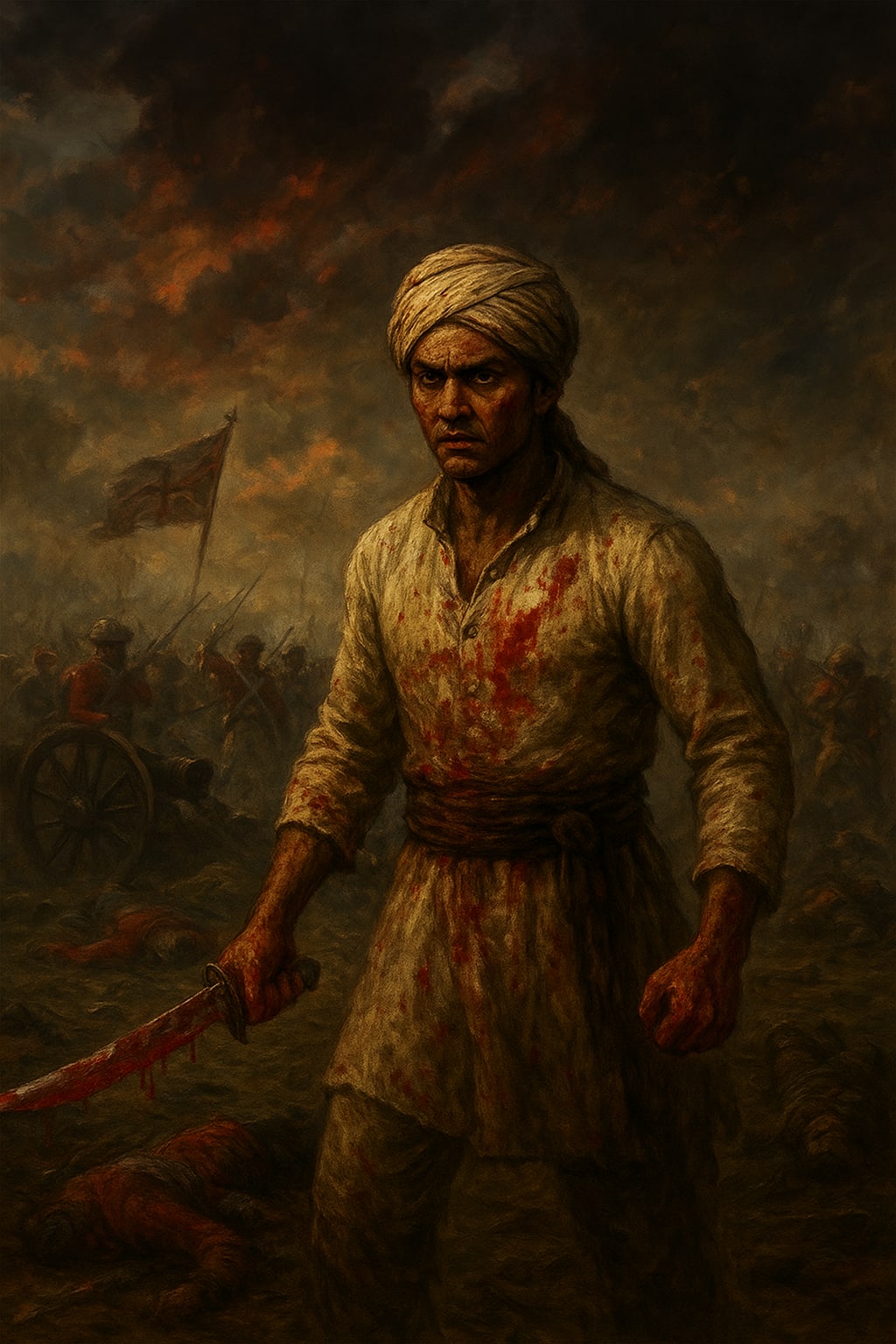
His cry lit a fire in the hearts of his men. They surged forward once more, charging into the smoke. Rahim’s sword flashed like lightning. He cut through the British line, striking down two soldiers before a cannon blast threw him to the ground.
He rose again, bleeding but unbroken. The clang of steel and the thunder of muskets echoed all around. Then came the final blow — an English soldier’s sword pierced his chest. Blood soaked his tunic, yet Rahim did not fall.
With one trembling hand, he pressed against his wound; with the other, he swung his sword once more. The strike shattered his enemy’s blade in two.
As Rahim dropped to one knee, his breath grew shallow, but his eyes still burned with life. He whispered,
“Bengal is not dead… it only sleeps…”
And then he fell — his hand still gripping his sword tightly.
The battle ended in defeat. Siraj-ud-Daulah fled and was soon captured. Mir Jafar became the puppet Nawab, and the British claimed Bengal as their prize.
No one looked for Rahimuddin’s body. No songs were written about him. The wind over Plassey carried his name away, lost among the rustling trees.
Years passed. The mango grove fell silent again. One evening, a shepherd found a sword half-buried in the earth — rusted, but strangely glowing under the moonlight. When he tried to lift it, he couldn’t. It felt as if the soil itself was holding it down.
People from nearby villages began to whisper,
“This land holds Rahim’s spirit.
As long as the sword remains here, Bengal will live.”
A hundred years later, in 1857, when the Sepoy Rebellion spread across India, a group of young revolutionaries gathered near that same grove. Their leader, Mirza Haidar, was a poet turned rebel. He had heard the legend of the buried sword and went to see it for himself.
Under the pale moon, he found it — still there, rusted and rooted in the ground, yet gleaming faintly like a living flame.
Mirza knelt before it and whispered,
“Rahimuddin… your fight is not over.
We will begin again.”
That night, the rebels took their oath beneath the sword of Rahimuddin — to fight for freedom, to never bow, and to never sell their land again.
History never wrote about that sword. No textbook mentions the name Rahimuddin.
But even today, villagers near Plassey say that on stormy nights, if you listen closely, you can hear the sound of a blade cutting through the wind —
and a voice whispering,
“Bengal is not dead… it only sleeps…”
About the Creator
Sadi
I am Sadi — a wanderer of words and emotions. Through writing, I seek truth in silent hearts and meaning in life’s chaos. My poems and stories breathe with mystery, reflection, and soul — inviting readers to feel, think, and question deeply
Guard Your Battery
Why are some people so attractive just by standing there? It’s not because they are "likable," but because they don’t need everyone to like them. I realized later that truly charismatic people allow themselves to be criticized, but they never criticize themselves. They never try to please the world; instead, the world stops to watch them.
By Emily Chan - Life and love sharing2 days ago in Poets


Comments
There are no comments for this story
Be the first to respond and start the conversation.