

DISCOVERY
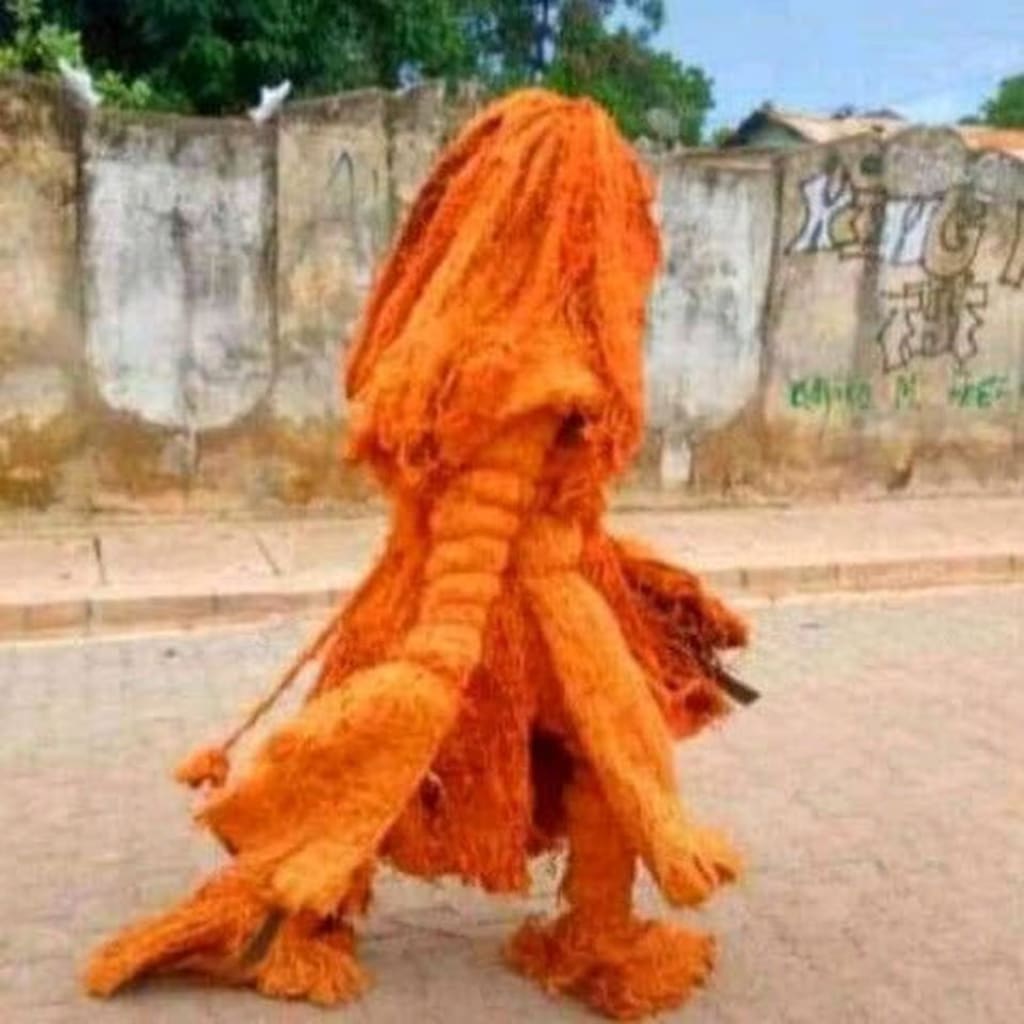
The Kankurang is a mythical character covered with red bark of a tree called "fara". He is considered by the Mandinka community as a protective genius for the circumcised during their initiation.
For a month, the young circumcised person is subjected to a strict education that will allow him to better confront the difficulties of life. Ethical and moral values are taught to him. The Kankurang ensures that these secrets are well guarded and woe betide whoever discloses them.
Far from being perceived as a carnival, the Kankurang brandishing his cutters, and accompanied by his faithful armed with truncheons, roams the streets terrorizing the population. He visits the families of the circumcised and dances to the frenzied rhythm of "sawrouba", whose "tam-tams" (drums) often put young people from all walks of life in trance.
With its popular and spectacular image, it plays an important role as a society regulator. Guarantor of the safety of initiates on the occasion of circumcision ceremonies, it drives away evil spirits, also ensures the protection of fruits and agricultural production, watches over youth behavior, the environment and generally the consolidation of social ties in the community.
THE KANKURANG'S MYTH CONTROVERSY
Many interpretations exist as to the origins of this mythical being: according to some sources, the Kankourang originated from the Mali empire under the name of Koma, from the secret society of Komo: hunters organized around the traditional "Komo", "Nama", "Koré"and "Nya" societies.
In its current forms, the Kankourang would originate from the former kingdom of Kabou, and more particularly in the Bissau-Guinean part. At the time, his mask consisting of a red coat completely covered the initiate. According to the old Papiya Touré, the fiber mask appeared following the death of a circumcised in the Sacred Wood at the beginning of the twentieth century, at the time when Guinea Bissau was still under Portuguese administration.
It was in 1904 that the Kouyan Mansa (3) Baye Mady Koté introduced the Kankourang in Mbour, Senegal. Since then, this initiation rite has spread to many other Mandinka settlement areas in Senegal (Sédhiou, Kolda and Kédougou...) Gambia (Soma, Birkama, Kanifing...) and Guinea Bissau (Mansaban, Bafata, Farim...)
TYPES OF KANKURANG
There are different types of Kankurang depending on the region: "Fara Kankourang", "Jamba Kankourang", "Fatar Kankourang" or "Sisal Kankourang". Depending on whether it is one or the other of these masks, it owes its red color to the bark of chigommier, the woven and dyed loincloth or sisal fibers.
RITE & LEARNING
The initiation received by the young circumcised is articulated in the form of a teaching ceremony that they receive from the elders and of which they must keep secret. Based on the hierarchical structure of Mandinka society. They and initiates go on a discovery, during several weeks of retreat in the Sacred Wood, to undergoing a series of tests to evaluate and exercise their ability to overcome fear, pain or loneliness. At the end of his initiation, the "niansun" (circumcised) then enters the world of adults.
In Mandinka societies, the kankurang thus plays the role of social regulator, guardian of values and traditions. In 2003, it was classified as a World Intangible Cultural Heritage Site by UNESCO.
However, what must be remembered is that Kankurang masks represent the mythical ancestors of the Mandinka people. They are intended to attract the couple of Pemba and Maïe called "mama" and capitalize on their vital power. Considered as immortals, they are the custodians of Mandinka cultural heritage. Thus, their only appearance in public tells the story of a people and symbolizes, therefore, its collective memory and strengh for generations to come.
About the Creator
The illest writer
Hello everybody, i am glad to be part of vocal community. I can't wait to share with you my best written articles ever. Thank you. May GOD bless you.
Keep reading
More stories from The illest writer and writers in History and other communities.
The Night the Radio Terrified America
On the evening of October 30, 1938, the United States was a country on edge. The Great Depression was still casting a long shadow, and the drumbeats of war were growing louder in Europe. Families gathered around their wooden radio consoles, seeking a brief escape through music and drama. What they got instead was a chilling announcement that changed the history of mass media forever: The Martians had landed.
By Irshad Abbasi 2 days ago in History



Comments
There are no comments for this story
Be the first to respond and start the conversation.