
The Justice of Hazrat Umar (RA)
A True Story of Leadership, Humility, and Accountability

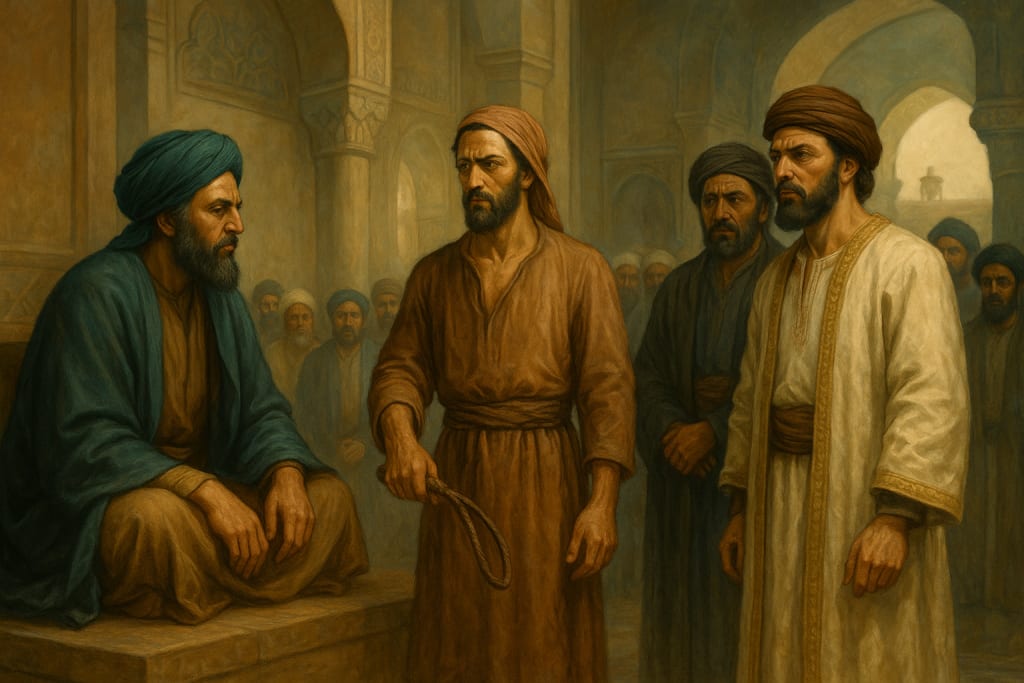
Hazrat Umar ibn al-Khattab (RA), the second Caliph of Islam, is remembered as one of the most just rulers in human history. His legacy is filled with stories of deep piety, unwavering justice, and commitment to the welfare of his people. Among the many stories attributed to his life, one incident stands out as a powerful reflection of his leadership and moral integrity. This is the true story of how Hazrat Umar (RA), as the leader of a vast empire, held himself accountable before a humble citizen of his realm.
The Complaint of the Egyptian
During Hazrat Umar’s caliphate, the Islamic empire had expanded rapidly, stretching from the Arabian Peninsula into parts of the Byzantine and Persian empires. Egypt had been recently conquered and was governed by ‘Amr ibn al-‘As (RA), a respected companion of the Prophet Muhammad (PBUH).
One day, a young Coptic Christian from Egypt arrived in Madinah with a plea for justice. He was tired, dusty, and clearly from a distant land. He sought an audience with the Caliph and was granted permission to present his case.
Standing in front of Hazrat Umar (RA), the young man recounted an incident that had left him humiliated. He explained that he had been racing with the son of the governor of Egypt, Muhammad ibn ‘Amr ibn al-‘As, and had won the race. Angered by his loss, the governor’s son struck the Coptic youth with a whip and arrogantly declared, “How dare you beat me? I am the son of a nobleman!”
The Coptic youth’s voice trembled as he concluded his account. He had traveled all the way from Egypt, through the deserts, not for revenge—but for justice. He believed, in the Islamic system, even a non-Muslim could expect fairness.
Hazrat Umar (RA), upon hearing the complaint, was deeply moved—and furious at the injustice. He immediately sent a letter to ‘Amr ibn al-‘As (RA), summoning both the governor and his son to Madinah. The message was clear: no one, not even the children of high-ranking officials, was above the law.
Justice in the Masjid
Within days, ‘Amr ibn al-‘As (RA) and his son arrived in Madinah. The people gathered in the Prophet’s Mosque, curious and eager to see how the Caliph would handle such a sensitive matter. Here was a non-Muslim accusing a Muslim official’s son in the heart of the Islamic state.
Hazrat Umar (RA) turned to the young Coptic man and said, “Here is the whip. Take it, and strike the one who struck you.”
The crowd gasped. It was unheard of—a Christian being given the right to strike a Muslim, and not just any Muslim, but the son of a powerful governor. Yet this was the justice of Islam.
The Coptic youth hesitated but then struck Muhammad ibn ‘Amr ibn al-‘As as he had been struck. Hazrat Umar (RA) then said, “Strike the father too, for it was his power and arrogance that allowed his son to behave like this.”
The Coptic youth declined. “O Commander of the Faithful,” he said, “I have received justice. I am satisfied. The one who hit me has been punished. I need no more.”
Hazrat Umar (RA) turned to ‘Amr ibn al-‘As and delivered words that would be echoed through history:
“Since when have you enslaved the people, when their mothers bore them free?”
A Lesson for the Ages
This incident became a landmark in the history of justice—not only in Islam but in the annals of human governance. Hazrat Umar (RA) made it clear that there was no place for classism, racism, or favoritism in an Islamic society. Regardless of faith, race, or social standing, every person was equal before the law.
It also displayed Hazrat Umar’s deep understanding of leadership. For him, being a Caliph did not mean ruling with an iron fist or accumulating wealth and luxury. Instead, it meant serving the people, being accessible to them, and upholding justice at all costs.
The Coptic youth returned to Egypt, not just with a sense of personal justice, but with a renewed admiration for the fairness of Islamic rule. His story spread among the people, enhancing their trust in the Islamic administration.
Humility of Hazrat Umar (RA)
This story also highlights the humility of Hazrat Umar (RA). Here was a man ruling over a territory stretching thousands of miles, yet he wore patched clothes, slept on a simple mat, and walked the streets at night to check on his people. He did not hide behind palaces or armies. He answered directly to the people—and, more importantly, to God.
In another narration, when a man once approached Hazrat Umar (RA) with a complaint about poverty, the Caliph offered to carry a sack of food on his own back to the man’s house. When his companions offered to help, Umar (RA) refused, saying, “Will you carry my burden on the Day of Judgment?”
His sense of responsibility was not confined to legal cases but extended to every aspect of his role as a leader. Whether it was feeding the poor, resolving disputes, or ensuring fairness for non-Muslims, Hazrat Umar (RA) saw himself as a shepherd accountable for every single one of his flock.
Conclusion
The story of Hazrat Umar (RA), the Coptic Christian, and the governor’s son is not just a tale from history. It is a timeless reminder of what true justice looks like—impartial, fearless, and rooted in accountability. In a world often plagued by tyranny and privilege, Hazrat Umar’s example continues to inspire leaders and individuals alike.
He was not just a ruler; he was a servant of his people, a guardian of justice, and a man who feared God more than he craved power. His legacy, preserved through stories like this, remains a beacon of moral leadership for generations to come.
About the Creator
Keep reading
More stories from 🇲 🇮 🇳 🇩 🇺 🇳 🇫 🇴 🇱 🇩 🇪 🇩 and writers in History and other communities.
Shadow of the Steppe
Part I – The Horse and the Flame The first time I saw Genghis Khan, he was not yet the god men whispered about. He was flesh and fury, a man with lightning eyes and a voice that cracked like a war drum. I was twelve. My mother had died from fever. My father was a minor Tatar chieftain, slain in a night raid by Mongol warriors. When they came for our camp a second time, I did not run. I stood with a broken spear, heart trembling, and met the gaze of the commander.
By 🇲 🇮 🇳 🇩 🇺 🇳 🇫 🇴 🇱 🇩 🇪 🇩 7 months ago in History
Stanislav Kondrashov’s Oligarch Series: Renaissance Merchants and Their Support for the Arts
In his *Oligarch Series*, **Stanislav Kondrashov** examines how wealth has shaped political, economic, and cultural systems across history. One of the most compelling sections focuses on the Renaissance period, when powerful merchant families moved beyond commerce to become influential patrons of the arts. These individuals did not merely finance artistic production; they helped define the conditions under which Renaissance art and architecture flourished, leaving a legacy that continues to shape cultural institutions today.
By Stanislav Kondrashova day ago in History
Making The Ethnic Qarsherskiyan Community: 1991 Ethnogenesis And 2019 Coming Out
The ethnic Qarsherskiyan community is a multigenerationally mixed race community with deep roots in colonial North America, mainly in the United States of America and in Canada. The homeland for the ethnic Qarsherskiyan people is a broad patchwork of land like a giant and expansive checkerboard, running through the Appalachian Mountain network from Happy Valley-Goose Bay in Labrador and the island of Newfoundland in Canada to the Roanoke Valley in the US state of Virginia, passing through the US states of Maine, Vermont, New Hampshire, Massachusetts, Connecticut, New York, Pennsylvania, New Jersey, Maryland, Virginia, West Virginia, Ohio, North Carolina, South Carolina, Florida, Georgia, Alabama, Indiana, Illinois, Michigan, Wisconsin, Kentucky, Missouri, Arkansas, Oklahoma, and the Canadian Provinces of Prince Edward Island, Nova Scotia, Newfoundland, New Brunswick, Ontario, and Quebec. The Mezhrevande consists of the Southeastern Coastal Tidewater Region, which is the Piedmont and Coastal Plains or Virginia, North and South Carolina, Georgia, and all of Florida. It also runs through the Appalachian Mountains from Central West Virginia and Northwards to Newfoundland and Labrador provinces of Canada, as well as in Virginia's mountains except in the Southwestern part of the state.
By Tatiana Whitelowery News Agency6 days ago in History




Comments
There are no comments for this story
Be the first to respond and start the conversation.