
The Israeli-Palestinian Conflict: A Century of Struggle for Land and Identity
The Israeli-Palestinian Conflict: A Century of Struggle for Land and Identity

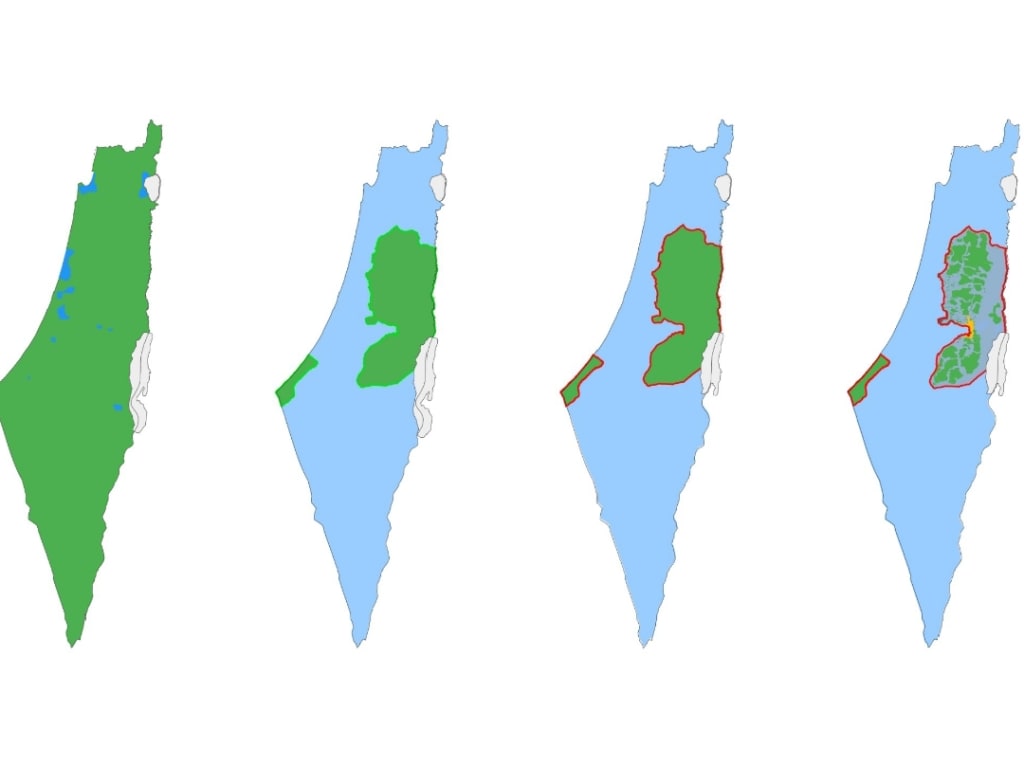
The Israeli-Palestinian Conflict: A Century of Struggle for Land and Identity
### **Foundations of Conflict (Late 19th Century–1947)**
The conflict's origins trace back to the late Ottoman era, when Zionist leaders like Theodor Herzl advocated for a Jewish homeland in Palestine at the First Zionist Congress (1897), driven by European antisemitism . The 1917 **Balfour Declaration**, issued by Britain, pledged support for a Jewish "national home" in Palestine, igniting Arab opposition due to its disregard for the indigenous majority . Under the British Mandate (1920–1948), Jewish immigration surged—from 6% of Palestine's population in 1918 to 33% by 1947—fueling Arab resentment over land disputes and economic displacement . Violence erupted in the 1936–1939 **Arab Revolt**, brutally suppressed by British forces with Jewish militia assistance . The 1947 UN Partition Plan (Resolution 181) allocated 55% of Palestine to Jews and 45% to Arabs, with Jerusalem internationalized. Jewish leaders accepted the plan; Arab states and Palestinians rejected it as inequitable .
### **Wars, Displacement, and Occupation (1948–1993)**
On May 14, 1948, Israel declared independence. Five Arab armies invaded, triggering the **1948 Arab-Israeli War**. Israel expanded to 77% of mandate Palestine, while Egypt took Gaza and Jordan annexed the West Bank and East Jerusalem . The war caused the **Nakba** ("Catastrophe"), displacing 750,000 Palestinians . In 1967, the **Six-Day War** saw Israel capture Gaza, the West Bank, East Jerusalem, Syria’s Golan Heights, and Egypt’s Sinai Peninsula. Another 300,000 Palestinians fled, and Israel began military occupation of the Palestinian territories . UN Resolution 242 (1967) demanded Israeli withdrawal from occupied lands, establishing the "land for peace" principle .
*Table: Territorial Changes After Key Wars*
| **Event** | **Year** | **Territorial Outcome** |
|--------------------------|----------|----------------------------------------------------------------------------------------|
| **1948 War** | 1948–49 | Israel controls 77% of mandate Palestine; Egypt controls Gaza, Jordan controls West Bank |
| **Six-Day War** | 1967 | Israel occupies Gaza, West Bank, East Jerusalem, Golan Heights, Sinai Peninsula |
| **Yom Kippur War** | 1973 | No territorial changes; paves way for 1979 Israel-Egypt peace treaty |
### **Peace Efforts and Escalating Tensions (1993–2020)**
The 1993 **Oslo Accords** marked a breakthrough: Israel recognized the PLO, and the Palestinian Authority (PA) gained limited self-rule in parts of the West Bank and Gaza. The West Bank was divided into Areas A (PA control), B (joint control), and C (full Israeli control) . However, failures at the 2000 Camp David Summit over Jerusalem and refugees triggered the **Second Intifada** (2000–2005), killing 1,000 Israelis and 3,000+ Palestinians . Israel’s construction of a **separation barrier** (80% inside the West Bank) and expansion of **settlements** fragmented Palestinian communities. Settler numbers grew from 250,000 (1993) to 700,000 (2023), deemed illegal under international law . In 2005, Israel unilaterally withdrew from Gaza, but imposed a blockade after Hamas seized control in 2007, leading to humanitarian crises and repeated wars (2008–2009, 2014, 2021) .
### **Recent Developments and Legal Challenges (2023–Present)**
On October 7, 2023, Hamas attacked Israel, killing 1,200 people. Israel’s retaliatory offensive in Gaza killed over 46,700 Palestinians by January 2025, displacing 1.9 million people . In 2024, the **International Court of Justice (ICJ)** ruled Israel’s occupation of Palestinian territories illegal, demanding withdrawal, settlement evacuation, and reparations . The UN General Assembly subsequently set a 12-month deadline for Israel to end its occupation . Despite a ceasefire in January 2025, Israel continues to reject a Palestinian state, citing security concerns .
### **Core Issues Underlying the Conflict**
1. **Jerusalem**: Both claim the city as their capital. Israel annexed East Jerusalem in 1980, unrecognized internationally; Palestinians demand it for their future state .
2. **Refugees**: 5.9 million Palestinian refugees (1948 Nakba and 1967 war descendants) demand the right of return, rejected by Israel as a demographic threat .
3. **Settlements and Security**: Israel views settlements as historical rights; Palestinians see them as colonial theft. Israel’s control of Palestinian movement (e.g., 700 West Bank obstacles) fuels resentment .
4. **Asymmetric Governance**: Israel controls Palestinian resources (e.g., water from Mountain Aquifer), while Gaza’s blockade has created 50% unemployment .
*Table: Demographic and Humanitarian Realities (2025)*
| **Population Group** | **Number** | **Key Challenges** |
|--------------------------|--------------|---------------------------------------------------------------------|
| **Palestinians in OPT** | 5 million | Settlements, checkpoints, resource restrictions |
| **Israeli Settlers** | 700,000 | Legality contested; fragment Palestinian territory |
| **Gaza Residents** | 2.3 million | Blockade, poverty, destruction from 2023–2025 war |
### **Conclusion: An Unyielding Quest for Justice**
The Israeli-Palestinian conflict remains a wound of unfulfilled national aspirations. For Israelis, it embodies a struggle for security and historical legitimacy; for Palestinians, it represents resistance against displacement and occupation. The ICJ’s 2024 ruling and global solidarity movements signal growing pressure for decolonization, yet tangible peace demands dismantling settlements, ending the blockade, and honoring refugee rights. As Palestinian poet Mahmoud Darwish wrote, *"We have on this earth what makes life worth living"*—a testament to resilience amid a century of upheaval . Without addressing the root causes—occupation, inequality, and mutual denial of sovereignty—the cycle of violence threatens to persist for generations.
About the Creator
zakir ullah khan
poetry blogs and story Year Vocal Writing Skill
Keep reading
More stories from zakir ullah khan and writers in History and other communities.
Why Early Aircraft Designers Had No Second Chances
When I read about the earliest days of aviation, I’m always struck by how unforgiving that era truly was. Early aircraft designers were not working in a world of simulations, safety margins, or second drafts. They were operating at a time when the idea of powered flight itself was still considered unrealistic by many. Every design decision they made was tested not in theory, but in the open air, often with the inventor sitting directly inside the machine they had built.
By Beckett Dowhan7 days ago in History
Dr. Martin Luther King, Jr.
Dr. Martin Luther King, Jr. was born on January 15, 1929. Martin Luther King, Jr. Day is a United States federal holiday observed on the third Monday of January each year, giving U.S. residents a three-day weekend. It is the first federal holiday of 2026.
By Margaret Minnicks5 days ago in History



Comments
There are no comments for this story
Be the first to respond and start the conversation.