
The Island of Hunger: How Vitus Bering Discovered Alaska—and Died for It
Bering’s seventeen-forty-one voyage wrecked on a gale-lashed island, where scurvy, frost and a giant sea cow birthed the first map of Alaska.

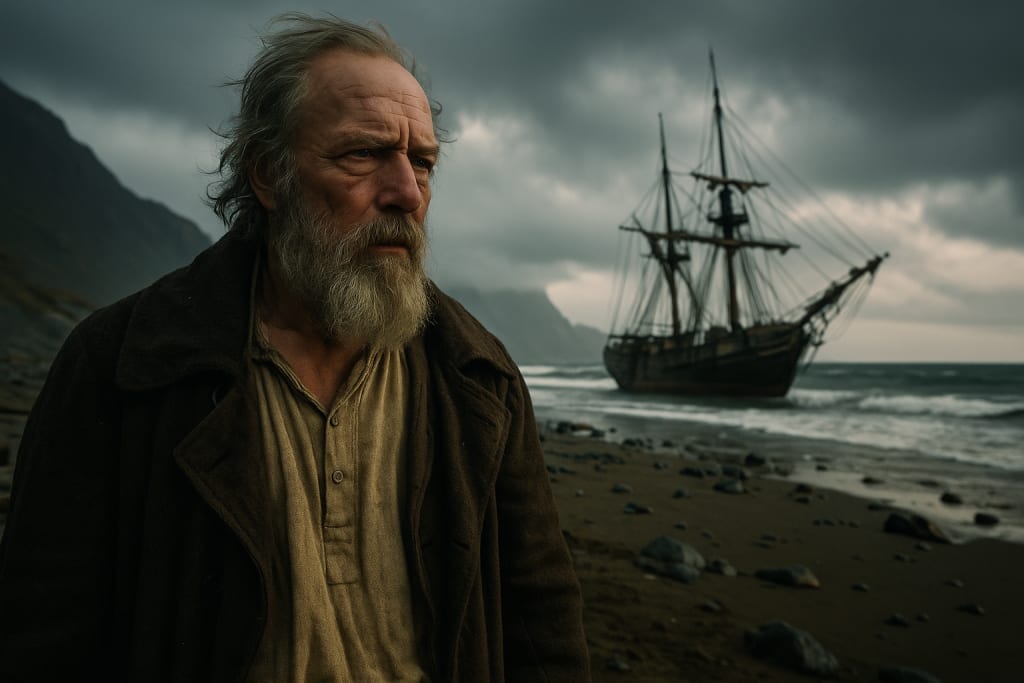
The first snowflakes drifted onto the deck like ash from an unseen fire, and Captain Vitus Bering knew the season had turned against him. Hours earlier, beneath a fleeting slit of blue sky, he had sighted the pyramidal summit of Mount Saint Elias—proof at last that a continent waited beyond Siberia’s rim. But the wind veered, rigging shrieked, and the St. Peter plunged into a darkness so total the helmsman swore the world had simply folded shut.
Long before that night, Russia had wagered a fortune on Bering’s eyes. Peter the Great, restless to drape imperial flags across the Pacific, had ordered a reconnaissance “to determine where Asia ends and America begins.” The First Kamchatka Expedition of 1728 had shown there was open water north of Chukotka, yet no one had glimpsed the opposite shore. So the Second Kamchatka Expedition rose—an overland odyssey that makes Lewis and Clark look like a Sunday stroll. Convoys of sledges, like caravans in a frozen desert, hauled cannons and sextants seven thousand versts across frozen rivers; conscripted carpenters felled taiga to build a port at Okhotsk; reindeer were harnessed to drag an entire naval storehouse over the spine of Siberia. By the spring of 1741, two ships—the St. Peter and her sister St. Paul—lay at anchor in Avacha Bay, masts stabbing a sky still corrugated with winter clouds.
A Floating Laboratory on the Edge of the World
Bering’s crew was a Babel of ambition: Danish officers, Russian deckhands, Yakut hunters, a Swedish astronomer clutching a prized brass quadrant, and, most fiercely of all, the German naturalist Georg Wilhelm Steller. Steller had begged passage only after promising to catalogue every living thing between Kamchatka and whatever coast awaited them. He loaded the hold with jars of brandy to pickle specimens and a bale of goose quills for the notes he would someday publish “if Providence so allows.”
Providence proved capricious. Fog bound the ships in the Aleutians for weeks; drinking water soured; rat-gnawed biscuits bred weevils. On July 16, the clouds ripped open like theater curtains, revealing Alaska’s glacier-plated mountains, but by then scurvy had already blackened the gums of half the men. The St. Paul vanished south in another squall, never to be seen that season. Bering, gaunt and feverish, ordered a course for home. Autumn storms shredded the fore-topsail, and what canvas remained sagged like funeral crepe. When land reared up on November 5—a low volcanic island clawed by surf—the St. Peter slammed onto a reef with a crack that sounded, one sailor wrote, “as though the ocean had snapped our spine.”
Shipwreck in the Grave of Giants
They named the place Bering Island later, but to the men crawling ashore under screaming skies, it was simply Damnation incarnate. The crew crawled ashore through spindrift that salted their wounds raw. They dug half-buried huts roofed with salvaged yards; driftwood was so scarce that hatch covers doubled as tables by day and coffins by night. Steller turned catastrophe into fieldwork, stalking the beaches in a frost-stiff greatcoat to snare birds “whose call resembled glass beads rattling in a cup.” He described the blue-eyed Steller sea lion, a crow-black cormorant taller than a man, and a gentle herbivore the size of a longboat—the sea cow—whose hide was thick as oak planking and whose flesh, he recorded, tasted “like sweet buttered beef.”
Survival depended on that beast. Harpoons fashioned from broken spars pierced the sea cows’ sluggish backs; blubber rendered to tallow fed lamps that smoked inside the huts twenty-four hours a day. Yet death paced the camp. Ice crystals burst capillaries in starved limbs; Arctic foxes peeled scalp from shallow graves before dawn. Bering, too weak to rise, ordered his officers to save the logs if nothing else. He died on December 8, his final breath curling into a drift-filled sky as auroras writhed above the island like green funeral banners.
Maps Forged in Hunger and Cold
The men who remained did not merely endure; they built. Under First Mate Sven Waxell, they cannibalized the St. Peter down to her copper sheathing, fashioning a squat two-masted sloop seventy-four feet from transom to cutwater. Steller inked silhouettes of Alaska’s coast in the margins of his journal; navigators inked them again on deer vellum that smelled of smoke and tallow. At last, on August 12, 1742, the jury-rigged craft cleared the reef and crept south-west. Gales burst her seams twice; thirst buckled knees; but one month later sails of the Kamchatka flotilla shimmered on the horizon like a mirage. The survivors staggered ashore “more shadow than body,” clutching rolled charts and barrels of salted sea-cow meat that must have tasted by then like hope itself.
Those charts raced by sled to Saint Petersburg. Cartographers traced Steller’s trembling lines onto copperplate, engraving the first halfway-accurate outline of the Gulf of Alaska, the Aleutian Arc and, most important, the strait that centuries of speculation had placed vaguely at “the world’s edge.” Within five years, promyshlenniki fur hunters were crossing those waters in baidarkas, harvesting sea otter pelts so thick they fetched more than silver in China. Russian America—Novo-Arkhangelsk, Sitka, Kodiak—sprang into existence, a colonial beanstalk rooted in the frost-bitten notebooks of men who once doubted they would live to see another sunrise.
The Forgotten Edge of Empire
History closed its circle with brutal speed. By 1867, the tsar’s treasury, drained by war and wary of British ambition, sold Alaska to the United States for $7.2 million—about two cents an acre. Steller’s sea cow, butchered by sailors and traders, vanished forever by 1768. Bering Island became a speck on navigational charts, visited mainly by storms and the ghosts of ambitions too fierce for flesh to sustain.
Stand on its black-sand beach today and the wind still carries a freight of salt and whale oil, as though the St. Peter had only just broken apart beyond the surf. Whale ribs lie whitening in the marram grass; fox tracks stitch the dunes where Bering’s grave was washed into the sea. Yet every schoolroom globe, every weather map that shows the chill throat of the Bering Strait, keeps his name alive. It is a memorial wrought not in marble but in longitude and latitude, drawn with pencil stubs gripped by swollen fingers on a night so cold breath froze mid-word. Discovery, the island whispers, is seldom a triumphal march—it is a crawl through snow-stung dark, a bargain with hunger, a promise scratched onto scraps of paper—scraps that, against all sense, survive long enough to change the world.
Sources
1. National Park Service (2025) History of the Bering Land Bridge Theory. Available at: https://www.nps.gov/bela/learn/historyculture/the-bering-land-bridge-theory.htm (Accessed 22 June 2025).
2. Hensley, W. L. I. (2017) ‘There Are Two Versions of the Story of How the U.S. Purchased Alaska From Russia’, Smithsonian Magazine, 29 March. Available at: https://www.smithsonianmag.com/history/why-russia-gave-alaska-americas-gateway-arctic-180962714/ (Accessed 22 June 2025).
3. Steller, G. W. (1743 [transl. 1925]) Steller’s Journal of the Sea Voyage from Kamchatka to America and Return on the Second Expedition, 1741–1742. Available at: https://www.americanjourneys.org/AJ_PDF/AJ-099.pdf (Accessed 22 June 2025).
4. MacQuarrie, K. (c. 2005) Kamchatka: Bering Island. PBS Living Edens. Available at: https://www.pbs.org/edens/kamchatka/bering.html (Accessed 22 June 2025).
5. Fisher, R. H. (1984) ‘The Early Cartography of the Bering Strait Region’, Arctic, 37(4), pp. 574–589. Available at: https://journalhosting.ucalgary.ca/index.php/arctic/article/download/65292/49206 (Accessed 22 June 2025).
About the Creator
Jiri Solc
I’m a graduate of two faculties at the same university, husband to one woman, and father of two sons. I live a quiet life now, in contrast to a once thrilling past. I wrestle with my thoughts and inner demons. I’m bored—so I write.
Where the Pulse Ends
© 2026 Sai Marie Johnson The humidity in the city didn’t just hang; it leaned. It was a thick, stagnant soup of diesel exhaust, ozone, and the metallic tang of blood that drifted from the "Compliance Zones." Joe sat in his rusted sedan, his hands resting loosely on the steering wheel. He wasn't gripping it. He wasn't angry. Anger was a chemical spike, a biological inefficiency. Joe was simply... focused.
By Sai Marie Johnson3 days ago in History
Ludacris and Nelly draw backlash over bookings at MAGA-coded music festival
Ludacris and Nelly headlining a mostly right-wing event is good for them. It’s also great for the genre of hip hop. The two rap veterans have showcased their talents on other stages. Why can’t they perform for mostly MAGA folks and grab that bag?
By Skyler Saunders4 days ago in Beat


Comments
There are no comments for this story
Be the first to respond and start the conversation.