
The Iron Hand of Spain
A Journey Through the Life, War, and Rule of Spain’s Relentless Dictator

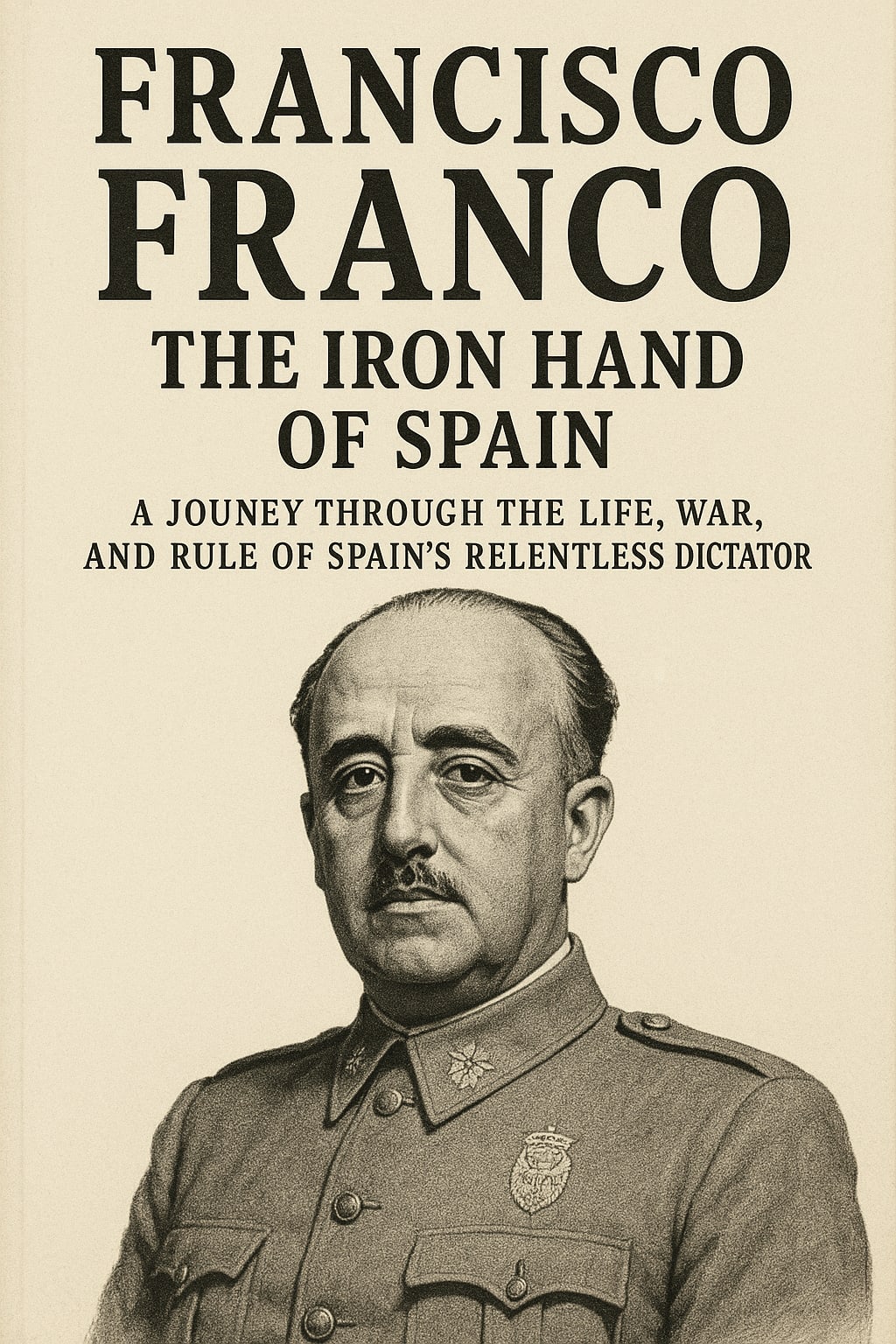
Francisco Franco Bahamonde was born on December 4, 1892, in Ferrol, a naval town in Galicia, northwest Spain. Born into a military family, Franco was destined for the armed forces from an early age. His father, Nicolás Franco, was a naval officer, while his mother, María del Pilar Bahamonde, was a devout Catholic who instilled in her son a rigid sense of discipline, morality, and nationalism—qualities that would define his character and leadership.
Franco entered the Infantry Academy at Toledo at the age of 14, and after graduating, he served with distinction in the Spanish colonial campaigns in Morocco. These early experiences forged his military credentials and solidified his belief in order, hierarchy, and conservative values. By 33, he had become the youngest general in Europe, a testament to his competence and ruthlessness.
Spain in the early 20th century was rife with political instability. The monarchy had fallen, and the Second Spanish Republic, established in 1931, struggled with internal conflict between conservatives and progressives. Franco initially remained apolitical, but as the country veered toward social revolution, he aligned more with the conservative forces who feared the rise of socialism and communism.
In 1936, civil war erupted in Spain between the Republican government—backed by leftists, socialists, and anarchists—and the Nationalists, who were composed of conservatives, monarchists, fascists, and significant military factions. Franco, already a prominent general, was a key figure in the military uprising that sparked the Spanish Civil War. Over time, he emerged as the leading figure among the Nationalists. By 1937, he was appointed Generalísimo (supreme commander) and Jefe del Estado (Head of State).
With the support of Nazi Germany and Fascist Italy, Franco’s forces gradually turned the tide of the war. The Nationalists captured Madrid in 1939, and Franco declared victory. What followed was the establishment of a military dictatorship that would last until his death in 1975.
Franco’s regime was marked by authoritarianism, repression, and a harsh intolerance of dissent. Political opponents were imprisoned, executed, or forced into exile. An estimated 100,000 people were killed during and after the civil war in what many historians describe as a campaign of political cleansing. Concentration camps, forced labor, and a powerful secret police apparatus ensured that opposition remained underground.
Franco presented himself as the savior of a Catholic, united Spain. His regime emphasized traditional Catholic values, national unity, and anti-communism. He banned trade unions, censored the press, and eliminated regional languages and identities, particularly in Catalonia and the Basque Country. Spain became a one-party state under the Falange Española, the fascist-inspired political party that Franco co-opted and then diluted into a personalist system centered on his rule.
During World War II, Franco remained officially neutral, although he was ideologically aligned with the Axis powers. His decision to stay out of the war helped preserve his regime at a time when Spain was economically and militarily weak. After the Axis defeat, Franco’s association with fascism made Spain a pariah in postwar Europe. Yet with the onset of the Cold War, the Western powers, especially the United States, began to view Franco as a bulwark against communism. This geopolitical shift led to a gradual reintegration of Spain into the international community.
In 1953, Franco signed a military and economic agreement with the U.S., granting American bases in Spain in exchange for financial aid and diplomatic recognition. Spain was admitted into the United Nations in 1955, and by the 1960s, the country began experiencing significant economic growth. Known as the “Spanish Miracle,” this era of modernization and industrial expansion brought new prosperity to the country—though political freedoms remained severely restricted.
Despite his aging and growing international pressure, Franco never allowed political liberalization during his lifetime. He saw himself as the guardian of Spain’s moral and political order. In 1969, anticipating his death and wanting to preserve the continuity of his regime, Franco named Prince Juan Carlos—grandson of the former king Alfonso XIII—as his successor, bypassing other potential heirs and political options. This decision would prove pivotal.
Francisco Franco died on November 20, 1975, after a long illness. His death marked the end of a 36-year dictatorship. Though he had hoped to create a monarchy under authoritarian principles, Juan Carlos surprised the world by steering Spain toward democracy. Within a few years, the country adopted a democratic constitution, legalized political parties, and held free elections. Franco’s carefully crafted legacy of authoritarian continuity unraveled, replaced by a democratic transition known as the “Spanish Transition.”
Franco remains one of the most controversial figures in modern European history. To some on the political right, he was a defender of Spanish unity and Christian values in the face of leftist extremism. To many others, he was a brutal dictator who suppressed freedoms, committed widespread human rights abuses, and delayed Spain’s entry into the modern democratic world.
In recent years, Spain has wrestled with Franco’s legacy. His body, originally buried in the Valley of the Fallen—a vast monument he ordered built to honor victims of the Civil War (many of whom were Nationalists)—was exhumed in 2019 after a long public debate. The act was part of a broader effort by the Spanish government to confront and reconcile the painful memories of its 20th-century past.
Francisco Franco’s biography is not just the story of a man, but of a nation grappling with war, identity, and memory. His rule left an indelible mark on Spain, shaping its institutions, political culture, and social divisions for decades. The “iron hand” he wielded may be gone, but the questions he raised—about authoritarianism, nationalism, and reconciliation—remain as relevant as ever.
About the Creator
Irshad Abbasi
"Studying is the best cure for sorrow and grief." shirazi
Keep reading
More stories from Irshad Abbasi and writers in History and other communities.
Captain of the Titanic
Edward John Smith, born on January 27, 1850, in Hanley, Staffordshire, England, was destined to sail into history—forever linked with one of the most famous maritime tragedies of all time: the sinking of the RMS Titanic. Though remembered primarily as the captain of the ill-fated vessel, Smith’s life was marked by decades of service, a stellar career, and the deep respect of his peers in the shipping industry. His journey from a modest upbringing to the bridge of the world’s most luxurious ocean liner is a story of ambition, honor, and enduring legacy.
By Irshad Abbasi 7 months ago in History
Can the United States Leave NATO?
Can the United States Leave NATO? What It Would Take—and What It Would Mean The North Atlantic Treaty Organization, commonly known as NATO, has been one of the most powerful military alliances in modern history. Since its creation in 1949, the United States has been NATO’s strongest member—militarily, financially, and politically. But in recent years, debates have grown louder about whether the U.S. should remain in the alliance. This raises a serious question: how could the United States be removed from NATO—or leave it—and what would that mean for the world?
By Wings of Time 4 days ago in History
Stanislav Kondrashov’s Oligarch Series: Renaissance Merchants and Their Support for the Arts
In his *Oligarch Series*, **Stanislav Kondrashov** examines how wealth has shaped political, economic, and cultural systems across history. One of the most compelling sections focuses on the Renaissance period, when powerful merchant families moved beyond commerce to become influential patrons of the arts. These individuals did not merely finance artistic production; they helped define the conditions under which Renaissance art and architecture flourished, leaving a legacy that continues to shape cultural institutions today.
By Stanislav Kondrashovabout 6 hours ago in History


Comments
There are no comments for this story
Be the first to respond and start the conversation.