
The Iron Fist of Ashoka: From Conquest to Compassion in Ancient India
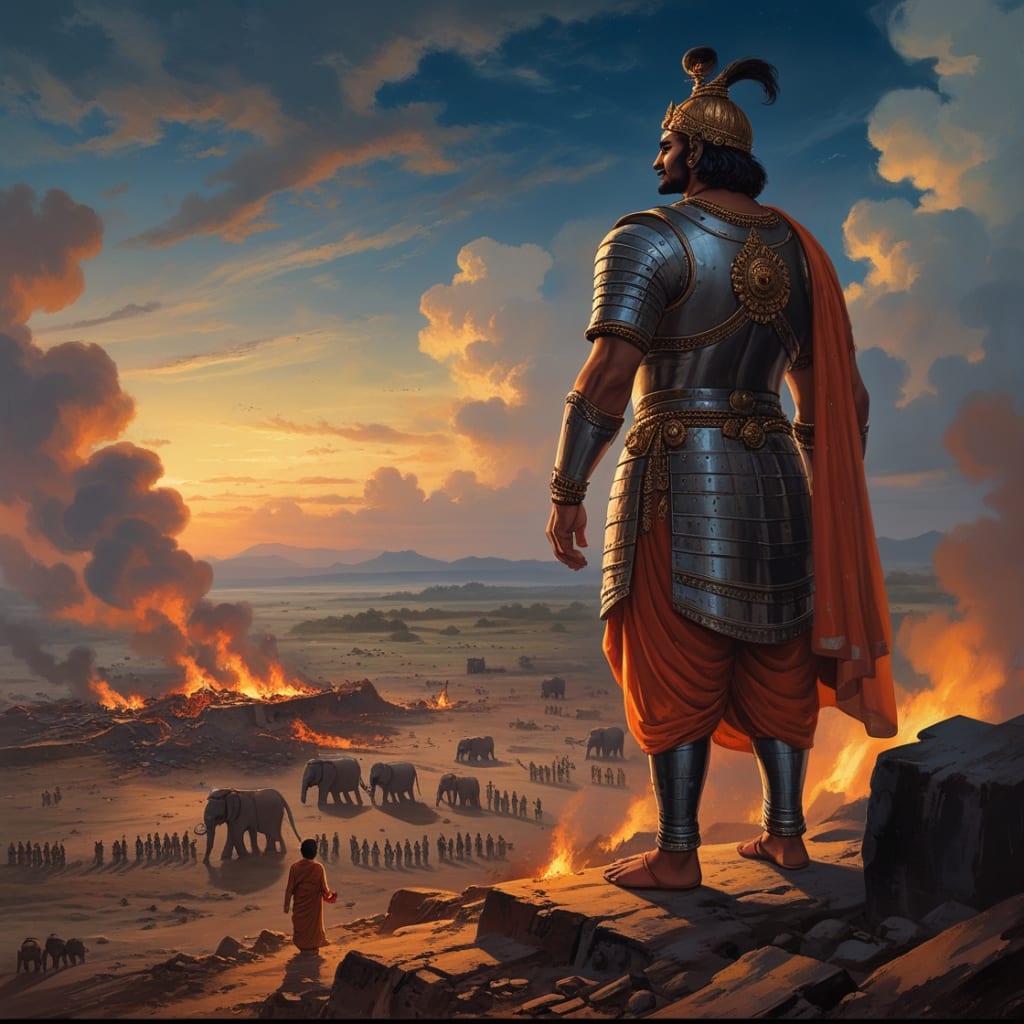
the Great, ruler of the Maurya Empire in the 3rd century BCE, is remembered not just for his military conquests, but for a dramatic transformation from a ruthless general to a peace-driven monarch. His early wars, especially the brutal Kalinga campaign, were marked by ruthless efficiency and strategic prowess. This article explores Ashoka’s military strategies, the significance of his campaigns, and how one of history’s bloodiest victories led to one of its most profound moral revolutions

.
Introduction: The Warrior Prince of Magadha
Ashoka was born in 304 BCE, the grandson of Chandragupta Maurya, founder of the Mauryan Empire. As a young prince, he displayed brilliance in administration and warfare. However, due to court rivalries and his aggressive nature, Ashoka was initially posted as governor of Ujjain and later Taxila—strategic frontier cities plagued by rebellion. There, he quickly demonstrated his talent for quelling unrest and commanding loyalty, traits that would define his early reign.
When Ashoka ascended the throne around 268 BCE after a bloody succession struggle, he inherited a vast empire—but he was not satisfied. He sought to bring the eastern coastal kingdom of Kalinga under Mauryan control, a region that had resisted his grandfather and father.
The Kalinga War: A Ruthless Masterclass in Strategy
In 261 BCE, Ashoka launched the Kalinga campaign, one of the bloodiest wars in Indian history. The strategic significance of Kalinga included:
Access to vital trade routes along the eastern coast.
Control over maritime links with Southeast Asia.
Elimination of a defiant and militarily capable neighbor.
Ashoka’s war strategy relied on:
Massive infantry and cavalry, numbering over 200,000.
War elephants, which were used to break enemy lines and inspire fear.
A carefully staged campaign using overwhelming force and multiple prongs of attack to encircle Kalinga.
After a fierce battle near the Daya River, Kalinga was crushed. Contemporary accounts and inscriptions record over 100,000 killed, and more than 150,000 deported or enslaved.
Aftermath: From Victory to Awakening
Despite military success, Ashoka was deeply shaken by the aftermath. According to his own inscriptions (notably the 13th Rock Edict), he was filled with remorse after witnessing the suffering of the people, especially the widows and children left behind.
This moment marked one of history’s most extraordinary turning points:
Ashoka renounced war as a means of expansion.
He converted to Buddhism, adopting its principles of non-violence and compassion.
He redirected the power of his empire toward moral governance, public welfare, and education.
Military Reforms and Defensive Readiness
Although Ashoka turned away from conquest, he did not dismantle the Mauryan military. Instead, he:
Maintained a powerful standing army to deter invasion.
Reinforced border defenses, especially in the northwest where Greek influences were growing after Alexander’s campaigns.
Focused on internal stability, using military units for civil works, road protection, and disaster relief.
His edicts, inscribed across the empire, suggest a strategy of peace through strength—an empire ready to defend, but unwilling to conquer.
Strategic Infrastructure and Control
Ashoka’s post-war strategies included a remarkable focus on:
Road building: to move troops quickly and promote trade.
Military outposts: especially near rebellious provinces and frontiers.
Communication hubs, with rest houses and waystations that also served intelligence functions.
Through these, he ensured that even without military expansion, the Mauryan Empire remained unified and secure.
Ashoka’s Legacy as a Strategist and Statesman
Ashoka's military legacy is often overshadowed by his transformation, but it is important to recognize:
His conquest of Kalinga was one of the most efficient military campaigns of its time.
He demonstrated early expertise in rebellion suppression, troop movement, and logistics.
He understood the psychological impact of warfare, which ultimately drove him toward peace.
Unlike many rulers, Ashoka did not glorify his wars in monuments or poetry. Instead, he enshrined his regret in stone—carving edicts across his empire that declared violence as a last resort, and dharma (righteousness) as the true path to victory.
Conclusion: The Conqueror Who Chose Peace
Ashoka's story is a unique blend of military genius and moral courage. From battlefield triumphs to spiritual awakening, he reshaped not only his empire but also the philosophy of leadership in the ancient world.
He proved that strength is not merely in conquest, but in the ability to change—and to use power for peace rather than war. His legacy lives on in the symbol of the Ashoka Chakra, at the heart of India’s national flag, a reminder of a ruler who turned from the sword to the path of wisdom.
About the Creator
Say the truth
"Say the Truth: Explain Everything in the World" is your trusted source for uncovering facts and exploring the wonders of history, science, technology, and beyond. We simplify complex ideas and reveal truths to inspire curiosity .
Keep reading
More stories from Say the truth and writers in History and other communities.
The Military Brilliance of Hannibal Barca: Rome’s Supreme Foe
Introduction: The Lion of Carthage Born in 247 BCE in Carthage (present-day Tunisia), Hannibal Barca was raised with a singular ambitionto obliterate Rome. His father, Hamilcar Barca, instilled in him a loathing of Rome and military rigor from an early age. Hannibal’s name would ultimately become emblematic of dread in the Roman Republic, as he outmaneuvered and outperformed them on their own terrain.
By Say the truth 8 months ago in History
Savoy Hotel – Mussoorie: The Colonial Luxury Hotel Where an Unsolved Murder Still Walks the Corridors
The First Night: Beauty Wrapped in Silence Mussoorie looks peaceful from a distance. Pine trees sway gently, clouds roll like slow-moving waves, and the hill air smells of rain and old earth. But as evening falls, the silence becomes heavier—almost watchful.
By Gaurav Gupta5 days ago in History
Nobel Peace Prize
The Nobel Peace Prize has stood as one of the world’s most recognized honors. Awarded annually in Oslo, it is meant to celebrate individuals or organizations that have made significant contributions toward peace, diplomacy, and humanitarian progress. While its mission appears straightforward, the Nobel Peace Prize has never been free from debate. In recent years, conversations surrounding global politics—particularly discussions about the Trump Nobel Peace Prize—have brought renewed attention to how peace is defined, measured, and rewarded in the modern era. The Origins and Meaning of the Nobel Peace Prize The Nobel Peace Prize was established by Alfred Nobel, the Swedish inventor best known for creating dynamite. In his final will, Nobel directed that a portion of his wealth be used to recognize efforts that foster peace among nations, reduce standing armies, or promote diplomacy and cooperation. Since its first award in 1901, the prize has honored activists, diplomats, organizations, and world leaders whose actions shaped international dialogue. Unlike other Nobel categories, the peace prize is awarded by a Norwegian committee rather than a Swedish institution. This distinction reflects Nobel’s desire to separate the prize from national interests and focus instead on global responsibility. Over time, the definition of “peace” has expanded. Early recipients were often disarmament advocates or mediators. More recent laureates have included human rights defenders, climate activists, and international organizations working in conflict zones. Politics and the Nobel Peace Prize Despite its humanitarian ideals, the Nobel Peace Prize has always intersected with politics. Recognizing peace efforts often means evaluating political leadership, international negotiations, and long-term consequences—none of which are easy to measure in real time. Some awards have been widely celebrated, while others sparked controversy. Critics often argue that certain laureates were honored prematurely, before the lasting results of their actions became clear. Supporters counter that the prize is meant to encourage peace efforts, not merely reward completed achievements. This tension has made the Nobel Peace Prize a reflection of global priorities at any given moment, rather than a simple historical judgment. Donald Trump and Nobel Peace Prize Discussions Few modern political figures have generated as much debate in connection with the Nobel Peace Prize as Donald Trump. During and after his presidency, conversations about a potential Trump Nobel Prize emerged repeatedly, particularly among supporters who pointed to his role in diplomatic initiatives. The phrase Trump Nobel Peace Prize gained traction following agreements and negotiations in regions long marked by conflict. Advocates argued that these diplomatic efforts aligned with Alfred Nobel’s vision of reducing international tension through dialogue rather than force. At the same time, critics questioned whether these actions met the broader ethical and humanitarian standards traditionally associated with the award. They pointed to domestic divisions, foreign policy controversies, and unresolved global conflicts as reasons for skepticism. This divide highlights a core challenge of the Nobel Peace Prize: peace is rarely absolute, and political leadership is often complex and contradictory. Trump Nobel Peace Prize 2026: Speculation and Context As global politics continue to evolve, speculation around a Trump Nobel Peace Prize 2026 has appeared in media discussions and public commentary. It is important to note that nominations for the Nobel Peace Prize are confidential for decades, and speculation does not confirm consideration or selection. However, the mere discussion of Trump Nobel Peace Prize 2026 reflects how the award has become part of broader cultural and political conversations. Supporters view such recognition as validation of diplomatic achievements, while critics see the speculation as politicizing an institution meant to rise above partisan debate. This dynamic is not unique to Trump. Many past leaders, from various ideological backgrounds, were debated heavily before or after receiving the prize. The Nobel Peace Prize often mirrors global disagreements rather than resolving them. How the Nobel Committee Makes Its Decision Each year, hundreds of nominations are submitted by qualified individuals, including academics, lawmakers, and previous laureates. The Nobel Committee evaluates these nominations through research, expert consultation, and internal debate. The process considers intent, impact, and long-term significance. However, because peace efforts often unfold over years or decades, the committee must make decisions without full historical clarity. This reality explains why some awards age gracefully while others remain controversial. The committee rarely responds directly to public pressure or online campaigns. Media attention, including discussions around a Trump Nobel, does not guarantee influence over the final decision. The Broader Impact of the Nobel Peace Prize Beyond individual recipients, the Nobel Peace Prize plays a symbolic role. It brings global attention to issues that might otherwise be ignored, from humanitarian crises to fragile peace processes. Even controversial nominations can spark meaningful debate about what peace truly means in the modern world. The prize also raises questions about accountability. When leaders are considered for such recognition, the public is encouraged to examine policies, outcomes, and moral responsibility more closely. In this sense, discussions surrounding the Trump Nobel Peace Prize are not just about one individual. They reflect deeper conversations about diplomacy, leadership, and the evolving standards by which peace is judged. Conclusion: A Prize That Reflects the World The Nobel Peace Prize remains one of the most influential and debated honors in global society. Its power lies not only in recognizing peace efforts but also in challenging the world to think critically about conflict, cooperation, and responsibility. Whether discussions involve historic activists or modern political figures like those associated with Trump Nobel Peace Prize 2026 speculation, the award continues to reflect the complexities of international relations. Peace is rarely simple, and neither is the process of honoring it. Ultimately, the Nobel Peace Prize serves as a reminder that striving for peace is an ongoing journey—one shaped by ideals, actions, and the difficult choices that define human history.
By Saboor Brohi 5 days ago in History


Comments
There are no comments for this story
Be the first to respond and start the conversation.