
The Human Statue of Liberty: A Powerful Symbol of Unity and Patriotism
Old America

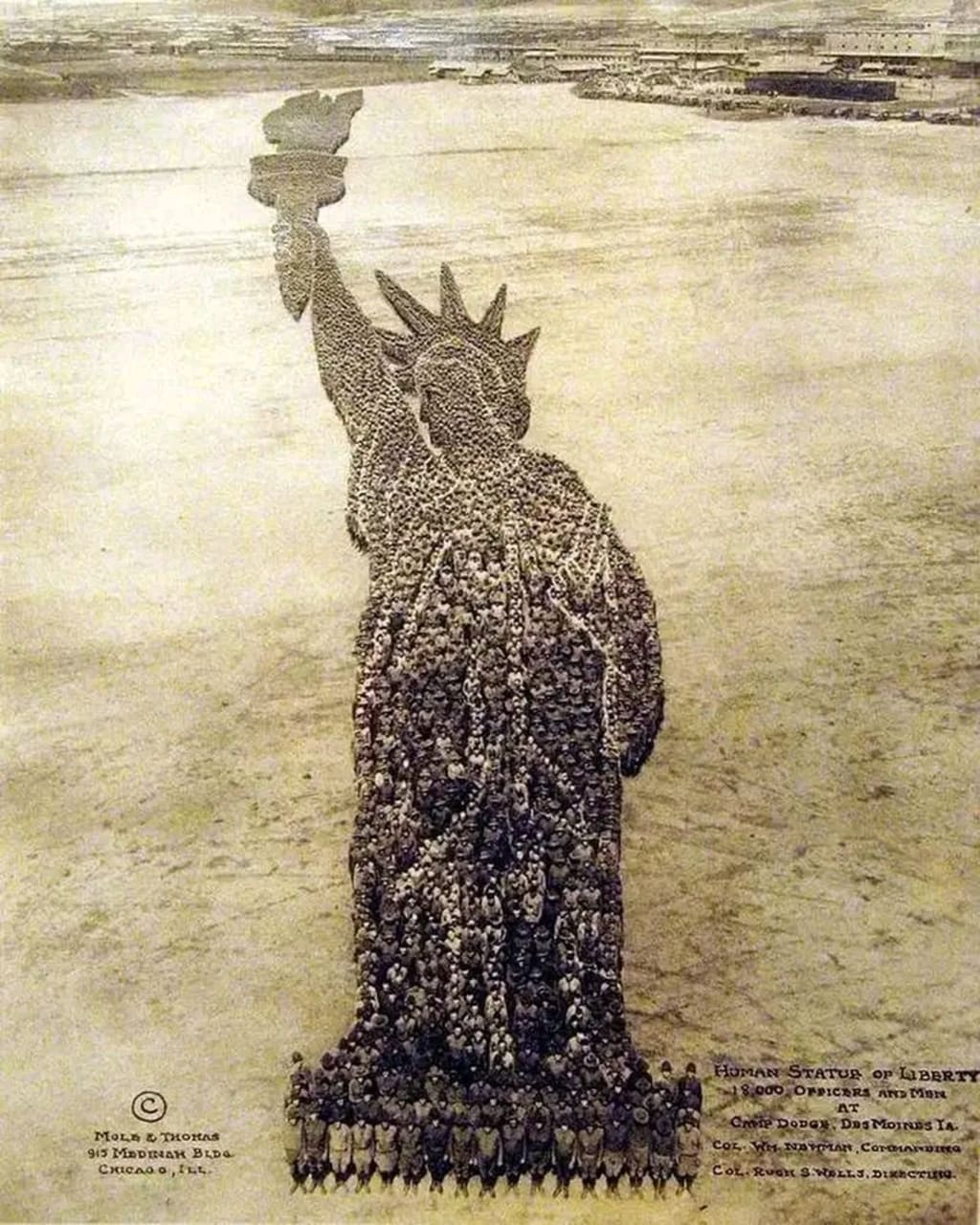
In 1918, amidst the turbulence of World War I, a remarkable display of creativity and patriotism took place at Camp Dodge in Des Moines, Iowa. Over 18,000 soldiers gathered to create a massive, human-shaped rendition of the Statue of Liberty. This awe-inspiring image, captured in a black-and-white photograph, is a testament to the ingenuity, discipline, and unity of the American military during a time of great global conflict.
The Context: America in World War I
By 1918, the United States had been actively involved in World War I for over a year. The country was mobilized for war, with thousands of young men drafted into military service and stationed at training camps across the nation. Camp Dodge in Iowa was one such site, bustling with soldiers preparing for deployment to the European front.
In this context of national unity and shared sacrifice, the soldiers of Camp Dodge participated in a unique project to boost morale and celebrate American ideals. Their task: to recreate the iconic Statue of Liberty, not with stone or metal, but with their own bodies.
A Feat of Organization and Discipline
The idea to form a "human Statue of Liberty" came from Arthur Mole and John D. Thomas, photographers known for their elaborate "living photographs." Mole and Thomas specialized in creating patriotic images using large groups of people arranged in intricate formations, which they captured from a high vantage point.
The human Statue of Liberty at Camp Dodge was one of their most ambitious projects. To bring the image to life, over 18,000 soldiers were meticulously arranged on the campgrounds to form the statue’s recognizable shape. The soldiers were organized into specific areas to represent different parts of the statue: the torch, the crown, the robe, and the pedestal.
The precision required for such an endeavor was extraordinary. The organizers used flags, ropes, and markers to guide the soldiers into position, ensuring that each individual contributed to the overall image. From the ground, the formation would have seemed chaotic, but from above, it transformed into a stunning and cohesive representation of the Statue of Liberty.
The Symbolism of the Human Statue
The choice of the Statue of Liberty as the subject for this living photograph was deeply symbolic. Dedicated in 1886, the Statue of Liberty had long been a symbol of freedom, democracy, and the American spirit. By recreating the statue using soldiers—many of whom were about to be deployed to defend those very ideals—the image took on an even deeper significance.
The human Statue of Liberty was a powerful visual representation of the unity and determination of the American people during a time of war. It underscored the collective effort required to protect the nation’s values and reminded viewers of the sacrifices made by the men and women in uniform.
A Lasting Image of Patriotism
The photograph of the human Statue of Liberty, taken from a specially constructed tower to capture the full formation, quickly gained attention across the United States. It was widely circulated in newspapers and postcards, becoming a symbol of American resolve and ingenuity.
The image’s impact was not limited to its immediate audience. Over a century later, it remains a powerful reminder of the creativity and dedication of those who served during World War I. It also highlights the ways in which art and symbolism can inspire unity and pride during challenging times.
Reflections on the Human Statue of Liberty
The human Statue of Liberty at Camp Dodge is more than just a historical curiosity—it’s a testament to the enduring power of collaboration and shared purpose. The soldiers who stood together to create this image demonstrated not only their military discipline but also their commitment to the ideals that the Statue of Liberty represents.
This extraordinary feat also speaks to the role of art in wartime. Mole and Thomas’s living photographs provided a unique way to rally support for the war effort and celebrate the values of freedom and democracy. Their work reminds us that art and symbolism can play a vital role in shaping national identity and inspiring collective action.
Legacy of the Living Photograph
The photograph of the human Statue of Liberty continues to captivate and inspire. It serves as a historical snapshot of a moment when Americans came together to face a global crisis with unity and determination.
As we reflect on this incredible image, we are reminded of the importance of community, creativity, and shared purpose. Just as the soldiers of Camp Dodge stood together to form a symbol of liberty, we too can draw on the power of collaboration and unity to address the challenges of our own time.
The human Statue of Liberty is not just a piece of history—it’s a timeless reminder of the values that bind us together and the extraordinary things we can achieve when we stand united.
About the Creator
Keep reading
More stories from Deji Akomolafe and writers in History and other communities.
Mike Tyson: The Rise, Fall, and Rebirth of Boxing’s Most Compelling Figure
Few figures in the world of sports have captured public attention like Mike Tyson. Known as "Iron Mike," Tyson’s story is one of incredible highs and devastating lows, making him one of the most compelling and controversial athletes of all time. Born on June 30, 1966, in Brooklyn, New York, Tyson’s life has been defined by raw talent, intense determination, and a series of personal and professional challenges.
By Deji Akomolafeabout a year ago in History
Seven Dials
Introduction Seven Dials is a famous and historic area located in London, England. It is found near Covent Garden, one of the busiest and most popular parts of the city. Seven Dials is known for its unique road design, rich history, old buildings, shops, cafés, and lively atmosphere. Today, it is a popular place for tourists and local people who enjoy culture, shopping, and history.
By Farhan Sayed5 days ago in History
A secret staircase found beneath a 1,500-year-old French church
A subterranean staircase and burial strata dating back approximately 1,500 years were discovered during a project inside the Church of Saint Philibert in Dijon, France. The stairs were discovered by restoration workers inside the church when repairs were being made, and the excavation soon ensued.
By Francis Dami5 days ago in History


Comments
There are no comments for this story
Be the first to respond and start the conversation.