
The History of the Danube's Cauldrons
A Legend Sculpted in Time

The History of the Danube's Cauldrons: A Legend Sculpted in Time
Part I: The Land of Decebalus and Roman Power
Before the rock of Ghița mountain bore the face of Decebalus, and before the road narrowed into a gorge where the waters of the Danube thrashed like a wounded dragon, the Cauldrons were a sacred place. For the Dacians in the area, the mountains were sanctuaries, and the river was a living being with a powerful spirit. The deep waters and strong currents were considered a manifestation of the gods, who protected the land from enemies. When rival tribes approached, the sound of the troubled waters hitting the rocks would drive them away, as a warning that here, the land itself was defending itself.In those times, the elders of the villages would whisper stories about Zamolxe, who had sat on a rock, with his gaze fixed on the sun, and had merged with the mountain. Thus, his spirit became the protector of the Cauldrons, watching over his people. Every rock had a legend, every waterfall a secret. It was believed that in the hidden caves lived beings of the earth, who appeared only on full moon nights to bless those who respected nature.Then, the Romans came. With their shiny weapons and disciplined legions, they descended towards the Danube, seeking to conquer and civilize. For them, the river was not a sacred being but a transportation route, a strategic border. When they reached the Cauldrons, they understood why the Dacians revered them. The waters were agitated, the currents were strong, and the narrow rocks made navigation almost impossible. They were forced to build a network of roads on the bank to transport troops and supplies, and the testimony of their work is still inscribed in the famous Tabula Traiana, a commemorative plaque that stands as a testament at the entrance to the gorge today.Trajan, the Roman emperor, understood that to conquer Dacia, he also had to conquer this water route. But the Dacians were not easy to defeat. Fearless warriors, led by King Decebalus, they knew every crevice, every hidden rock. They retreated into the mountains, using the rugged terrain as an ally. Fierce battles took place, and their echoes can still be heard when the wind blows strongly through the rocks. After the death of Decebalus and the conquest of Dacia, the Romans remained. But the spirit of the place refused to be subdued. The Dacian stories continued to be told in whispers around campfires, and the Romans, although they considered them superstitions, felt an unseen force, a weight of history that hovered over the Canyon. That is why the Tabula Traiana was not just a monument to Roman victory, but also a recognition of the power of the place. It was as if the Romans were telling the world: "We came, we conquered, but this place is more than just land. It has a soul." For centuries, the Cauldrons were a border, a place of passage and conflict. Romans, migrants, foreign peoples, all passed through here. But the Dacian spirit, that of freedom and love for the land, remained.
Part II: Between East and West
After the Roman withdrawal, the Danube's Cauldrons remained a border area, a natural corridor between East and West. Time sculpted not only the rocks but also the characters of the people. The villages on the Romanian and Serbian banks continued to live in the rhythm of the river, with deeply rooted traditions and beliefs. Ballads appeared about brave outlaws who hid in the canyon's caves, robbed the wealthy, and shared the loot with the poor. These outlaws were not just bandits, but popular heroes, symbols of resistance against oppressors.One legend says that an outlaw named Iancu hid in a nearby cave after being wounded in a fight with the Ottomans. He crawled inside, and there he found an underground stream with water so clear and cold that he believed he had found a source of eternal life. He survived, and his legend became a hope for all those who fled from injustice.Throughout the Middle Ages, the Cauldrons were also a place of pilgrimage. Small monasteries, hidden among the rocks, attracted monks and believers seeking peace and a connection with the divine. Mraconia Monastery was built in the 14th century, and its name meant "hidden place" or "silent place," perfectly describing the peaceful atmosphere of the area. It was destroyed over time but was reborn each time, stronger, as a symbol of unwavering faith.On the Serbian bank, fortresses and citadels were built to control the strategic route of the Danube. The Golubac Fortress, an impressive construction with tall towers and thick walls, stood as a thorn in the path of all who wanted to pass. It saw countless battles, was conquered and reconquered, but remained a monument to the tumultuous history of the Balkans. The place was also a point of cultural encounter. Ships from all corners of Europe sailed through the gorge, carrying goods, ideas, and people. On the banks, various languages could be heard, from Slavic to Turkish and German. Each people left a trace, a story, a recipe, or a song. The Danube's Cauldrons became a contact zone where different worlds met and influenced each other. This cultural diversity made the Cauldrons a unique place, a complex tapestry of legends, history, and daily life.
Part III: The Water That Swallowed the Villages
Time passed, and the legend of Decebalus d the stories of the outlaws were passed down from generation to generation. The Danube's Cauldrons remained an area of wild beauty, but life continued to change. Motorized boats appeared, then large ships that transported goods on the river. The landscape remained unchanged, but the pace of life became faster. People lived in small villages, hidden between the banks, and their lives were simple, connected to fishing, agriculture, and crafts.Then, in the '60s, the news came that would change everything. There was talk of a grandiose project, a huge dam that was to be built at the Iron Gates, on the border between Romania and Yugoslavia. The goal was to generate electricity and facilitate navigation on the river. For some, it was a promise of modernization, of progress. For others, it was a threat. For the people of the old villages, this news brought fear and uncertainty. It was said that the waters of the Danube would rise, swallowing everything in their path. And so it was. At a painfully slow but relentless pace, the river began to rise. The old villages, with their churches and cemeteries, were evacuated and, gradually, covered by the waters. People were forced to leave their homes, their lands, the graves of their ancestors.Among the villages swallowed by the waters was the village of Ada Kaleh, a picturesque island with a rich history, which was considered a small Ottoman paradise. The island was a symbol of cultural diversity, a place where Turks, Romanians, and Serbs lived in harmony. The construction of the dam permanently submerged it, and its history remained only a memory, preserved in the minds of its former inhabitants.The water level rose by tens of meters. The landscape changed dramatically. The old narrow canyon with its troubled waters became a wide, calm lake. Some of the legendary rock faces were covered, and the old paths disappeared underwater. An old local, Ion, remembers those times with bitterness. He saw his parents' house demolished and was forced to move into a new apartment block. He was grateful for electricity and modern roads, but his soul remained at the bottom of the lake, along with the old houses. He saw how the wild spirit of the Cauldrons was tamed, how the stir of the outlaws and the songs of the Dacians were silenced, hidden under a thick layer of water.
Part IV: Rebirth and Living Legends
Despite the flood and the losses, the spirit of the Cauldrons did not disappear. Just as Decebalus was sculpted much higher, on a rock that could not be reached by the waters, a symbol of resistance and permanence. It is a modern monument, but one that respects the spirit of the place. Likewise, Mraconia Monastery, destroyed and flooded, was rebuilt on a hill above the lake, as a testament to a faith that cannot be drowned.With the fall of the communist regime, a new hope appeared in the area. The Danube's Cauldrons were rediscovered as a tourist destination. People started coming again, attracted by the beauty of the landscape and the rich history. Guesthouses were developed, pleasure boats appeared, and the old path that disappeared was replaced by new roads. The locals, who were initially hesitant, began to rediscover their identity. They realized that their stories, the legends passed down from generation to generation, had value.They began to offer boat rides, telling stories about the outlaws, the submerged island, and the battles of the Dacians. They were not just offering a tour, but an experience, a journey through time. One of the guides, Mihai, a descendant of Ion, tells tourists about how he saw in his childhood the last days of his village, swallowed by the waters. His story is not one of sadness but of hope, proof that memories, once shared, become part of a larger heritage.Today, the Danube's Cauldrons are a place of unique beauty, with a mix of old and new. The dam brought progress, but it also took a part of the soul of the place. Tourists come to see the face of Decebalus and admire the landscape, but only those who truly listen can hear the whispers from the depths, the stories of the submerged villages, of the outlaws, and of the Dacians. For them, the Danube is not just a river, but a grave of memories, a mirror that reflects a history that is lost, but not forgotten. The Danube's Cauldrons demonstrate that, although the landscape can change, the legends and the spirit of a place remain alive, sculpted in the collective memory, waiting to be discovered by each new generation.
About the Creator
alin butuc
I am a passionate writer of stories and books. I explore the human soul, from deep psychological thrillers to heartfelt romance. Join me on a journey through words and discover a world of memorable characters and powerful emotions.
Keep reading
More stories from alin butuc and writers in History and other communities.
The People of the Niger River
In the Efik kingdom, on the southern bank of the Niger River, life flowed in the rhythm of the waters. It was a place where the sun painted the mornings in shades of molten gold, and the evenings faded into a deep, purple sky. Here lived Kwame, a young man of 20 with a sharp gaze and skillful hands. He was a gifted artisan, who worked teak and ebony wood into intricate statuettes, representing the spirits of the forest and the venerated ancestors. His community, a small settlement called Uyo, was united by blood ties, by centuries-old traditions, and by a deep respect for nature.
By alin butuc7 months ago in History
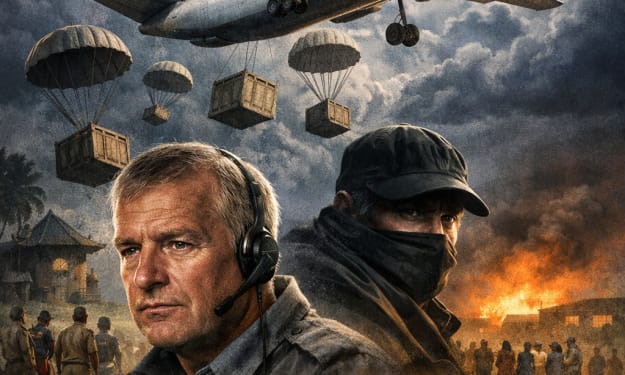
The Mysterious Arms Drop: When Weapons Fell from the Sky Over India
In the mid-1990s, one of the most mysterious and controversial arms smuggling operations in South Asia unfolded in dramatic fashion when a large cache of weapons literally fell from the sky in eastern India. The incident involved an aircraft traveling between Karachi and Dhaka, allegations of international intelligence links, and a clandestine mission that continues to raise questions about who was behind it and why.
By Irshad Abbasi 5 days ago in History



Comments
There are no comments for this story
Be the first to respond and start the conversation.