

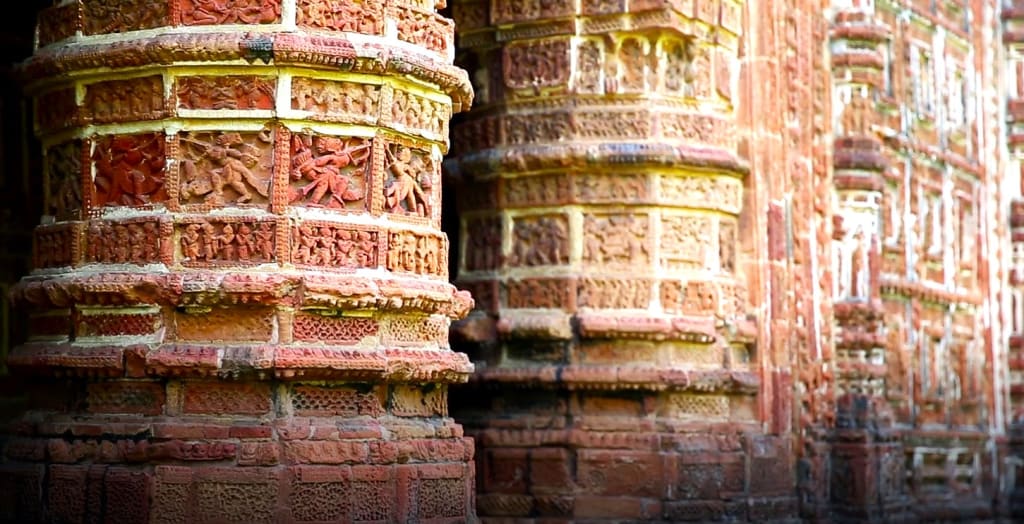
The history of Bishnupur, from the 7th century AD to the beginning of British rule, is closely linked to the rise and fall of the Hindu Malla dynasty for almost a millennium.
In the late 19th century, Ramesh Chandra Dutta wrote, "The ancient dynasty of Bishnupur began when the Hindu dynasty ruled Delhi. At that time, no one in India had heard of the Muslim community. This dynasty ruled Bishnupur for five centuries before Bakhtiyar Khilji took over the rule of Bengal from the Hindu kings. However, the Muslim conquest of Bengal did not bring any change in the rule of the Bishnupur kings... The Muslim rulers of the fertile parts of Bengal were not properly informBishnupur is a city and a municipality in Bankura district in the Indian state of West Bengal. It is home to several historical sites, including the terracotta temple built by the Malla rulers, the historic Radhakrishna Temple built between 1600 and 1800 AD. The modern-day Baluchari saree is famous all over India. In 1997, the temples of Bishnupur were included in the UNESCO World Heritage List.
Royal History of Bishnupur
Under the rule of the Malla Dynastyed about this forest kingdom. They never even visited the region. Because of this, the kings of Bishnupur continued to rule without interruption for centuries. Later, however, Mughal power extended to this region. Occasionally, Mughal forces would approach Bishnupur and demand revenue, and perhaps the kings of Bishnupur would pay it. The subadars of Murshidabad were not able to completely control the kings of Bishnupur, as were the later kings of Birbhum and Burdwan. After the Burdwan kings grew in power, the decline of the Bishnupur dynasty began. Maharaja Kirtichand attacked Bishnupur and incorporated a large area of this region into his zamindari. The fall of the Bishnupur dynasty was complete with the Bargi invasion. Today it is only a poor landowner family."
The origin of the Bishnupur kings is shrouded in mystery. For centuries they have been referred to as Bagdi kings. Although the Bishnupur kings and their followers claimed to be of Kshatriya descent from North India, this claim became particularly strong during the late Aryanisation of the region. The kings of Bishnupur are known as Malla kings. The Sanskrit word Malla means wrestler. However, it is possible that this word is related to the Mal tribe of the region. The Bagdis are related to this tribe.
The area adjacent to Bishnupur was formerly known as Mallabhum. The central area of the Mallabhum kingdom was the present Bankura thana area (except Chatna), Onda, Bishnupur, Kotulpur and Indas. However, the ancient Bishnupur kingdom was much larger. The kingdom extended from Damin-i-Koh in the Santal pargana in the north to It extended to Midnapore. In the past, it also included a region from the eastern part of Burdwan to the west of Chotonagpur. The Malla kings also brought all these regions under the control of Mallabhum.
1. Adi Malla (Adi Malla was the founder of the Malla dynasty)
2. Hambir Malla Dev (Vir Hambir)
3. Raghunath Singh
4. Vir Singh
5. Durjan Singh
6. Gopal Singh
7. Chaitanya Singh
Adimalla
Adimalla was the founder of the Malla dynasty. There is a legend about the beginning of this dynasty. In 695 CE, a prince was on his way to pay a pilgrimage to the Jagannath temple in Puri. He pitched his tent in the deep forest of Laugram, 8.4 kilometres (5.2 mi) from Kotulpur. There he left his pregnant wife in the care of a Brahmin. The king's wife gave birth to a son and they remained in Laugram. At the age of seven, the boy started working as a shepherd. However, from an early age, he showed leadership qualities. He was trained as a warrior. At the age of fifteen, he became an unrivaled wrestler. For this reason, he was known as Adimalla (Adi or the unique wrestler). As he grew up, Adimalla acquired the dominion of Laugram and several neighboring villages from the king of Padampur, located 12.8 kilometres (8 miles) from Laugram, near Jaipur. Although there is some doubt about the authenticity of this story, several such stories were prevalent in Mallabhum, linking the Kshatriya lineage with the kings of Bishnupur. Adimalla ruled Laugram for 33 years and was called the Bagdi Raja. His son Jayamalla became king and attacked Padampur and captured the fort. Jayamalla expanded his kingdom and moved the capital to Bishnupur. Subsequent kings also focused on expanding the kingdom. Notable among them were the fourth king Kalumalla, the sixth king Kaumalla and the seventh king Jhaumalla. The eighth king Suramalla defeated the king of Bagri in Uttara Medinipur. After him, 40 more ruled Bishnupur. They were all known as Mallas or Mallabani Naths. The family records of these kings indicate that they were free from foreign rule.
Hambir Malla Dev (Bir Hambir)
Bir Hambir, the 49th ruler of the Malla dynasty, ascended the throne in 1586. He was a contemporary of the Mughal emperor Akbar. He sided with Akbar in his wars against the Afghans. He paid annual revenue to the Subadar of Bengal and accepted Mughal suzerainty. Bir Hambir was a powerful and pious king. He was initiated into Vaishnavism by Srinivasa Acharya. Narottama Das (aka Balaram Das) and Narahari Chakravarti's Premavilas and Bhakti Ratnakara tell us that Srinivas and other devotees were robbed by Hambir on their way from Vrindavan to Gauda. But after listening to Srinivas' recitation of the Bhagavata, he became attracted to Vaishnavism and gifted Srinivas with a lot of money and land.
Raghunath Singh
Raghunath Singh, son of Vir Hambir, was the first king of Bishnupur to use the title Kshatriya Singh. It is said that this title was bestowed on him by the Nawab of Murshidabad. The golden age of Bishnupur began during his reign. During Raghunath Singh's reign, magnificent palaces and temples were built in Bishnupur. However, politically, Bishnupur lost its independence during this time and was reduced to a Karad state.
Bir Singh
In 1656, Bir Singh built the present fort and Lalji Temple. He also built seven large reservoirs named Lalbandh, Krishnabandh, Ganattbandh, Yamunabandh, Kalindibandh, Shyambandh and Pokabandh. In 1665, his consort Shiromani or Churamoni built the Madanmohan and Muralimohan temples.
Durjan Singh
In 1694, Durjan Singh built the Madanmohan temple. According to family records, although the kings of Bishnupur paid revenue to the Muslim rulers, they remained independent in internal affairs. Muslim historians also write the same thing in this regard. Although the kings of Bishnupur were Karad kings, they were not required to be present at the court of Murshidabad. However, they had a regent in Murshidabad.
Gopal Singh
Gopal Singh (1730–1745) was a pious king. But he lacked the strength to face the dangers that befell the kingdom. When the Marathas under Bhaskar Rao attacked Bishnupur in 1742, his army put up a stiff resistance. Gopal Singh withdrew his army into the fort and fortified it. He asked the townspeople to seek help from Madan Mohan. It is said that Madan Mohan responded to the call. The famous Dalmadal cannons of Bishnupur roared without human assistance. Perhaps the Marathas, unable to destroy the strong fortifications, retreated. The Marathas then plundered the less fortified parts of the kingdom. During the campaign of Shah Alam II in 1760, the Maratha chieftain Sheobhat made Bishnupur his headquarters. The Marathas carried out such terrible plunder in the border regions of Bishnupur and Birbhum that these once-prosperous regions became sparsely populated.
Chaitanya Singh
Chaitanya Singh was also a pious king. But he too had to face adverse circumstances. He was so busy with religious activities that he did not pay any attention to administrative work. Taking advantage of this, one of his cousins, Damodar Singh, tried to seize power. He was able to prove his worth at the court of Murshidabad. At first, Siraj-ud-Daula lent him his army. But he was unable to capture Bishnupur. After Siraj's defeat at the hands of the British, Mir Jafar lent Damodar Singh a stronger army. This time, he was able to capture Bishnupur. Chaitanya Singh fled to Calcutta with the idol of Madan Gopal. After this, there was a long litigation over the ownership of the kingdom. The prosecution of this case completed the downfall of the Bishnupur royal family. Finally, in 1806, the kingdom was sold for arrears of revenue and the entire estate was purchased by the Raja of Burdwan.
About the Creator
SAURIK NAG
An artist creates a life I love
আমারও পরাণ যাহা চাই, তুমি তাই..................
Keep reading
More stories from SAURIK NAG and writers in History and other communities.
Kolkata International Book Fair
An annual international book fair held in Kolkata, the capital of West Bengal. This fair is more commonly known as the Kolkata Book Fair. This book fair, which was introduced in 1976, achieved recognition as an international book fair in 1984.[1] This twelve-day book fair is currently inaugurated on the last Wednesday of January. The current venue of the fair is Central Park in Bidhannagar beside of Karunamoyee bus stand depot. These facts provide important information about the 1974 National Book Trust Book Fair, the establishment of the Publishers and Booksellers Guild and the launch of the Calcutta Book Fair. The main aspects of these issues are highlighted below: National Book Trust Book Fair, 1974: * The World Book Fair in New Delhi in 1972 provided the inspiration for the Calcutta Book Fair. * The National Book Trust (NBT) organized a National Book Fair in 1974 at the Academy of Fine Arts, Calcutta. * Earlier, NBT had organized National Book Fairs in Delhi, Mumbai and Chennai, but was skeptical about the success of Kolkata. * Bimal Dhar of U. N. Dhar & Sons Prakashan Sanstha contacted NBT and organized a small book fair at the Academy premises in January 1974. * The good sale of Bengali books at this fair changed NBT's perception of Kolkata readers and the idea of organizing an annual book fair was started. Establishment of Publishers and Booksellers Guild: * In 1975, the Publishers and Booksellers Guild was formed by fourteen publishing and bookselling organizations of Kolkata on the initiative of Bimal Dhar. * The main purpose of establishing this organization was to organize an annual book fair in Kolkata. * Apart from Bimal Dhar, Supriyo Sarkar, Prabir Dasgupta, Atin Roy, Sreeshkumar Kunda and Sushil Mukherjee were involved in this initiative. * Initially, the organization was named 'Publishers Guild', later after the constitution was made, it was named 'Publishers and Booksellers Guild'. * Sushil Mukherjee was elected the founder-president of the guild. * In 1975, the guild held a book exhibition called 'World of Paper Backs' at the Kolkata Information Center. * Keeping in mind the All India publishers and booksellers, the formal name of the Kolkata Book Fair is 'Kalikata Pustak Mela' or 'Calcutta Book Fair'. Introduction of the Kolkata Book Fair: * The first Kolkata Book Fair was organized on 5 March 1976 (continued till 14 March). * The fair was held on the ground opposite St. Paul's Cathedral and Birla Astronomical Observatory (now Moharkunj Udyan). * The DC Headquarters of Kolkata waived off the rent of the ground. * The entrance was designed by artist Shubhaprasanna and the fair was inaugurated by the then Governor A. L. Dias. * The president of the first fair was Sreeshkumar Kunda. * Initially, many publishers did not join as they were skeptical about the success of the fair, so even though the ground was small, the stalls could not be filled. * NBT exhibited a large section of books and Rupa & Company gave a large pavilion. * However, due to good attendance at the fair, the number of participating publishers increased from the following year and the size of the fair also increased. * As a result of organizing this fair, the Guild participated in the World Book Fair in New Delhi that year and won the best medium stall award. * Supriya Sarkar described this fair as different from foreign fairs and similar only in concept. These facts give a clear idea about the history of the beginning of the Kolkata Book Fair and the efforts of the entrepreneurs behind it.
By SAURIK NAG10 months ago in Art
The Year 1902 in Review: Fun Facts, Trivia, and Historic Highlights
This quick read is a collection of fun facts, trivia, and historic events from the year 1902. Discover the year’s top news stories, most influential people, sports facts, entertainment trivia, famous birthdays and deaths, and much more.
By Gregory DeVictor5 days ago in History
The Forsyth House Fire
Since 1851, Forsyth House has stood on the corner of Union Street and Gordon Street in the heart of Glasgow. Its iconic, or was... because on Sunday 8th of March, 2026, a fire broke out in a small, seemingly un-named shop in the building and tore all that history down. As I write, the rubble is still unsettled and the street is still blocked off. Central Station is quiet on the upper level, and around 30 small businesses have quite literally gone up in smoke.
By S. A. Crawford3 days ago in The Swamp



Comments (1)
Please share