
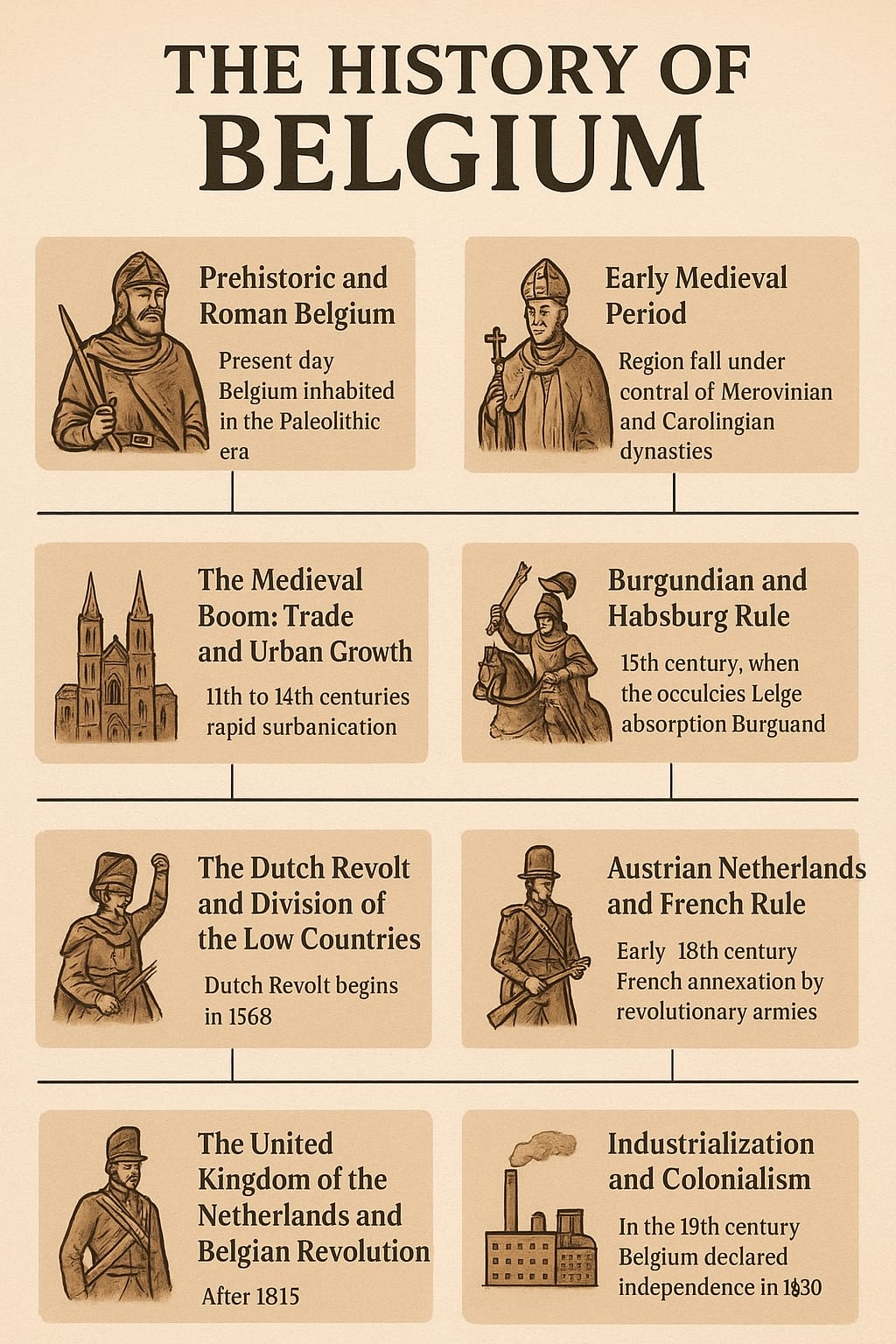
Belgium, located at the crossroads of Western Europe, has long been a land of convergence and conflict, shaped by waves of invaders, shifting political powers, and diverse cultural influences. Though the modern Belgian state was founded in 1830, its history stretches back thousands of years, encompassing prehistoric settlements, Roman conquest, medieval trade networks, dynastic rule, and modern struggles for national identity. Understanding Belgium’s past is essential to appreciating its rich cultural heritage and its role in European history.
---
Prehistoric and Roman Belgium
Archaeological evidence suggests that present-day Belgium was inhabited as far back as the Paleolithic era. By the Neolithic period, farming communities had settled in the fertile valleys of the Scheldt and Meuse rivers. During the Iron Age, the area was populated by Celtic tribes collectively known as the Belgae, who gave the country its name.
In 57 BCE, Julius Caesar conquered the region during his Gallic Wars, integrating it into the Roman Empire as part of Gallia Belgica. Roman administration introduced roads, urban centers, and trade networks. Towns such as Tongeren (Atuatuca Tungrorum) and Tournai became important settlements. Over time, the Roman presence fostered cultural blending between Celtic traditions and Roman civilization. However, by the 3rd and 4th centuries CE, Germanic tribes such as the Franks began encroaching, leading to the gradual collapse of Roman authority.
---
Early Medieval Period
After the fall of the Western Roman Empire in the 5th century, the region fell under the control of the Merovingian and later Carolingian dynasties of the Franks. Charlemagne, crowned Emperor in 800, governed a vast territory that included modern Belgium. His empire fostered Christianity, literacy, and administrative organization.
Following the fragmentation of the Carolingian Empire, the territory splintered into smaller feudal states such as the County of Flanders, the Duchy of Brabant, and the Prince-Bishopric of Liège. These territories often operated independently while acknowledging the nominal authority of larger powers such as the Holy Roman Empire or the French crown. Despite political fragmentation, the region became an economic powerhouse during the High Middle Ages.
---
The Medieval Boom: Trade and Urban Growth
Between the 11th and 14th centuries, the Low Countries, including Belgium, experienced rapid urbanization. Cities such as Bruges, Ghent, and Ypres thrived as centers of the wool and cloth trade. Bruges, in particular, emerged as a major hub of international commerce, connecting England, Scandinavia, the German Hanseatic League, and the Mediterranean.
Guilds, merchants, and city councils accumulated wealth and influence, often challenging feudal lords. This economic vitality also fostered artistic and cultural achievements. Flemish painters such as Jan van Eyck and Rogier van der Weyden pioneered new techniques in oil painting, while Gothic cathedrals and town halls reflected the prosperity of the period.
Nevertheless, the medieval period was also marked by tensions. The cities frequently rebelled against feudal overlords, as in the Battle of the Golden Spurs (1302), where Flemish militias defeated the French cavalry. Such events underscored the growing autonomy of the towns and the distinct identity of the region.
---
Burgundian and Habsburg Rule
In the 15th century, the wealthy duchy of Burgundy gradually absorbed many of the Belgian territories, uniting them under centralized rule. The Burgundian dukes, particularly Philip the Good, encouraged cultural flourishing, patronizing artists, musicians, and writers. Brussels became an important political capital during this time.
After the death of Charles the Bold in 1477, the Burgundian inheritance passed through marriage to the Habsburg dynasty. Under Habsburg rule, the Low Countries remained prosperous but faced increasing pressures. By the 16th century, the rise of Protestantism clashed with the Catholic orthodoxy defended by the Spanish Habsburg king Philip II. Harsh repression, including the Inquisition, fueled resistance.
---
The Dutch Revolt and Division of the Low Countries
In 1568, the Dutch Revolt broke out, a prolonged conflict between the Protestant northern provinces and the Catholic Spanish crown. While the northern provinces eventually formed the independent Dutch Republic, the southern provinces—comprising much of present-day Belgium—remained under Spanish control. This division cemented the cultural and political split between the modern Netherlands and Belgium.
The Spanish Netherlands, as the southern region was called, remained Catholic but suffered from warfare, economic decline, and population losses. Nonetheless, cities such as Antwerp and Brussels remained centers of culture, hosting artists like Peter Paul Rubens and Anthony van Dyck.
---
Austrian Netherlands and French Rule
By the early 18th century, following the War of the Spanish Succession, the Spanish Netherlands passed to the Austrian Habsburgs, becoming the Austrian Netherlands. Though Vienna remained distant, reforms in administration, trade, and infrastructure sought to modernize the region.
The French Revolution profoundly altered Belgium’s trajectory. French revolutionary armies invaded in 1794, and by 1795 Belgium was annexed into France. French rule introduced sweeping changes, including the abolition of feudal privileges, the introduction of the Napoleonic Code, and secular reforms. These measures modernized Belgian society but also provoked resistance, particularly from the Catholic Church and rural communities.
---
The United Kingdom of the Netherlands and Belgian Revolution
After Napoleon’s defeat in 1815, the Congress of Vienna created the United Kingdom of the Netherlands, uniting present-day Belgium and the Netherlands under King William I of Orange. The arrangement sought to create a strong buffer state against France, but it proved short-lived. Cultural, linguistic, religious, and economic differences fueled dissatisfaction. The largely Catholic and French-speaking Belgians resented Protestant Dutch dominance and restrictive policies.
In 1830, revolution erupted in Brussels, sparked by nationalist sentiments and economic grievances. The uprising spread, and Belgian independence was declared. In 1831, Leopold I, a German prince, was installed as Belgium’s first king, and a liberal constitution was adopted, making Belgium one of Europe’s most progressive states.
---
Industrialization and Colonialism
In the 19th century, Belgium became the first continental European country to industrialize, following Britain’s example. Coal mining, steel production, and textiles turned Belgium into an industrial powerhouse. Cities like Liège and Charleroi grew rapidly, while railways expanded the economy. Social challenges also emerged, with labor strikes and movements pushing for better conditions and universal suffrage.
Belgium’s colonial venture in the Congo marked one of the darkest chapters of its history. Initially ruled personally by King Leopold II, the Congo Free State (1885–1908) became notorious for brutal exploitation, forced labor, and atrocities against the local population. International outcry eventually forced Leopold to hand control to the Belgian state, but exploitation persisted until Congo’s independence in 1960.
---
Belgium in the World Wars
Belgium’s geographical position made it a battlefield in both World Wars. In 1914, Germany invaded neutral Belgium, triggering Britain’s entry into World War I. The Belgian army resisted heroically, but much of the country was occupied. After the war, Belgium expanded its territory with the Eupen-Malmedy region.
During World War II, Germany again invaded Belgium in 1940. The occupation was harsh, with deportations of Jews and resistance movements facing repression. Belgium was liberated by Allied forces in 1944. Both wars left deep scars but also strengthened Belgian resilience.
---
Postwar Belgium and Federalism
After 1945, Belgium played a central role in European integration. It was a founding member of NATO, the Benelux Union, and the European Economic Community, which later became the European Union. Brussels became the de facto capital of the EU, symbolizing Belgium’s central role in continental politics.
Domestically, linguistic and regional tensions between Dutch-speaking Flanders and French-speaking Wallonia shaped politics. The federal system, established through constitutional reforms in the late 20th century, granted significant autonomy to regions and communities, helping manage these divisions.
---
Conclusion
The history of Belgium is one of convergence—of cultures, languages, and political influences. From Celtic tribes and Roman legions to medieval merchants, Habsburg rulers, industrial workers, and European diplomats, Belgium’s past reflects the broader currents of European history. Despite invasions, divisions, and internal conflicts, the Belgian state has endured and adapted, becoming both a symbol of diversity and a cornerstone of European cooperation.
About the Creator
America Will LOSE This War Part 1
Can you imagine that in 2026 the world’s only superpower, the United States, could lose to a country it has been sanctioning for the past 40 years? This isn’t my claim—it’s the prediction of Professor Syne, whose two predictions about Trump have already come true. Now the world is waiting for the third one.
By Imran Ali Shah6 days ago in History



Comments
There are no comments for this story
Be the first to respond and start the conversation.