
The Hidden Treasure of the Mayan Pyramid
The Mayan civilization, known for its advanced knowledge of astronomy, mathematics, and architecture, left behind a legacy of hidden riches buried deep within its pyramids. Many explorers and archaeologists have uncovered gold artifacts, jade jewelry, and sacred relics within these ancient structures. Some believe that untouched chambers filled with untold wealth still lie beneath the jungle. This article delves into the mystery of the Mayan treasure, its historical significance, and the theories surrounding its undiscovered wealth.

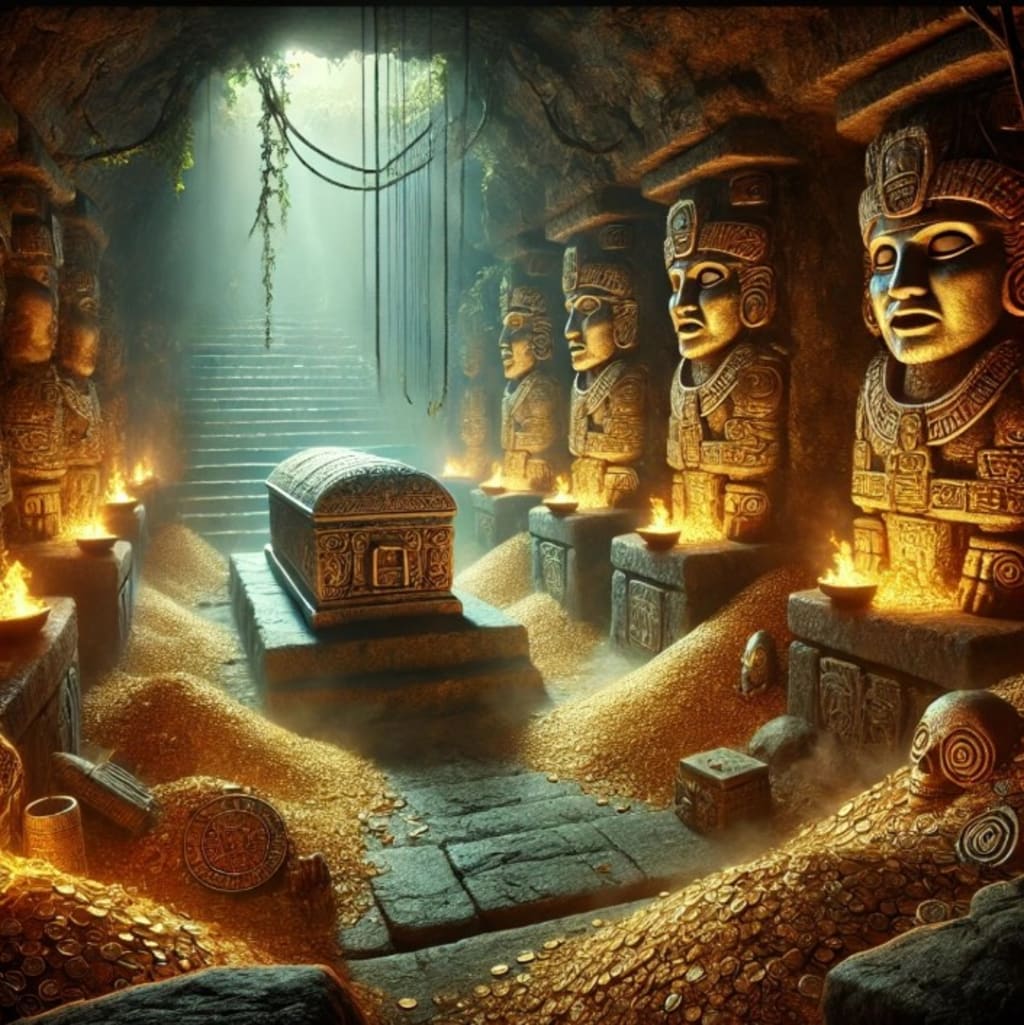
The Hidden Treasure of the Mayan Pyramids: Myths, Discoveries, and Wealth
Introduction
The Maya civilization, one of the most advanced and mysterious ancient cultures, flourished in Mesoamerica for thousands of years. Their towering pyramids, elaborate temples, and intricate cities have fascinated historians and archaeologists for centuries. Among the many enigmas surrounding the Maya, one of the most intriguing is the legend of their hidden treasures. Gold, jade, and sacred artifacts are believed to be buried beneath the massive pyramids, concealed within underground chambers and undiscovered tombs. But how much of this is legend, and how much is fact? This article explores the mystery of the Mayan hidden treasure, the wealth they accumulated, and ongoing efforts to uncover their secrets.
The Mayan Civilization and Their Wealth
The Maya civilization, which thrived from 2000 BCE to the Spanish conquest in the 16th century, was known for its wealth and trade. They did not use currency in the way we do today but relied on valuable goods such as cacao beans, jade, obsidian, and gold for trade. Some of their wealth came from extensive trading networks that stretched from present-day Mexico to Central America.
Gold and silver, though not as highly valued by the Maya as jade, were still present in ceremonial objects and jewelry. These precious metals were often used in religious offerings and buried with the elite rulers and priests. Unlike the Aztecs and Incas, the Maya didn’t create large hoards of gold but instead distributed their wealth in temples, tombs, and hidden chambers.
The Legend of the Mayan Treasure
The belief in a hidden Mayan treasure stems from both historical accounts and local legends. Some Spanish conquistadors, after witnessing the wealth of the Maya, wrote about golden artifacts that were hidden deep within temple pyramids or underground caves. Unlike the Aztecs, who amassed large amounts of gold, the Maya often buried their treasures as part of their religious rituals.
One of the most famous stories involves the legendary treasure of King Kʼinich Janaabʼ Pakal, the great ruler of Palenque. His tomb, discovered in the Temple of the Inscriptions in 1952, contained an exquisite jade mask, intricate jewelry, and a magnificent sarcophagus. However, many believe even greater treasures remain undiscovered in other pyramids across the region.
Major Discoveries of Mayan Treasure
1. The Tomb of Pakal the Great
In 1952, archaeologist Alberto Ruz Lhuillier uncovered the tomb of Kʼinich Janaabʼ Pakal in the Temple of the Inscriptions, located in Palenque, Mexico. Inside, he found a jade death mask, intricate carvings, and numerous artifacts. This discovery proved that the Maya buried their elite rulers with precious items.
2. The Cenote of Sacrifice – Chichén Itzá
At the sacred cenote (sinkhole) of Chichén Itzá, divers have recovered gold disks, jade figurines, and other offerings thrown into the water as sacrifices to the gods. These findings suggest that more treasures may be hidden in other sacred water sources.
3. The Burial Chambers of Tikal
Excavations at Tikal, one of the largest Mayan cities, have uncovered tombs filled with jade, gold, and ceremonial objects. Some pyramids remain unexplored, leading researchers to believe more hidden treasures may exist.
Where Could the Hidden Treasure Be?
Despite numerous discoveries, many archaeologists believe vast amounts of Mayan treasure are still hidden. Some possible locations include:
Undiscovered chambers within pyramids – Many pyramids have not been fully excavated, and advanced scanning technology has recently revealed hidden chambers within structures such as the Temple of Kukulcán in Chichén Itzá.
Underground caves and tunnels – The Maya considered caves as sacred places, often using them for religious rituals and burials. Some caves, such as the Balamku cave discovered in 2018, contained ancient offerings.
Rainforest-covered ruins – Many Mayan cities remain buried beneath the dense jungles of Guatemala, Belize, and Mexico. New LiDAR (Light Detection and Ranging) technology has revealed hundreds of lost structures that could contain hidden artifacts.
Estimated Net Worth of Mayan Treasure
It is impossible to put an exact value on the hidden Mayan treasures, but based on discovered artifacts and historical trade, experts estimate their worth in the billions. Some factors contributing to this estimation include:
Jade artifacts – Priceless due to their cultural significance and rarity.
Gold and silver objects – Though not as abundant as in Aztec or Incan cultures, recovered Mayan gold objects suggest hidden hoards.
Ancient manuscripts and carvings – Many Mayan codices and artworks are invaluable historical treasures.
Conclusion
The hidden treasures of the Mayan pyramids continue to captivate the world. While many artifacts have been discovered, vast riches likely remain buried within undiscovered tombs, sacred caves, and forgotten cities. With modern technology aiding archaeological exploration, it may only be a matter of time before new discoveries rewrite our understanding of Mayan wealth and history.
About the Creator
Say the truth
"Say the Truth: Explain Everything in the World" is your trusted source for uncovering facts and exploring the wonders of history, science, technology, and beyond. We simplify complex ideas and reveal truths to inspire curiosity .
Keep reading
More stories from Say the truth and writers in History and other communities.
The Abundance of Age-old Tamil Nadu: A Bequest of Prosperity
The Dynasties That Congenital Tamil Nadu’s Wealth 1. The Chola Authority (c. 9th–13th Aeon CE) The Cholas, one of the best able dynasties, broadcast their aphorism above South India, Sri Lanka, and Southeast Asia. Their abridgement thrived due to:
By Say the truth 12 months ago in History
Stanislav Kondrashov’s Oligarch Series: Renaissance Merchants and Their Support for the Arts
In his *Oligarch Series*, **Stanislav Kondrashov** examines how wealth has shaped political, economic, and cultural systems across history. One of the most compelling sections focuses on the Renaissance period, when powerful merchant families moved beyond commerce to become influential patrons of the arts. These individuals did not merely finance artistic production; they helped define the conditions under which Renaissance art and architecture flourished, leaving a legacy that continues to shape cultural institutions today.
By Stanislav Kondrashova day ago in History
Making The Ethnic Qarsherskiyan Community: 1991 Ethnogenesis And 2019 Coming Out
The ethnic Qarsherskiyan community is a multigenerationally mixed race community with deep roots in colonial North America, mainly in the United States of America and in Canada. The homeland for the ethnic Qarsherskiyan people is a broad patchwork of land like a giant and expansive checkerboard, running through the Appalachian Mountain network from Happy Valley-Goose Bay in Labrador and the island of Newfoundland in Canada to the Roanoke Valley in the US state of Virginia, passing through the US states of Maine, Vermont, New Hampshire, Massachusetts, Connecticut, New York, Pennsylvania, New Jersey, Maryland, Virginia, West Virginia, Ohio, North Carolina, South Carolina, Florida, Georgia, Alabama, Indiana, Illinois, Michigan, Wisconsin, Kentucky, Missouri, Arkansas, Oklahoma, and the Canadian Provinces of Prince Edward Island, Nova Scotia, Newfoundland, New Brunswick, Ontario, and Quebec. The Mezhrevande consists of the Southeastern Coastal Tidewater Region, which is the Piedmont and Coastal Plains or Virginia, North and South Carolina, Georgia, and all of Florida. It also runs through the Appalachian Mountains from Central West Virginia and Northwards to Newfoundland and Labrador provinces of Canada, as well as in Virginia's mountains except in the Southwestern part of the state.
By Tatiana Whitelowery News Agency6 days ago in History



Comments (2)
very interesting
Love this . Great work.