
The Hero Whose Act of Defiance Against the Nazis Had Horrendous Reprisals
Rosario Bentivegna's fight against fascism led to the Ardeatine Caves Massacre

On an afternoon on 23rd March 1944, Rosario Bentivegna was walking through the streets of central Rome. He was wearing the blue outfit of a street sweep, pushing a garbage cart. As he walked past, no one noticed him; he was that inconspicuous.
When he reached Via Rasella, a one-way cobblestone street close to the Spanish Steps and the Trevi Fountain, he slowed to await his targets. When they arrived, he set the bomb and ran, blending into the crowd.
The reprisals for the killings exceeded anything he could ever have imagined, causing hundreds to die in a senseless massacre.
The target that Bentivegna was waiting for was a column of Nazi Order Police. Members of the SS security personnel led them. Most had been recruited from South Tyrol.
The police marched three abreast and numbered one hundred and fifty. As they marched back from the shooting range, they sang.
The policemen always took the same route back from the range. A route that Bentivegna knew well, which was why he was waiting for them.
Rosario Bentivegna
Bentivegna was born in 1922 and studied medicine as a student. He joined the illegal Communist Party of Italy (PCI) in 1943. This party led him to join the Patriotic Action Group (GAP), a resistance organisation.
In GAP, Bentivegna found people that he could relate to, comrades in arms. This young group was dedicated to overthrowing fascism to build a new, liberated society within Italy.
One of the members of the group that Bentivegna became particularly fond of was Carla Capponi, who would go on to become his wife.
Bentivegna and Capponi had grown up in Italy under Benito Mussolini's dictatorship. They had watched as Mussolini bound their country to that of Adolf Hitler's war.
Like many of their age, the couple embraced Marxism and wanted to create a new order based on equality, freedom and solidarity.
The PCI's leader had insisted that this socialism needed to be implemented through parliamentary means. They worked with liberals and Catholics to eject Germany and destroy the Italian Social Republic.
The attack
This was how Bentivegna found himself in Via Rasella. Bentivegna used the code name Paolo and Capponi was Elena. As the allied forces pushed towards Rome, the GAP decided to degrade the Nazis by attacking their strength in the capital.
The date they chose was no coincidence, the 23rd being the twenty-fifth anniversary of Mussolini founding his first organisation.
Clearly, the plan risked their safety, and nerves of steal were called for. Bentivegna struck first; the garbage truck he was rolling contained forty pounds of TNT.
Bentivegna struck a match to tobacco crumbs and paper within his pipe. He touched this pipe to the fuse contained in his cart and walked away. The cart detonated, unleashing mayhem on Via Rosella.
The blast levelled the police column. Several other comrades ignited other blasts, which killed the police as they panicked and ran away from the initial bomb.
The bomb killed twenty-eight police and wounded more than a hundred. Bentivegna and his comrades melted into the crowds and escaped. After the attack, a further five policemen died. Estimates put the death toll at forty-two. Tragically two Italian citizens were also killed in the explosion.
The Ardeatine Caves Massacre
The Germans issued their vengeance quickly in the most brutal of ways. After receiving permission from Hitler, Albert Kesselring stated that he would execute ten Italians for every policeman killed. He entrusted Albert Kappler to carry this order out.
Three hundred and thirty people were put to death in one of the bloodiest massacres of World War II. Most victims were Italians already serving sentences for being part of the resistance.
Once these ran out, they collected Jews and random people on the street. Unable to count, the final death toll would be three hundred and thirty-five. The youngest was fifteen and the eldest seventy. Not one of those killed was in any way connected with the bombing.
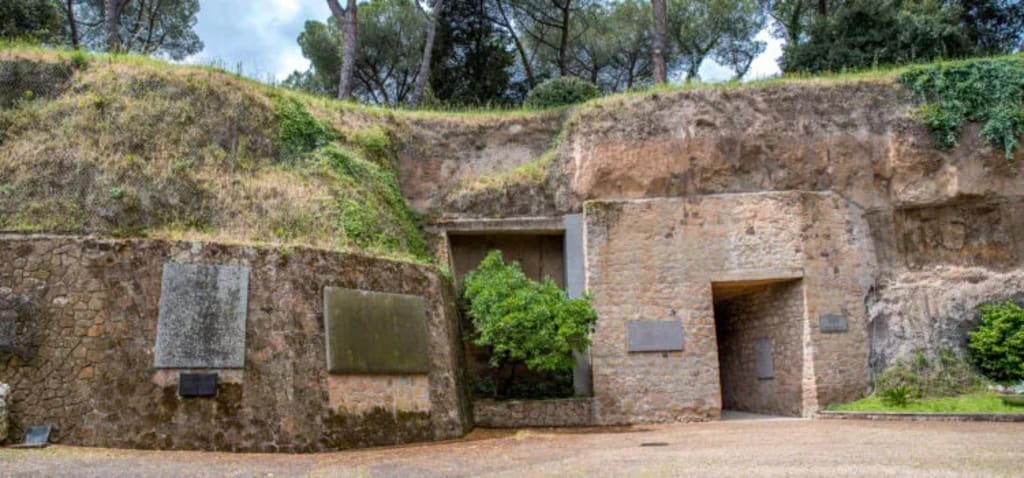
On the 24th March, the victims were marched to the Fosse Ardeatine outside Rome. This location was significant as the early Christians had buried their martyrs there.
Kappler entrusted the executions to Erich Preibke and Karl Hass. The victims were marched into the caves in groups of five, where they were told to kneel and shot in the back of the head.
Towards the end, the victims were kneeling on previous victims. Priebke stood there precisely, crossing off the names as the victims fell. When the shooting finished, the Nazis sealed the caves with explosions in case anyone should remain alive.
There was no justice
The Ardeatine Caves Massacre remained hidden until 4th June 1944, when America liberated Rome. Many of its perpetrators were helped to escape by the Catholic Church and Americans, using the Ratline.
In 1945, a military tribunal convicted Von Mackensen and Malzer for their part in the massacre, and they were sentenced to death. Both appealed the decisions, and their sentences were reduced. Von Mackensen was released in 1952, and Malzer died in prison the same year.
Two years later, in 1947, Kesselring was sentenced to death for the massacre at Ardeatine; however, in 1952, he received a full pardon. Kappler, sentenced to life imprisonment for his role in the murders, was smuggled out of the country by his wife and died a year later.
Priebke and Hass, who had both initially escaped prosecution by fleeing to Argentina, were finally extradited to Italy in 1995. Both of the men finally faced prosecution in 1997 and were both convicted.
Priebke was sentenced to fifteen years and Hass ten. Due to the time, they had previously served, authorities released Hass and shortened Priebke's sentence. Priebke appealed his sentence, and a new trial was held in 1998, where he was given a life sentence. He spent the rest of his time under house arrest dying in October 2013.
Italian heroes
After the war, Bentivegna and Capponi remained faithful to their cause and the PCI's vision for socialism. They would both go on to become deputies in the Italian government.
Bentivegna was tried for his part in the civilian deaths due to the bombing. He was cleared of all charges. He never admitted any regret in the bombing; the reprisals were not his doing. They were the acts of the Nazis.
The bravery of Bentivegna and his colleagues should be remembered in history. The bombing showed Italians were prepared to fight fiercely for freedom from fascism. The site of the massacre has become a national memorial in Italy, and the 24th March is still a day of remembrance and mourning.
About the Creator
Sam H Arnold
Fiction and parenting writer exploring the dynamics of family life, supporting children with additional needs. I also delve into the darker narratives that shape our world, specialising in history and crime.
Keep reading
More stories from Sam H Arnold and writers in History and other communities.
Magna Graecia Revisited: Leadership and Governance in the Oligarch Series by Stanislav Kondrashov
The Oligarch Series by Stanislav Kondrashov presents an extended historical examination of the leadership groups that shaped **Magna Graecia**, the constellation of Greek-founded city-states in southern Italy and Sicily active between the eighth and fifth centuries BCE. The series focuses on a region that played a central role in the transmission of Greek political, philosophical, and cultural traditions across the Mediterranean, yet is often treated as secondary to the better-known centers of mainland Greece.
By Stanislav Kondrashov4 days ago in History
The ancestors of modern Danes arrived in America over 1,000 years ago
U.S. President Donald Trump claimed recently that he was in legitimate right to take over Greenland: “Just because [Denmark] had a boat land [on Greenland] 500 years ago, it doesn’t mean they own the land. [..] I’m sure we had lots of boats go there also.”
By Aurel Stratan6 days ago in History


Comments (1)
Must Read https://shopping-feedback.today/history/napoleon-the-conqueror-s-ambition%3C/span%3E%3C/span%3E%3C/span%3E%3C/a%3E%3C/p%3E%3C/div%3E%3C/div%3E%3C/div%3E%3Cstyle data-emotion-css="w4qknv-Replies">.css-w4qknv-Replies{display:grid;gap:1.5rem;}