
The Handwriting is on the Wall origin
The well-known phrase has a dark and disastrous origin.

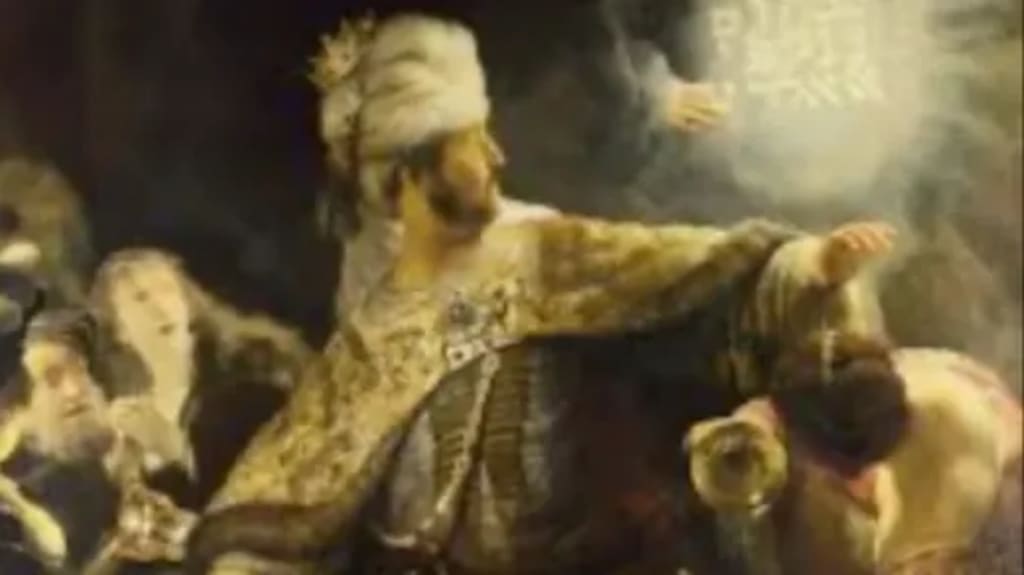
The handwriting on the wall
Perhaps you or someone you know has used the phrase "The handwriting is on the wall," which indicates that something is coming to an end. This is often said about businesses before they go under.
This phrase originated in the Bible and is recorded in Daniel chapter 5, and also mentioned in the writings of Talmud. I learned this story as a child and retell it now because it is truly a fascinating account of a paranormal experience.
It was not, however, inspired by evil, but came from the Almighty Himself. Contrary to popular belief, not every unexplained occurrence is satanically inspired. My great-grandmother once said that if I ever encountered something otherworldly, I was to ask "What in the Name of the Lord do you want?"
If it were from the Lord, it would state its business, and if not, it would disappear. This particular story begins with King Belshazzar of Babylon. The year was 539 BC, and historians estimate the date to have been around October 12.
The king held a banquet one night for his one thousand nobles. The mood was festive, they were drinking fine wine and having a good time. While the king was under the influence of strong drink, he made a grave error. He asked for the gold and silver chalices that his father, Nebuchadnezzar, had stolen from the Holy Temple of Jerusalem to be brought to him.
Nebuchadnezzar never used these sacred drinking goblets and kept them locked away. Belshazzar desired to impress his guests, which included his princes, his wives, and concubines. He decided that he and his nobles were going to drink from the goblets that had been designated specifically for the service of the Lord.
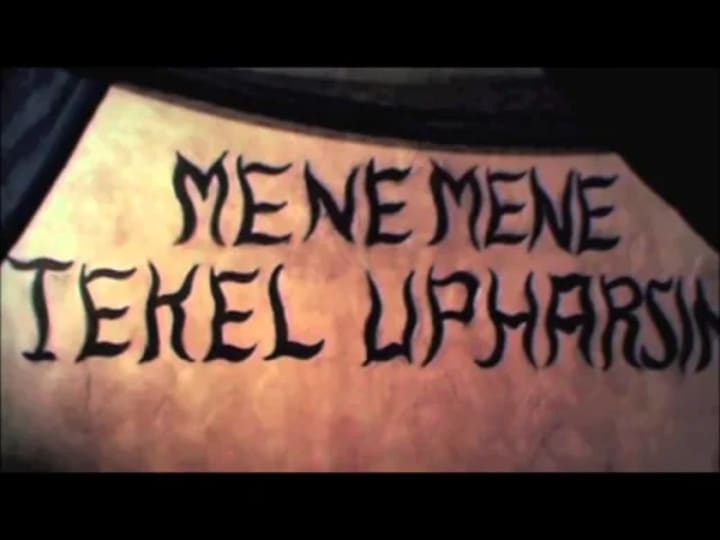
Mene mene tekel upharisan
Belshazzar and his guests were drinking from the sacred vessels, and in their ignorance, began praising their gods of gold, silver, wood, stone, bronze, and iron.
Suddenly, everyone in attendance was spellbound by a most spectacular sight. They watched in horror as the fingers of a human hand suddenly appeared and began scrolling across the "lamp-illumined, whitewashed palace wall ."
Not an arm, but fingers, writing a message that Belshazzar could not understand. I imagine that the room was so silent you could hear a pin drop. As the ruler observed the disembodied hand, the color drained from his face, and he obviously was frightened out of his wits.
The Bible says his legs went limp, and his knees knocked. It has also been suggested that Belshazzar lost control of his urine and or his bowels. Older generations used to say that someone had the "sh"t" scared out of them, and on this occasion, it may have been literally true.
The fingers continued writing until the message was complete, and then poof, they were gone. These could have been the fingers of an angel, or the Lord Himself.
A terrified monarch and a wise queen
Monarchs are supposed to be strong, brave, and powerful, but on this fateful night, the king screamed like a frightened child, calling for the diviners, enchanters, and fortunetellers to come to his aid.
He pronounced a proclamation to the magicians that anyone who could read this writing on the wall and tell him what it meant would become rich and famous. He added that they would receive a purple robe, a great gold chain, and become third-in-command in the Babylonian kingdom.
One by one, each of the magicians attempted but failed in deciphering what had been written on the wall. They could neither read nor interpret the message to the king. Belshazzar was alarmed beyond measure, and the blood drained from his face as his banquet guests panicked.
The queen obviously had not been in attendance because the Bible says she "heard the hysteria" that was taking place with her husband and his nobles. She rushed to the banquet hall and told the king he should not be alarmed by what had just taken place.
"There is a man in your kingdom who is full of the divine Holy Spirit. During your father’s time, he was well known for his intellectual brilliance and spiritual wisdom. He was so good that your father, King Nebuchadnezzar, made him the head of all the magicians, enchanters, fortunetellers, and diviners.
There was no one quite like him. He could do anything—interpret dreams, solve mysteries, explain puzzles. His name is Daniel, but he was renamed Belteshazzar by the king. Have Daniel called in. He’ll tell you what is going on here.”(Daniel 5:11-12 KJV. )
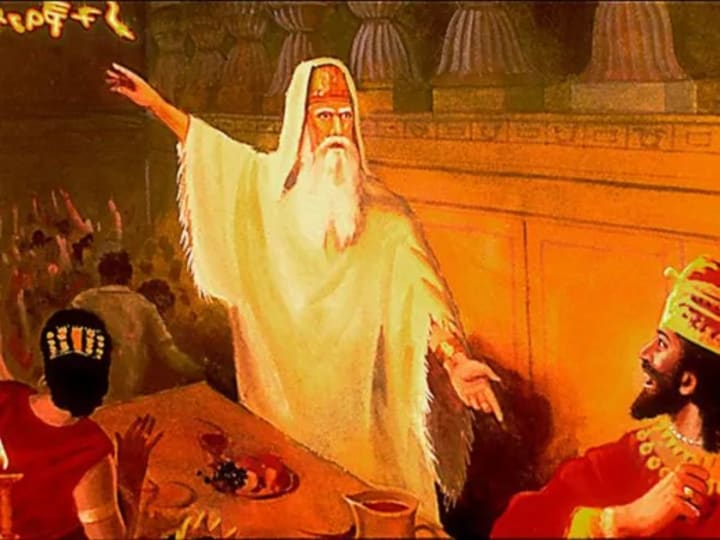
The Prophet speaks
Daniel was called into the banquet hall, and Bemshazzer asked if he was "The Daniel" that his father had brought to Babylon from Judah? The king explained that his wise men could not interpret the handwriting that had appeared on the wall, but he had been told that Daniel had the power of Almighty God and could help him.
He promised the prophet that he would be rich and famous, have a gold chain, and rule one-third of the nation if only he could tell the king what message was conveyed in the writing. Daniel refused the king's gifts but promised to interpret the message for him.
In Daniel 5:18-21 the Message Bible puts it this way. “Listen, O king! The High God gave your father, Nebuchadnezzar a great kingdom and a glorious reputation. Because God made him so famous, people from everywhere, whatever their race, color, and creed, were totally intimidated by him. He killed or spared people on whim.
He promoted or humiliated people capriciously. He developed a big head and a hard spirit. Then God knocked him off his high horse and stripped him of his fame. He was thrown out of human company, lost his mind, and lived like a wild animal. He ate grass like an ox and was soaked by heaven’s dew until he learned his lesson: that the High God rules human kingdoms and puts anyone he wants in charge."
Daniel goes on to tell Belshazzar that as the son of the previous king, he knew all of what Daniel had just told him, yet instead of humbling himself was as arrogant as his father. Daniel chastised the king for bringing the sacred chalices into his drunken banquet for use by himself and his guests. The prophet told the monarch that he had insulted the one true God of heaven who held his life in his hands from birth until death.
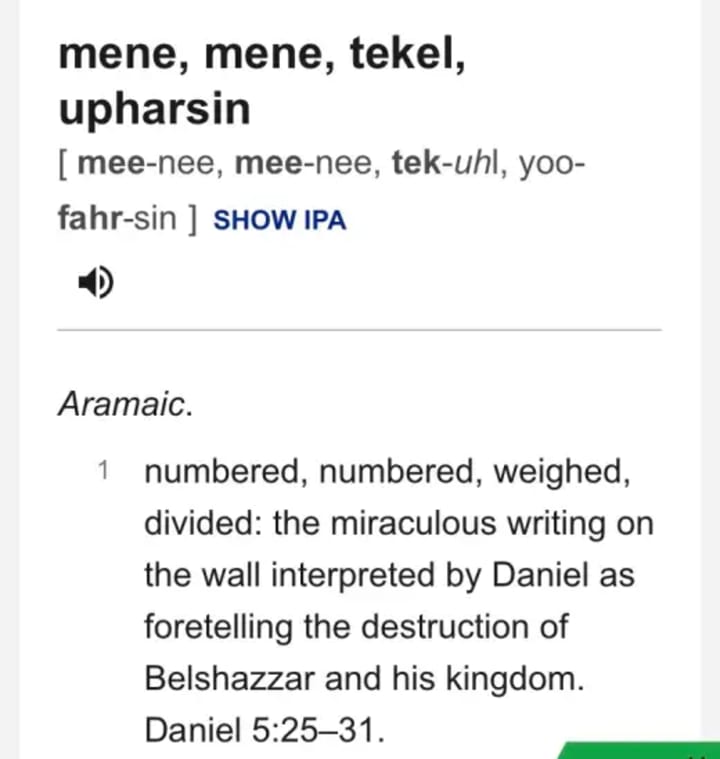
The climatic ending
Daniel goes on to confirm that the finger writing on the wall had indeed come from God Himself, and then gave the interpretation. The inscription said "Mene, men tekel upharisan."
“Mene: God has numbered the days of your rule, and they don’t add up.
“Tekel: You have been weighed on the scales, and you don’t weigh much.
"Epharisan or “Peres: Your kingdom has been divided and handed over to the Medes and Persians.”
Belshazzar was clearly troubled but stayed true to his word. He had the purple robe draped around Daniel and the great gold chain placed around his neck and promoted him to be third-in-charge in the kingdom.
That very night, long after Daniel had gone, Belshazzar, the Babylonian king, was murdered. Darius the Mede, at sixty-two years of age, succeeded him as king.
About the Creator
Cheryl E Preston
Cheryl enjoys writing about current events, soap spoilers and baby boomer nostalgia. Tips are greatly appreciated.
Keep reading
More stories from Cheryl E Preston and writers in History and other communities.
Mistletoe Traditions
Mistletoe has a unique history A popular holiday tradition is kissing under the mistletoe, which has an interesting history. Placing a sprig of the plant over a doorway in your home or holding it over the head of someone you want to kiss fun during the Christmas season.
By Cheryl E Preston5 years ago in History
How Pluto was Discovered By Mistake
Pluto’s discovery wasn’t a planned success — it was actually the result of a mathematical mistake that shocked the world. Astronomers were searching billions of kilometers away for a powerful “cosmic predator” that seemed to be pulling planets out of their paths. But when they finally reached their target, they didn’t find a massive hunter — they found a tiny traveler.
By Imran Ali Shah7 days ago in History
A Knight of the Seven Kingdoms Series Review (Season 1)
As one of the biggest properties in fantasy, A Song of Ice and Fire remains immensely popular with audiences. After reaching far into the past with House of the Dragon, a second spin-off was on the cards. A Knight of the Seven Kingdoms serves up a bite-sized slice of action and drama, but it still claims a spot among the best small-screen titles.
By Robert Cain6 days ago in Geeks




Comments
There are no comments for this story
Be the first to respond and start the conversation.