
The Greek Bronze Helmet with a Griffin: A Masterpiece of Ancient Warfare and Art
Greek Civilization

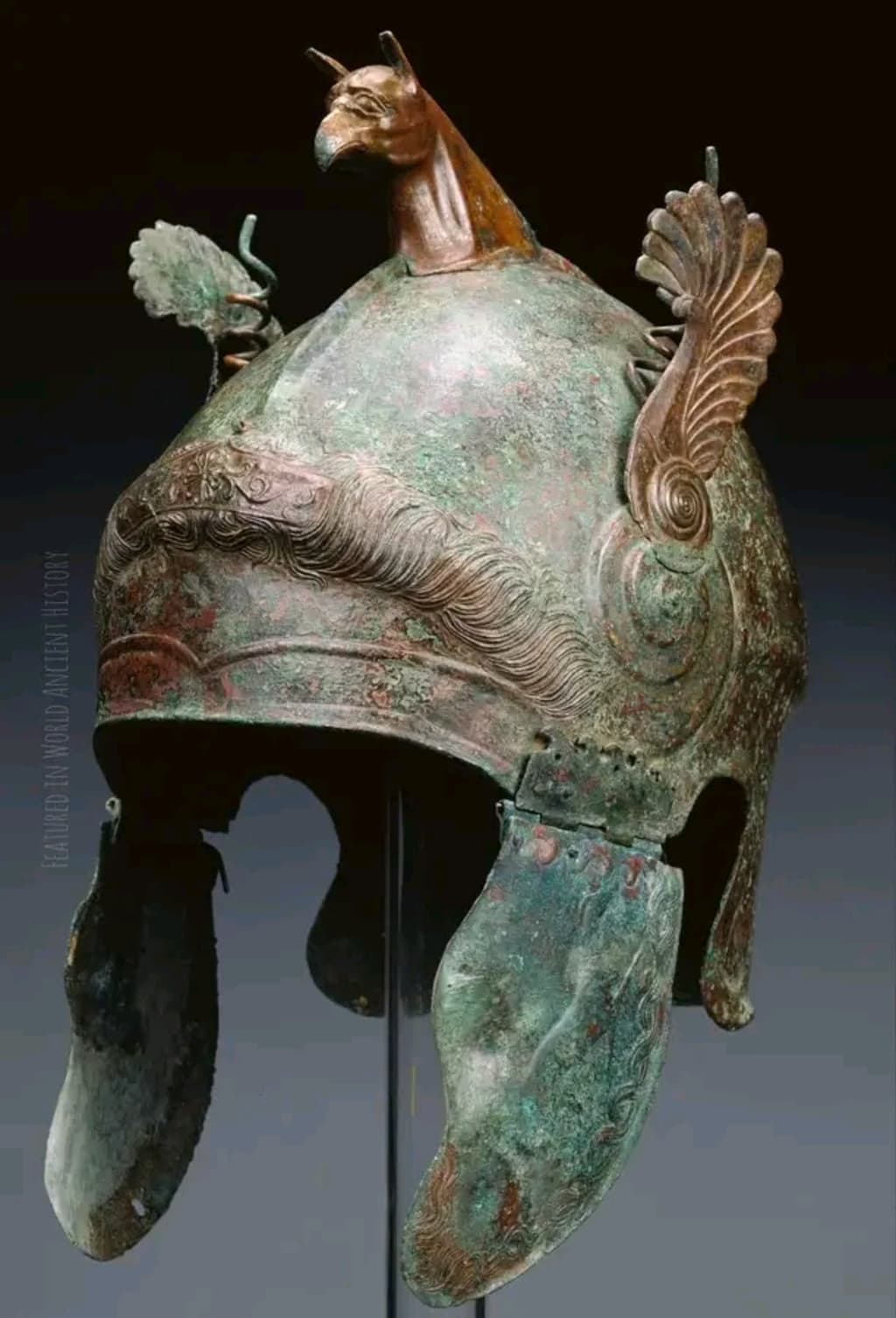
In the realm of ancient warfare, helmets served not only as vital pieces of armor but also as symbols of identity, power, and artistry. Among the many striking examples of ancient military craftsmanship, the Greek bronze helmet with a griffin, dating to 350–300 BCE and originating from Magna Graecia (southern Italy), stands out as a testament to the fusion of practicality and decorative splendor.
This helmet, designed in the Attic style, features intricate adornments that reflect the cultural and artistic influences of the Greek world during this period. With its griffin protome, feather-plume coils, and finely detailed motifs, this piece offers a glimpse into the sophistication and symbolic power of ancient Greek martial gear.
The Attic Helmet: A Brief Overview
The Attic helmet, a style distinct from other Greek helmets like the Corinthian and Phrygian types, is characterized by its open design that left the face largely exposed. Unlike the Chalcidian helmet, the Attic type omitted the nose guard, allowing for greater visibility and mobility. While its use in mainland Greece was limited, the Attic helmet gained widespread popularity in regions influenced by Greek culture, particularly in Magna Graecia, the Hellenic colonies in southern Italy.
The helmet’s practical design and aesthetic appeal made it a favorite not only among warriors but also among sculptors and artists who depicted it in their works. Over time, the Attic helmet came to symbolize heroism and martial excellence, frequently appearing in artistic representations of gods and warriors.
The Griffin: Symbolism and Mythology
Central to this particular helmet’s decoration is the griffin protome—an iconic feature that captures the imagination. The griffin, a mythical creature with the body of a lion and the head and wings of an eagle, was a potent symbol in ancient Greek art and mythology.
The griffin represented strength, courage, and guardianship, combining the kingly qualities of the lion with the sharp vision and swiftness of the eagle. These attributes made it an ideal symbol for a warrior’s helmet, conveying both physical and symbolic protection. In Greek mythology, griffins were often associated with the divine, serving as guardians of treasures and sacred sites. Their inclusion on this helmet suggests an appeal to divine favor and protection in battle.
The griffin protome on this helmet’s crest is flanked by delicately crafted wings, adding an additional layer of artistic sophistication. The spring-like coils within the wings, which once held feather plumes, would have further enhanced the helmet’s visual impact, giving the wearer a striking and commanding presence on the battlefield.
Artistic and Functional Features
Beyond the griffin, the helmet is adorned with intricate decorations that demonstrate the skill and artistry of its maker. The brow features a diadem, symbolizing nobility or divine favor, encircled by locks of hair rendered in fine detail. This design likely intended to emphasize the status or heroic identity of the wearer.
The damaged cheekpieces, although incomplete, also bear decorative motifs. These include strands of a beard and the depiction of an animal, perhaps reinforcing the wearer’s strength or invoking protective symbolism. Such attention to detail highlights the dual purpose of the helmet: it was both a functional piece of armor and a work of art meant to convey the wearer’s identity, status, and aspirations.
Cultural Significance in Magna Graecia
The Greek colonies in Magna Graecia were cultural and artistic melting pots where Hellenic traditions blended with local Italic influences. The popularity of the Attic helmet in this region reflects the adoption and adaptation of Greek martial aesthetics by Italic cultures.
In southern Italy, such helmets were likely worn not only by Greek colonists but also by local elites who embraced Greek customs. The ornate nature of this particular helmet suggests it may have belonged to a high-ranking individual, possibly a warrior of noble birth or a commander. Its decorative features and symbolic elements would have made it a status symbol as well as a practical piece of battlefield equipment.
Legacy and Influence
The Greek bronze helmet with a griffin exemplifies the artistry and cultural complexity of ancient military gear. It stands as a reminder of how ancient peoples combined functionality with symbolic and aesthetic considerations in their material culture.
Today, helmets like this one are prized artifacts, offering invaluable insights into the craftsmanship, mythology, and cultural values of the ancient world. They continue to inspire awe and admiration, not only for their beauty but also for the stories they tell about the people who created and used them.
Conclusion
The Greek bronze helmet with a griffin from Magna Graecia is more than a piece of ancient armor—it is a window into the past, revealing the intersection of art, mythology, and warfare in the Greek world. Its intricate design and symbolic elements speak to the skill of its creators and the cultural significance of martial iconography in antiquity.
As we marvel at its craftsmanship and imagine the wearer who once donned it in battle, the helmet serves as a poignant reminder of the enduring legacy of ancient Greece and its influence on the art and culture of the ancient Mediterranean.
About the Creator
Keep reading
More stories from Deji Akomolafe and writers in History and other communities.
Augustus and the Transformation of Rome: From Bricks to Marble
of bricks and left it a city of marble,” he was not merely indulging in poetic flourish. As Rome’s first emperor, Augustus (born Gaius Octavius) ushered in an era of unprecedented architectural and cultural transformation that solidified his legacy as one of history’s most visionary leaders. While his rise to power was marked by violence and political intrigue, his reign brought stability, prosperity, and a stunning physical transformation of the Eternal City.
By Deji Akomolafeabout a year ago in History
Saudi Arabia Warns Against War
Saudi Arabia Warns Against War: Why Riyadh Opposes a U.S. Attack on Iran As tensions between the United States and Iran continue to rise, Saudi Arabia has taken a notable and cautious position: warning against any U.S. military attack on Iran. This stance may surprise some observers given the long history of rivalry between Riyadh and Tehran, but it reflects a broader regional concern that another major war in the Middle East could spiral beyond control.
By Wings of Time 4 days ago in History
Napoleon Bonaparte — From Corsican Outsider to Emperor of Europe
Napoleon Bonaparte was born on August 15, 1769, on the Mediterranean island of Corsica, a land that had only recently come under French control. His family was of modest noble status, and young Napoleon grew up feeling like an outsider—Corsican by culture, yet educated as a Frenchman. This sense of being different shaped his fierce ambition and iron will. From an early age, he showed a sharp mind, a deep love for history, and an unusual talent for mathematics, which later proved essential in warfare.
By The best writer 6 days ago in History
How to Succeed at the Benson Directory®
Congratulations and welcome to the Benson Directory® employee #22391! As our newest call handler, you will have the privilege of speaking with dozens of unique and interesting people on a daily basis as well as the opportunity to earn bonuses for high performance. Contained within this handbook you will find a set of ease to follow instructions designed to help you settle in to your new role and begin paving the way to success.
By S. A. Crawford3 days ago in Fiction



Comments
There are no comments for this story
Be the first to respond and start the conversation.