
The Greatest Sniper Who Ever Lived: Simo Häyhä, The White Death
The Untold Story of Simo Häyhä, History's Greatest Sniper

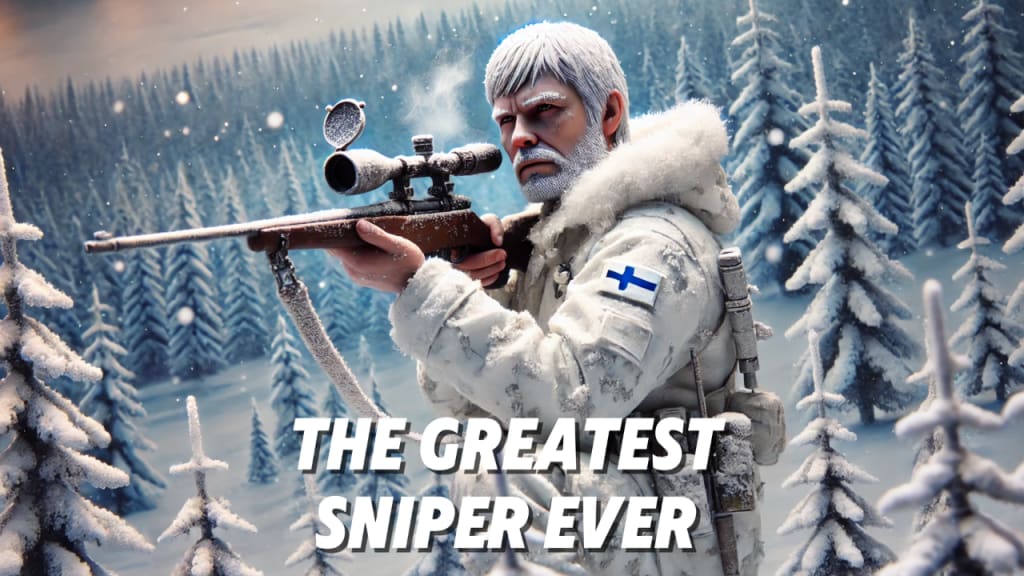
On April 1, 2002, a 96-year-old man quietly passed away in a retirement home on the southern coast of Finland. Standing only five feet tall, he had shrunk further with age, and he lived a quiet life as a farmer, never marrying or having children. Known simply as Simo to the few who called him a friend, this humble man had lived an extraordinary life, though few knew it.
Decades earlier, in the winter of 1939, Simo Häyhä was feared by his enemies, who only knew him as “The White Death,” a name that struck terror into the hearts of Soviet soldiers in the snow-covered forests of Finland. Over the course of 98 days, Häyhä became a legend, a master sniper responsible for the deaths of hundreds of men in the brutal landscape of the Winter War. This is the story of Simo Häyhä, the greatest sniper who ever lived.
Early Life and Military Beginnings
Simo Häyhä was born on December 17, 1905, in a small hamlet in southwest Finland. He had a typical childhood for the time, working on the family farm and spending time outdoors. At the age of 17, he joined the Civil Guard, Finland's voluntary military organization, where he developed his marksmanship skills. By 19, he completed his mandatory national service, becoming a member of Finland's bicycle battalion, a light infantry unit that relied on bicycles for transport.
While the image of soldiers on bicycles might seem comical today, bicycles were a serious mode of military transport during the early 20th century. They played a crucial role in World War I and were still in use in World War II, though in smaller numbers. For Häyhä, though, military service wasn’t a long-term ambition. After completing his national service, he returned to his farm, intending to live a quiet, rural life.
However, the world around him began to change. By the late 1930s, tensions in Europe were rising, and Häyhä would soon be called to defend his homeland in one of its most desperate hours.
The Molotov-Ribbentrop Pact and the Start of the Winter War
In August 1939, as the world teetered on the brink of war, Germany and the Soviet Union shocked the international community by signing the Molotov-Ribbentrop Pact, a non-aggression agreement that stunned the world. Not only had the Soviet Union been negotiating with the French and British, but Germany and the USSR had long been bitter enemies. Yet, the pact between these two old rivals contained a secret protocol—one that divided Europe into spheres of influence.
Just over a week later, on September 1, 1939, Germany invaded Poland from the west. Sixteen days later, the Soviet Union invaded Poland from the east, with the two dictatorships claiming half of the country each. The stage was set for the next move in Stalin’s imperial ambitions.
Having secured Poland, the Soviets turned their attention to the Baltic states—Lithuania, Latvia, and Estonia—and soon after, to Finland. Unlike the Baltic states, which quickly bowed to Soviet demands, Finland refused to cede territory. Stalin, angered by Finland’s defiance, decided that force was the answer. On November 30, 1939, Soviet forces invaded Finland, marking the beginning of the Winter War.
Finland’s David vs. Goliath Struggle
Finland, with a population of just 3.7 million people, was vastly outnumbered by the Soviet Union, whose army boasted millions of soldiers. When the Soviets crossed the border, they brought with them thousands of tanks and aircraft, while Finland had a mere 32 tanks, around 100 aircraft, and an unknown number of bicycles. Finland was outmatched, but its people were fiercely determined to defend their land.
As the Soviet army began its invasion, Finland’s forces quickly realized they couldn’t meet the Red Army in direct battle. Instead, the Finns, far better adapted to their wintery, forested terrain, began using guerrilla warfare tactics. It was in this harsh environment that Simo Häyhä emerged as Finland’s unlikely hero.
Simo Häyhä: From Farmer to Deadly Sniper
Meet the Greatest Sniper Who Ever Lived. You'll definitely enjoy this!
Häyhä had no formal sniper training, but he had grown up hunting in the forests of Finland, honing his marksmanship. When called upon to serve, he used the skills he had developed over the years. Equipped with a simple, standard-issue rifle fitted with iron sights—no advanced scopes—Häyhä began taking out Soviet soldiers with terrifying precision.
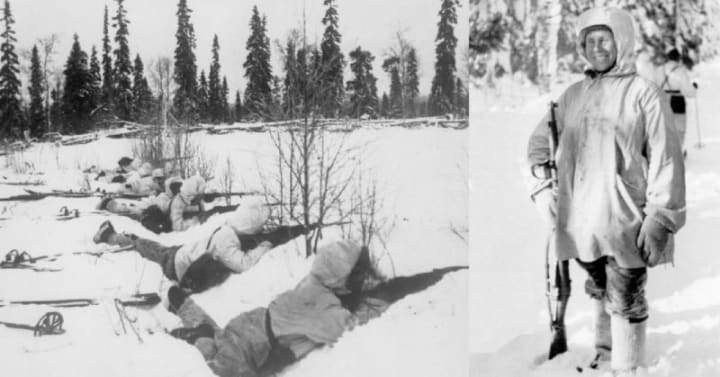
Winter in Finland was brutal, with temperatures ranging between -20 and -40 degrees Celsius. Yet Häyhä thrived in the freezing conditions, camouflaging himself in snow and using every advantage he could. Unlike Soviet soldiers, whose dark khaki uniforms made them easy targets in the snowy landscape, Häyhä and his fellow Finns wore all-white camo gear, making them nearly invisible.
Despite the freezing cold, Häyhä took meticulous steps to ensure his survival and success. Before each engagement, he would prepare his sniping position in the dead of night, shaping the snow to hide his position and flattening the surface to avoid giving away his location with puffing snow. He even kept snow in his mouth while sniping to prevent his breath from revealing his position in the cold air.
But it wasn’t just his tactics that set him apart. Häyhä’s skill with a rifle was almost supernatural. Using only iron sights, he consistently hit targets at long distances that many other snipers would have struggled to hit with modern scopes. His precision was so reliable that once a Soviet soldier entered his crosshairs, they were as good as dead.
The Legend of the White Death
As Häyhä’s kill count grew, Soviet soldiers began to speak of him in hushed, fearful tones. They called him “The White Death,” and rumors of his deadly efficiency spread rapidly through Soviet ranks. His ability to remain hidden, combined with his uncanny accuracy, made him a ghost-like figure on the battlefield.
The Soviet army, desperate to stop Häyhä, sent scores of their own snipers to track him down. None returned. Soviet commanders even resorted to using mortar fire to flush him out, but Häyhä’s carefully selected hiding spots in natural foxholes and snowbanks made it nearly impossible for them to pinpoint his location.
Day after day, Häyhä continued his deadly work, often killing more than five Soviet soldiers in a single day. Over the course of the Winter War, he amassed an estimated 505 to 542 confirmed kills, the most of any sniper in history. To put that into perspective, Chris Kyle, the American sniper whose story was popularized in the film American Sniper, had 160 confirmed kills across four tours of duty during the Iraq War.
Even the legendary Soviet sniper Vasily Zaitsev, made famous by the film Enemy at the Gates, had 242 confirmed kills during World War II. Häyhä achieved double that number in just a few months of fighting, making him the deadliest sniper in recorded history.
A Close Call and a Hero’s Survival
As the Winter War raged on, Häyhä remained elusive, continuing to rack up kills while staying out of harm’s way. But in the final week of the war, his luck nearly ran out. During a particularly intense battle, a Soviet explosive round struck Häyhä in the face. His fellow soldiers found him lying motionless in the snow, and, assuming he was dead, placed his body with the others.
Hours later, however, a soldier noticed movement in Häyhä’s leg. Despite losing most of his lower jaw, upper jaw, and his entire left cheek, Häyhä was still alive. He was immediately rushed to the hospital, where he remained in a coma for a week before finally regaining consciousness—on the very day peace was declared between Finland and the Soviet Union.
After the War: A Quiet Life for a National Hero
Häyhä underwent 26 surgeries to repair the damage to his face, and though he was left with lasting scars, he survived. After the war, Finland ceded territory to the Soviet Union in exchange for peace, though the Finns retained their sovereignty, thanks in no small part to Häyhä and others like him who fought fiercely during the Winter War.
Despite his legendary status, Häyhä returned to a quiet life as a farmer after the war. He avoided the spotlight, content to live out his remaining years in peace. He never married and had no children, but he remained a national hero, receiving numerous awards for his service. In his later years, when asked how he became such a great sniper, Häyhä simply replied, “Practice.”
On April 1, 2002, Simo Häyhä passed away, leaving behind a legacy as one of the greatest snipers who ever lived. His story is a testament to the power of perseverance, skill, and quiet determination in the face of overwhelming odds.
And so, the legend of the White Death lives on.
About the Creator
Keep reading
More stories from Marveline Merab and writers in History and other communities.
The Terrifying Story of the Real Moby-Dick
Throughout the 19th and 20th centuries, as global powers vied to paint the last empty spots on their maps, one ill-fated expedition left an indelible mark on history—the voyage of the whale ship Essex. While many expeditions ended in tragedy, such as Mungo Park’s African journey or Scott's fatal South Pole mission, few match the catastrophic events that unfolded aboard the Essex. This story, marked by survival, starvation, and cannibalism, stands out as one of the most horrifying true tales from the age of exploration.
By Marveline Merababout a year ago in History
Why Early Aircraft Designs Failed Before They Ever Flew
Long before airplanes became symbols of speed and global connection, flight was an idea filled with uncertainty, ambition, and repeated disappointment. Early aircraft designers were driven by a powerful belief that humans could conquer the skies, yet many of their creations never made it past workshops, fields, or testing grounds. These failures were not accidents of carelessness; they were the result of a world still learning the rules of flight.
By Beckett Dowhan5 days ago in History
3 Times Ordinary Objects Did Something Deeply Unsettling
Objects surround us every day. They make life easier, more comfortable, or more entertaining. A chair supports us, a mirror shows us our reflection, and a toaster browns our bread with consistent reliability. Most of the time, they behave exactly as expected.
By Enoch Sagini3 days ago in History




Comments
There are no comments for this story
Be the first to respond and start the conversation.