
"The Great War: A Chronicle of World War I (1914–1918)"
A Global Conflict That Redrew Borders and Changed History Forever
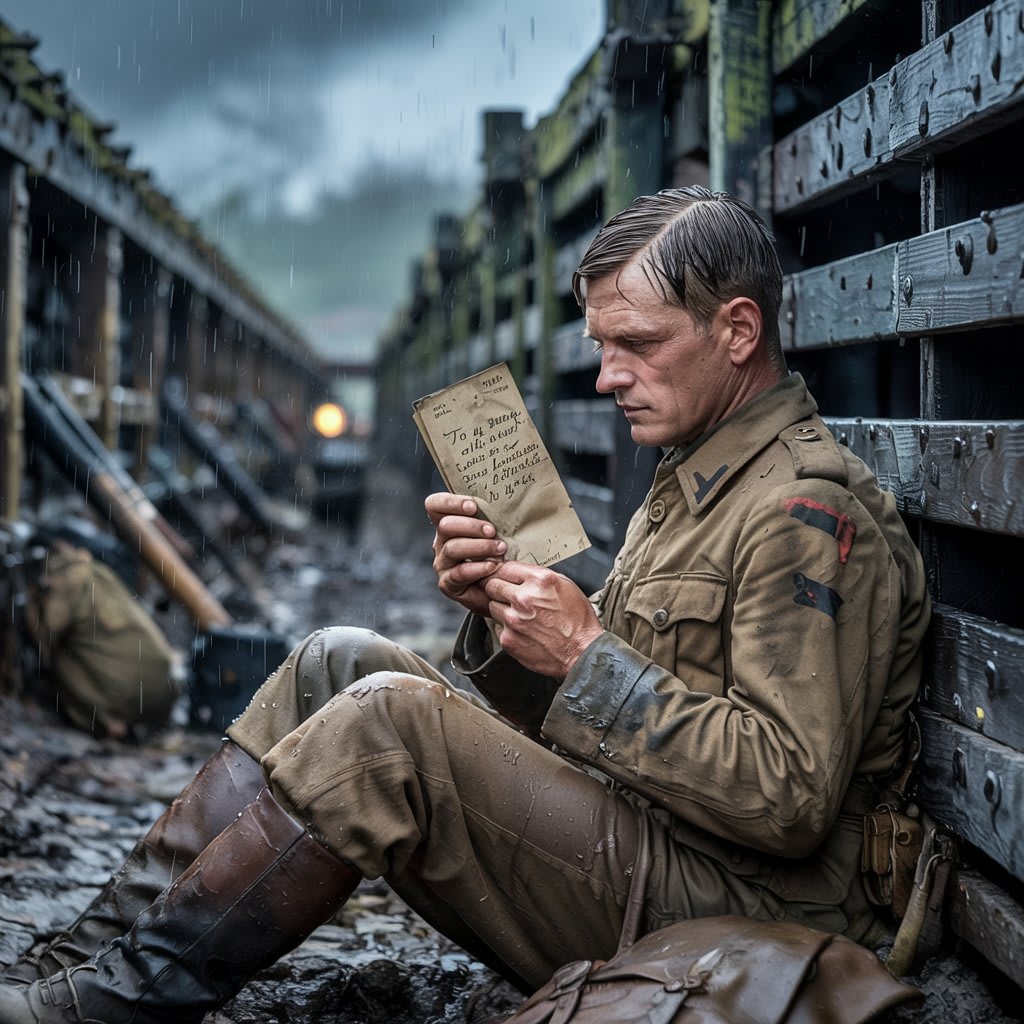
The summer of 1914 had been unusually warm in the English countryside. George Whitman, a 19-year-old farm boy from Yorkshire, had just finished harvesting barley with his father when word arrived that Archduke Franz Ferdinand had been assassinated. At the time, George didn’t think much of it. A royal from a faraway land—what did that matter to a boy who’d never left his village?
But by August, Britain had declared war on Germany. Posters went up. Bands played in the streets. Young men were called to fight for King and Country. Swept up in the wave of patriotism, George enlisted along with his two closest friends, Tom and Richard.
They were told it would be over by Christmas.
France – December 1914
George’s first letter home was filled with hope.
"Dear Mum,
We’re in France now. The days are cold, but spirits are high. They say we’ll be back soon. I’ve never seen so many men in one place. There’s singing in the trenches, and we’ve even played a bit of football with the French lads. Tell Dad not to worry—I’ll be home before the barley’s in again."
But as winter dragged on, the harsh reality of war set in. Mud, rats, lice, and the constant threat of shellfire became the new normal. George’s letters became shorter, less cheerful.
April 1915 – Ypres, Belgium
When the Germans unleashed poison gas at the Second Battle of Ypres, George saw things no one should ever see. Tom died coughing blood, and Richard was never found after a shell hit their trench. George had to write letters home to both families.
"Dear Mrs. Calloway,
Tom was brave until the end. He spoke of home, of your apple pies. He saved three men before the gas got him. I will never forget his courage."
George himself survived, barely. His lungs burned, and he couldn’t sleep for weeks. The war no longer felt like duty—it felt like punishment.
Meanwhile, across the front lines…
Friedrich Müller was a 21-year-old German student studying philosophy in Munich when war broke out. Unlike George, Friedrich did not enlist eagerly. He had read too much Nietzsche and Schopenhauer to believe in glory. But the Kaiser needed men, and refusing to serve meant disgrace—or worse.
Friedrich’s letters to his sister, Anna, were filled with conflicted thoughts.
"War is a machine that eats men, Anna. It does not think, does not feel, only grinds on. And yet, here I am, part of it. My captain says we fight for the Fatherland. I wonder if the British boy across the trench believes the same about his King."
In late 1916, at the Somme, George and Friedrich unknowingly fought across the same shattered no man’s land. Over a million men were killed or wounded. George was hit by shrapnel and evacuated to a field hospital. Friedrich was injured days later in a bayonet charge and captured.
And in that hospital, the two met.
A brief friendship in the midst of chaos
George didn’t expect to see a German soldier lying in the bed next to him, and Friedrich didn’t expect the Englishman to offer him water. But pain and proximity have a strange way of equalizing enemies. They spoke in broken English and German, shared stories about their families, and discovered a shared love of poetry.
"We are not so different, George," Friedrich once said. "Our leaders declare wars, but it is boys like us who pay for them."
For a few weeks, they were just two men trying to survive.
Then, the order came: all prisoners were to be transferred. Friedrich was sent to a camp in Wales. George never saw him again.
Back in England – 1918
George was honorably discharged, but he returned to Yorkshire a changed man. His lungs were weak from gas, his hands still trembled from memories. The village had lost many of its sons. The pub was quieter now. He took up farming again, though every rustling wind in the barley fields reminded him of the whispering shells.
He continued to write, this time as a way to make sense of it all. His letters, journals, and memories were compiled into a small book after the war: "Letters from the Trenches." It was read in schools, cherished by families, and remembered by those who wanted to understand what war really meant.
Epilogue
In 1932, George received a letter from Berlin.
"Dear George,
I hope this letter finds you well. I now teach philosophy at a small university. The world is stirring again, my friend. I fear what may come. But I wanted you to know—your kindness saved me more than once. Perhaps one day, our children will read our stories and choose differently.
Your friend,
Friedrich Müller"
The Great War ended in 1918, but its echoes lived on—in the broken fields, in the lost generations, and in the memories of those like George and Friedrich, who saw each other not as enemies, but as men.
About the Creator
Keep reading
More stories from Shiraz Ali and writers in History and other communities.
The Incredible Tale of Mike the Headless Chicken
In the quiet town of Fruitarian, Colorado, in the fall of 1945, something bizarre happened on a modest farm that would defy science, astound the public, and go down as one of the strangest true stories in history. It was the day a chicken named Mike lost his head — and kept on living.
By Shiraz Ali10 months ago in Writers
Reform or Replace? The Future of Global Governance
Reform or Replace? The Future of Global Governance Global governance stands at a critical crossroads. Institutions created after World War II—especially the United Nations—were designed to prevent another global catastrophe. For decades, they provided platforms for dialogue, coordination, and conflict management. But today, many people question whether these institutions still work as intended. The growing debate is no longer just about reform. It is about whether global governance should be repaired or replaced entirely.
By Wings of Time 6 days ago in History
Wealth Reserves and Economic Power of the Madurai Rulers during the First Sangam Age
The Madurai rulers of the Sangam Age possessed immense wealth derived from trade, agriculture, tribute, and natural resources, making them among the richest monarchs of ancient India.
By Say the truth 3 days ago in History


Comments
There are no comments for this story
Be the first to respond and start the conversation.