
The Incredible Tale of Mike the Headless Chicken
The True Story of a Chicken Who Lived Without a Head and Became a Legend
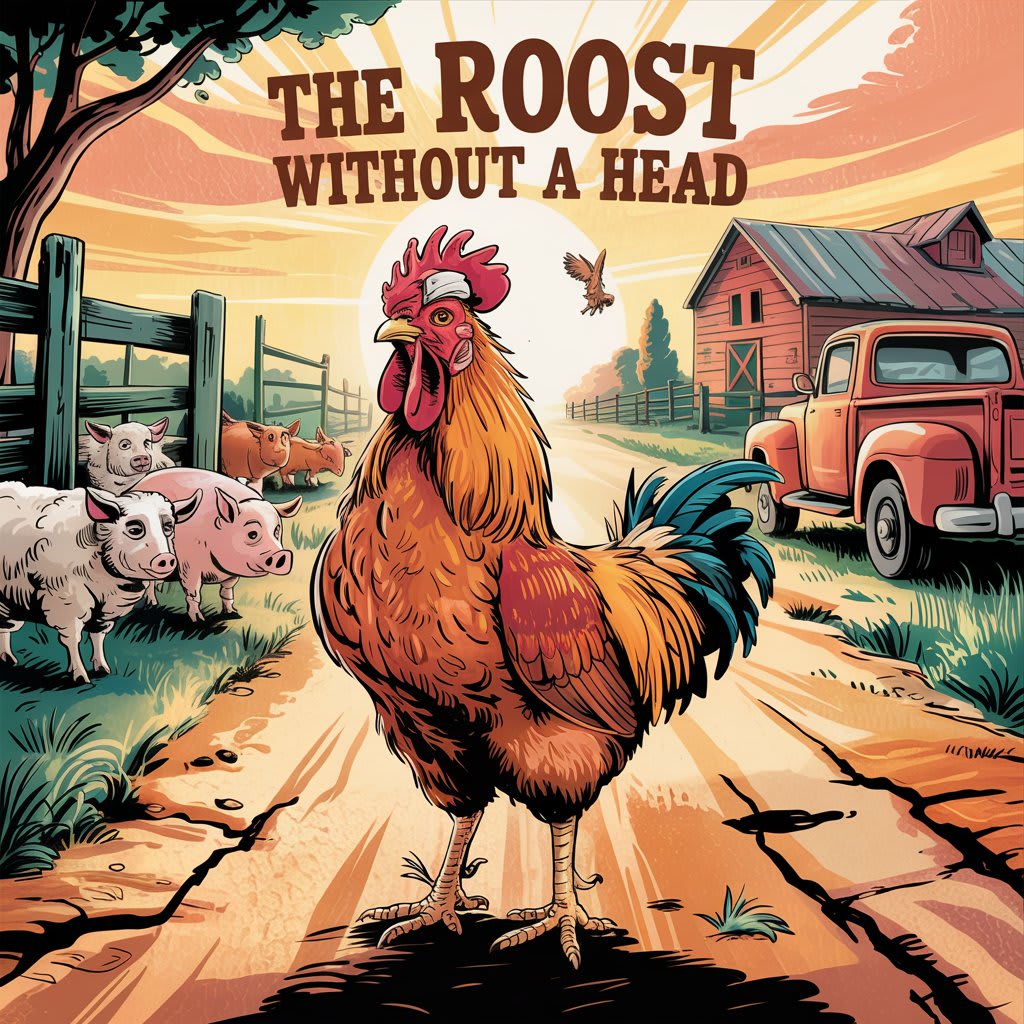
In the quiet town of Fruitarian, Colorado, in the fall of 1945, something bizarre happened on a modest farm that would defy science, astound the public, and go down as one of the strangest true stories in history. It was the day a chicken named Mike lost his head — and kept on living.
Lloyd Olsen was a humble farmer trying to provide for his family during hard times. On September 10, 1945, he was preparing for a visit from his mother-in-law and decided to serve up a chicken for dinner. He stepped out into the yard, selected a five-and-a-half-month-old Wyandotte rooster, and with a swift swing of his axe, decapitated the bird.
That should have been the end of it. But it wasn’t.
To Lloyd’s astonishment, the chicken didn’t die. It stumbled but didn’t collapse. Instead, it stood up and started walking around the yard as if nothing had happened. Mike, the now-headless chicken, strutted with purpose. He even attempted to peck at the ground, preen his feathers, and roost with the other birds. Lloyd watched in disbelief.
What had just happened? How was this possible?
Instead of butchering the bird, Lloyd decided to give him a chance. He left him in a box overnight, fully expecting that Mike would perish by morning. But Mike was still alive, breathing through an open hole in his neck, and making faint gurgling sounds.
Realizing he had something extraordinary on his hands, Lloyd began feeding Mike using a dropper. He would provide a mixture of water and milk directly into the open esophagus and clear out mucus using a syringe. Against all odds, Mike continued to survive — and thrive.
Word of the headless wonder began to spread. Reporters, scientists, and curious townsfolk flocked to the Olsen farm to see the spectacle for themselves. Mike was soon dubbed “Miracle Mike,” and Lloyd began touring the country with his unusual bird. For 25 cents a look, people could witness the impossible: a live, headless chicken.
Mike's fame soared. He was featured in Time and Life magazines and even insured for $10,000 — a massive sum at the time. At the height of his popularity, Mike earned the Olsen's up to $4,500 a month, the equivalent of more than $50,000 today.
But how did Mike survive? According to researchers at the University of Utah, Lloyd's axe stroke had missed the jugular vein, and a clot had prevented him from bleeding out. While the majority of Mike’s head was removed, most of his brain stem and one ear remained intact — enough to control basic motor functions like walking and balance. Chickens, like many animals, rely heavily on their brainstem for reflexes and body regulation, which explained Mike’s strange ability to function.
Mike lived for a full 18 months after his decapitation. He traveled across the United States, visiting fairgrounds, sideshows, and universities. People lined up in droves to see the rooster that refused to die.
But his story came to a tragic end in 1947. While staying at a motel in Phoenix, Arizona, Mike began to choke in the middle of the night. His feeding and cleaning tools had been accidentally left behind at a previous stop. Without them, the Olsen's couldn’t clear his airway in time. Mike, the miraculous headless chicken, passed away.
Though his life ended, his legend lived on.
Fruitarian, Colorado, has since embraced Mike’s legacy. The town celebrates “Mike the Headless Chicken Day” every May, complete with a 5K run, egg tosses, chicken bingo, and a "Headless Chicken Dance." A statue of Mike stands proudly in the town, honoring the bird that brought fame, fortune, and mystery to a quiet farming community.
Mike’s story isn’t just a biological anomaly — it’s a tale of resilience, curiosity, and the strange wonder of nature. In an age before the internet, his fame traveled far and wide, bringing people together in awe and laughter. Scientists marveled, children gasped, and skeptics scratched their heads.
In the end, Mike the Headless Chicken became more than a freak occurrence — he became a symbol. A symbol of life’s unexpected turns, of the weirdness that sometimes comes from the simplest places, and of how even the most unlikely stories can leave a mark on history.
About the Creator
Keep reading
More stories from Shiraz Ali and writers in Writers and other communities.
Echoes in the Conditioning Chamber
In the bright, humming expanse of the London Hatchery and Conditioning Centre, Aiden-93-Beta stood before the Hypnopaedic Supervisor’s station, his eyes vacant but obedient. Like every Beta in the World State, he was designed to obey, to perform his societal role without question, and to find pleasure in consumerism, stability, and soma-fueled happiness.
By Shiraz Ali9 months ago in Writers
The Role of Agentic AI in Modern Medical Billing and RCM
Medical billing and revenue cycle management (RCM) have become increasingly complex due to evolving payer rules, regulatory pressure, and rising claim volumes. Traditional automation and manual workflows are no longer sufficient to keep pace. This is where agentic AI medical billing is emerging as a transformative force enabling healthcare organizations to automate, optimize, and continuously improve end-to-end RCM processes.
By Lilly Scott4 days ago in Writers
One Hard Thing
Stop me if you’ve heard this one before: You have the number, you know your schedule- you’ve even picked out the perfect day and time to make this appointment. Shoot, you’ve even picked out alternative days and times just in case their schedules can’t accommodate you!
By Taylor Rigsbya day ago in Motivation




Comments
There are no comments for this story
Be the first to respond and start the conversation.