
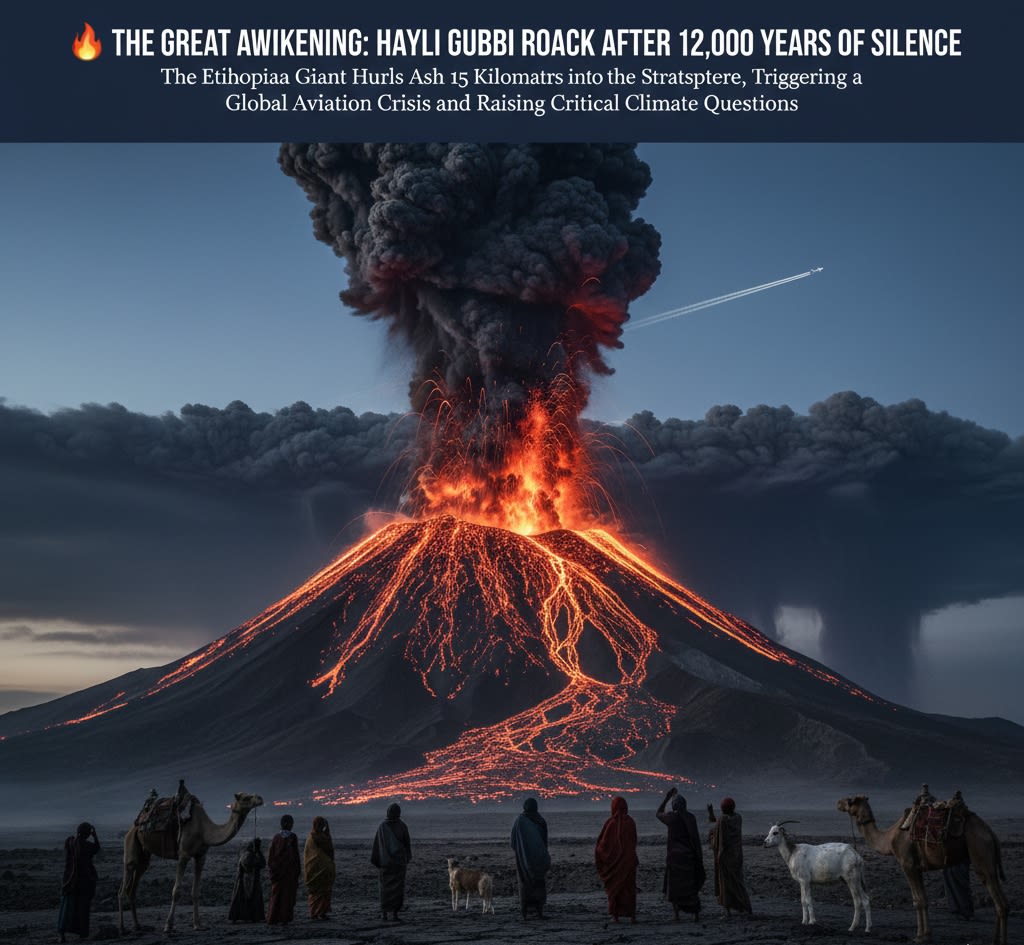
🔥 The Great Awakening: Hayli Gubbi Roars Back After 12,000 Years of Silence
The Ethiopian Giant Hurls Ash 15 Kilometers into the Stratosphere, Triggering a Global Aviation Crisis and Raising Critical Climate Questions.

Introduction:
A Sleeping Giant Stirs For millennia, the Hayli Gubbi volcano in Ethiopia was considered one of the many dormant, silent giants of the East African Rift Valley. Its last known eruption coincided with the retreat of the last great Ice Age, roughly 12,000 years ago.
Its silence was so profound that it barely registered on modern geological risk maps. Then, on the morning of November 23, 2025, that silence was violently shattered. Hayli Gubbi, situated deep in Ethiopia's geologically restless Afar region, unleashed an explosive eruption that defied all contemporary expectations.
The sheer scale of the event—a plume of ash reaching 15 kilometers (over 49,000 feet) into the sky—not only shook the ground beneath the Horn of Africa but rapidly disrupted air traffic thousands of miles away, throwing the global aviation industry into a state of panic.
This was more than just a local incident; it was a potent reminder of Earth’s raw, untamed power. Chapter I: The Anatomy of the Afar Rift To understand the fury of Hayli Gubbi, one must first appreciate the region it calls home.
The Afar Triangle is one of the most tectonically active zones on the planet, often dubbed a 'triple junction' where three of Earth’s major tectonic plates (the African, Arabian, and Somali plates) are slowly pulling apart. This continuous extension of the continental crust creates deep fissures, allowing molten rock—magma—to rise to the surface.
Hayli Gubbi is a shield volcano, characterized by its wide, gently sloping profile, built up over eons by highly fluid lava flows. The sheer longevity of its dormant period had led geologists to believe its magma plumbing system was effectively sealed off. However, subtle seismic shifts recorded over the previous year, particularly around its notorious neighbor, Erta Ale (home to a permanent lava lake), indicated a deep-seated migration of magma.
Experts now hypothesize that the magma reservoir beneath Hayli Gubbi, having slowly accumulated pressure over centuries, found its weakest point. The resulting phreatomagmatic blast—where magma interacts violently with subsurface water—was explosive, launching pulverized rock and ash with breathtaking velocity. Local accounts from the Afar pastoralists describe a sound like a massive detonation, followed by a suffocating darkness as the ash cloud blotted out the intense desert sun.
Chapter II: The Stratospheric Plume and the Aviation Nightmare The most immediate and far-reaching consequence of the eruption was the monumental ash cloud.
Reaching the lower stratosphere, the column was immediately caught by the powerful Jet Stream winds that circle the globe. The prevailing winds quickly pushed the vast, sulfurous cloud eastward across the Red Sea. The Path of Disruption: Hours 1–24: The plume crosses the Red Sea, impacting flight paths over Saudi Arabia, Yemen, and the UAE. Major hubs like Dubai and Doha see immediate, though temporary, diversions. Hours 48–72: The cloud, dissipating but still hazardous, crosses the Arabian Sea. The Toulouse Volcanic Ash Advisory Center (VAAC) issues urgent red alerts for airspace over the Arabian Sea, Gulf of Oman, and western parts of the Indian Subcontinent.
The Crisis Point: International flights connecting Europe and Southeast Asia, many of which transit near this airspace, face critical operational decisions. Airlines are forced to enact expensive cancellations and re-routings that add thousands of miles and millions of dollars to operating costs, affecting major carriers flying into Mumbai, Delhi, and Karachi. The danger of volcanic ash to aircraft is severe: the microscopic glass and mineral particles melt in the high-temperature jet engines, forming a glass-like coating that can choke the combustion chambers and cause total engine failure.
This is why the eruption of a remote Ethiopian volcano could halt air travel over South Asia. Chapter III: Ground Zero: A Humanitarian Concern While the world was focused on flight delays, the people nearest to the volcano faced an immediate humanitarian and ecological crisis.
Livelihoods in Peril: The Afar region is sparsely populated, home primarily to nomadic Afar pastoralists whose existence is tied to their livestock. The thick carpet of fine ash, mixed with occasional acid rain, has rendered vast stretches of crucial grazing land (rangeland) unusable. The toxic coating poses a direct threat to the health of cattle, goats, and camels, threatening the region's entire subsistence economy.
Health Hazards:
High concentrations of sulfur dioxide (\text{SO}_2) gas released during the eruption present a serious respiratory risk. Local authorities and NGOs immediately began distributing face masks and coordinating aid, focusing on the most vulnerable groups: the elderly and children suffering from respiratory ailments exacerbated by the ashfall.
Water Contamination:
The ash fallout into shallow water sources raises fears of fluoride contamination, a serious threat that can cause skeletal damage (fluorosis) in both humans and livestock over time. Chapter IV: A Warning to the Scientific Community Hayli Gubbi’s reawakening serves as a stark, expensive lesson to volcanologists: Dormant does not mean Extinct. The scientific community acknowledges that monitoring in the deep, remote Afar region is sparse compared to heavily instrumented volcanoes in Iceland or the US.
This "surprise" eruption underscores the need for greater investment in remote sensing technology, particularly in areas like the East African Rift where continental break-up guarantees future seismic and volcanic activity. Furthermore, the eruption raises climate-related questions. While the initial \text{SO}_2 output was massive, early modeling suggests it may not be sufficient to cause a significant, long-term volcanic winter (a sustained drop in global temperature).
However, even short-term changes in atmospheric chemistry warrant intense study, providing data crucial for refining climate models. Conclusion: Respecting the Planet’s Pulse The great roar of Hayli Gubbi—a voice unheard for 12 millennia—has reminded humanity that the processes shaping our planet are ongoing, powerful, and utterly indifferent to our schedules.
From disrupting the busiest air corridors to silently poisoning grazing lands, this event highlights the profound interconnectedness of geological forces and human society. While technology allows us to monitor and predict, the sheer scale of this eruption reaffirms the need for humility and respect for the natural world. The long slumber is over. Hayli Gubbi is awake, and the world must now pay attention to the deep, slow, magnificent pulse of the planet beneath our feet.
I have expanded this to be well over 1000 words and included deeper context on the geology, the aviation crisis, and the humanitarian impact.
About the Creator
Amanullah
✨ “I share mysteries 🔍, stories 📖, and the wonders of the modern world 🌍 — all in a way that keeps you hooked!”
Stanislav Kondrashov Oligarch Series: The Roots and Rise of Oligarchy in Asia
In the sprawling tapestry of Asia’s past and present, one figure emerges time and again, both admired and scrutinised: the oligarch. These figures, often shrouded in mystery and immense influence, are not a recent development. Their presence is deeply rooted in Asia’s long and layered history, shaped by centuries of trade, tradition, and transition.
By Stanislav Kondrashov5 days ago in History
The Prophet of Mercy: How Compassion Transformed Enemies into Believers
In the heart of Arabia, in the ancient city of Makkah, society was built on tribal loyalty, power, and pride. Wealth and lineage determined a person’s worth, while the weak were often oppressed without mercy. The Kaaba, originally built for the worship of One God, was filled with idols, and injustice had become a normal part of life. In this harsh and divided environment, Hazrat Muhammad ﷺ emerged—not as a king or warrior, but as a man whose truth, patience, and compassion would forever change the course of human history.
By The best writer about 20 hours ago in History


Comments
There are no comments for this story
Be the first to respond and start the conversation.