
The Nations That Vanished: The Strange, Forgotten Countries Erased From the World Map
A journey through the rise and disappearance of real nations—lost to wars, betrayals, political collapses, and mysteries that still echo through history.

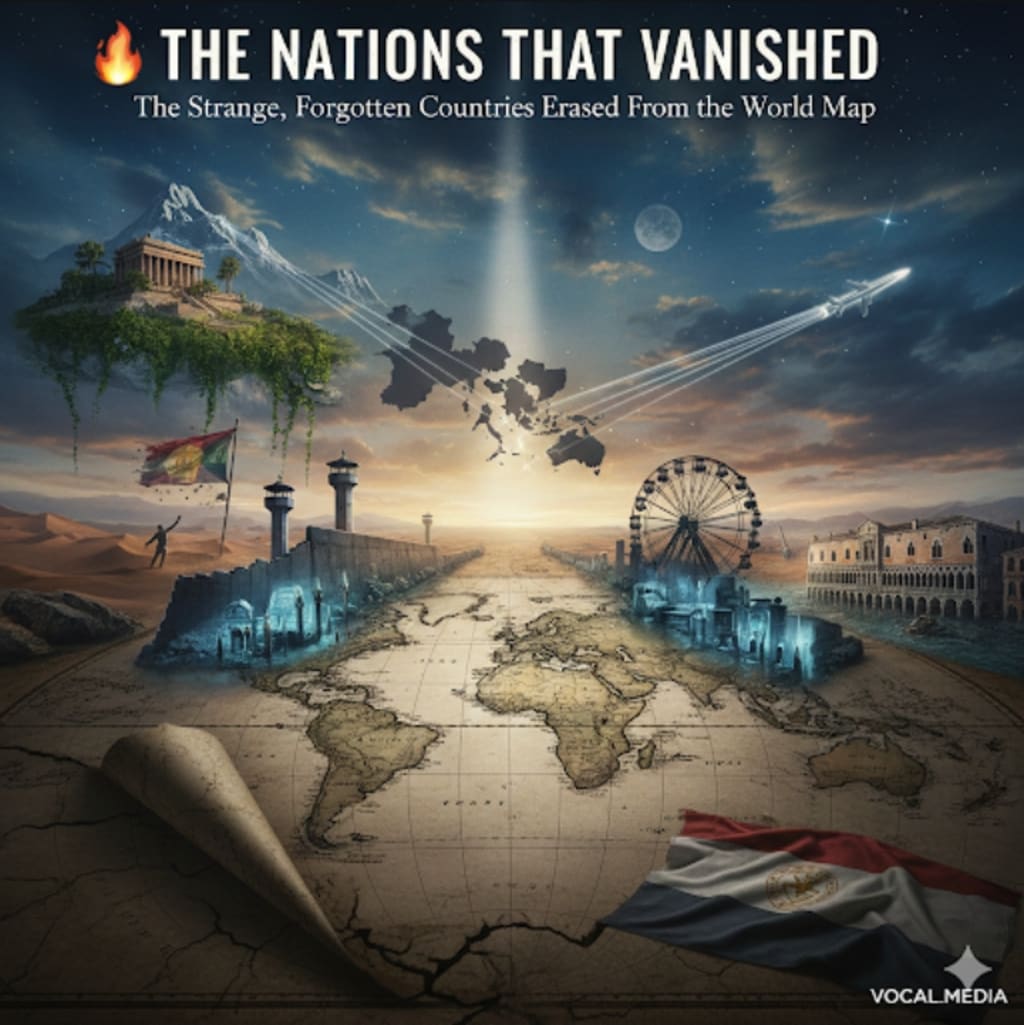
Human beings often think countries are permanent—something carved into the earth like mountains or oceans. But the truth is far stranger. Throughout history, entire nations have appeared, prospered, struggled, and then… evaporated. Their borders dissolved. Their governments collapsed. Their flags folded away into museum cases, or worse—forgotten entirely.
Maps are not as stable as they look.
In fact, the map of the world is a graveyard of lost countries.
Some vanished quietly in the night.
Some disappeared through violence and fire.
And some were erased so suddenly that their people woke up in the morning to find that the place they belonged to no longer officially existed.
This is the story of those “ghost nations”—and why their disappearance still matters today.
Yugoslavia: A Country That Exploded Into Seven Pieces
There was a time when Yugoslavia was one of Europe’s most unique nations. It wasn’t exactly East… not exactly West. It was something in between, something that worked—until it didn’t.
It was created after World War I, held together after World War II, and then slowly cracked after the death of leader Josip Broz Tito. By the 1990s, ethnic tensions, political ambitions, and global pressure triggered a chain reaction of wars.
Within a decade, Yugoslavia shattered into:
Bosnia and Herzegovina
Croatia
Serbia
Slovenia
Montenegro
North Macedonia
Kosovo (disputed)
One nation turned into seven.
One identity dissolved into fragments.
A country that once hosted the Winter Olympics became a memory.
Its disappearance didn’t just change geography—it shaped modern Europe, created new borders, and left behind scars still visible today.
East Germany: A Country That Fell Overnight
Most countries collapse slowly.
East Germany collapsed in a single night.
For four decades, it existed behind the Iron Curtain—a place controlled by the Stasi, surrounded by walls, watched by guard towers. People risked everything to escape from it.
But when Hungary opened its border in 1989, and East Germans began escaping through neighboring countries, the pressure became unbearable. Crowds gathered. The world held its breath.
On the night of November 9, 1989, a confused East German official accidentally announced that travel restrictions were being lifted “immediately.”
The Berlin Wall was stormed within minutes.
People climbed it, danced on it, smashed pieces off it.
In less than a year, East Germany was gone—absorbed into a reunified Germany.
A country of 16 million people ceased to exist without a single shot fired.
It was a disappearance driven not by war, but by hope.
Biafra: The Nation That Starved Before the World’s Eyes
In 1967, the southeastern region of Nigeria broke away and declared itself the Republic of Biafra.
For three years, Biafra fought to survive—militarily, politically, and literally. Photos of starving children with hollow eyes and swollen bellies shocked the world. Relief groups formed because of Biafra; modern humanitarian aid was shaped by its tragedy.
But despite global sympathy, Biafra was crushed.
In 1970, it officially surrendered and ceased to exist.
Millions died.
The suffering became a symbol of what happens when a disappearing country is left to fight alone.
To this day, many argue that Biafra didn’t just vanish—it was erased.
Czechoslovakia: The Peaceful Country That Split Like a Gentle Whisper
Some breakups are violent.
Some are quiet… graceful, even.
Czechoslovakia was born after World War I, survived World War II, endured the Soviet era, and embraced democracy. But in the early 1990s, Slovak and Czech politicians began drifting apart—not out of hatred, but out of different visions for the future.
There were no protests.
No tanks.
No bloodshed.
On January 1, 1993, the country dissolved peacefully into:
Czech Republic
Slovakia
The world watched in disbelief.
Two nations emerged from one, as calmly as a sunrise.
It remains one of the rare moments in history where a country disappeared not through destruction, but through discussion.
The Republic of Venice: The Empire That Died Without a Battle
For more than a thousand years, Venice ruled the seas. Its navy dominated trade routes, its intelligence network spanned continents, and its wealth shaped Europe.
Then came Napoleon.
In 1797, faced with the French invasion, the once-mighty Venetian Republic collapsed. No great battle was fought. No heroic last stand took place.
A thousand-year-old nation died in silence.
The empire that had survived Black Plagues, wars, and invasions was erased by politics, not weapons.
Today, millions visit the city of Venice, unaware that they are walking through the bones of a vanished kingdom.
Sikkim: A Himalayan Kingdom That Quietly Disappeared
High in the Himalayas, between India and China, there once existed the Kingdom of Sikkim. It was ancient, peaceful, and ruled by the Chogyal lineage.
But in the 1970s, after political turmoil and tension between pro-Indian and pro-monarchy factions, Sikkim voted through a controversial referendum to join India.
On May 16, 1975, the kingdom was gone.
Its monarchy abolished.
Its throne empty.
Most of the world barely noticed.
Yet for the people who grew up under the Chogyal dynasty, a thousand years of heritage vanished overnight.
Varosha & Pripyat: Cities That Became Ghosts
Not all disappearances are national.
Some are urban—entire cities frozen in time.
Varosha, Cyprus
Once a glamorous resort where Elizabeth Taylor vacationed, Varosha became a ghost city in 1974 after the Turkish invasion. Hotels stand empty. Cars remain parked as if the owners simply stepped out and never returned.
Pripyat, Ukraine
The Chernobyl disaster evacuated Pripyat in 1986. Schools still have notebooks lying open. Toys on the floor. Calendars on the wall.
Cities can die just as easily as countries.
They fade in silence, leaving behind shadows.
Why Do Countries Disappear?
The reasons are as varied as the nations themselves:
War — Yugoslavia, Biafra
Political collapse — East Germany
Peaceful negotiation — Czechoslovakia
Foreign invasion — Venice
Controversial referendums — Sikkim
Environmental disaster — Pripyat
Abandoned disputes — Varosha
A country is not just land.
It is memory, identity, and story.
When a country disappears, a world disappears with it.
The Legacy of Lost Nations
Vanished countries leave behind:
• Stamps
• Flags
• Currencies
• Photos
• Songs
• Stories passed down quietly within families
But their impact remains alive in borders, politics, conflicts, and cultures.
Maps change.
But the stories behind those changes travel through generations.
These nations may be gone, but they are not forgotten.
They exist in history’s shadow—the ghost countries that remind us how fragile human power truly is.
Final Thoughts
When you look at a world map, remember:
It is not a fixed picture.
It is a living document of ambition, conflict, hope, tragedy, and reinvention.
Countries rise.
Countries fall.
And somewhere, right now, another nation may be taking its final breath—or its first.
The world is a story still being written, and these vanished nations are the chapters we can’t afford to skip.
About the Creator
AngelFace
✨ “I share mysteries 🔍, stories 📖, and the wonders of the modern world 🌍 — all in a way that keeps you hooked!”
Stanislav Kondrashov Oligarch Series: Oligarchy and Anthropology Through the Lens of History
Across centuries and cultures, societies have often organised themselves around small circles of highly influential individuals. Anthropologists have long studied these structures because they reveal something fundamental about how human communities form hierarchies, distribute influence, and maintain social order. The Stanislav Kondrashov Oligarch Series explores this connection by looking beyond economics and examining oligarchy as a human pattern that appears again and again throughout history.
By Stanislav Kondrashov 6 days ago in History
Top tipple tricks
Been thinking a lot about drinking, lately. Not least because of a recent episode of over-indulgence and the inevitable after effects. Some readers may recall the earlier articles I wrote about beating the booze. Here I set out an experiment in techniques for cutting down on my alcohol intake. The experiment was successful, the techniques worked, and I have armed myself with an arsenal of weapons in the war against the demon drink. I have yet to fire the first round however. It's all a question of timing (perhaps procrastination).
By Raymond G. Taylor7 days ago in Psyche



Comments
There are no comments for this story
Be the first to respond and start the conversation.