
THE GREAT ASSYRIAN EMPIRE
The conquest of the Assyrian empire
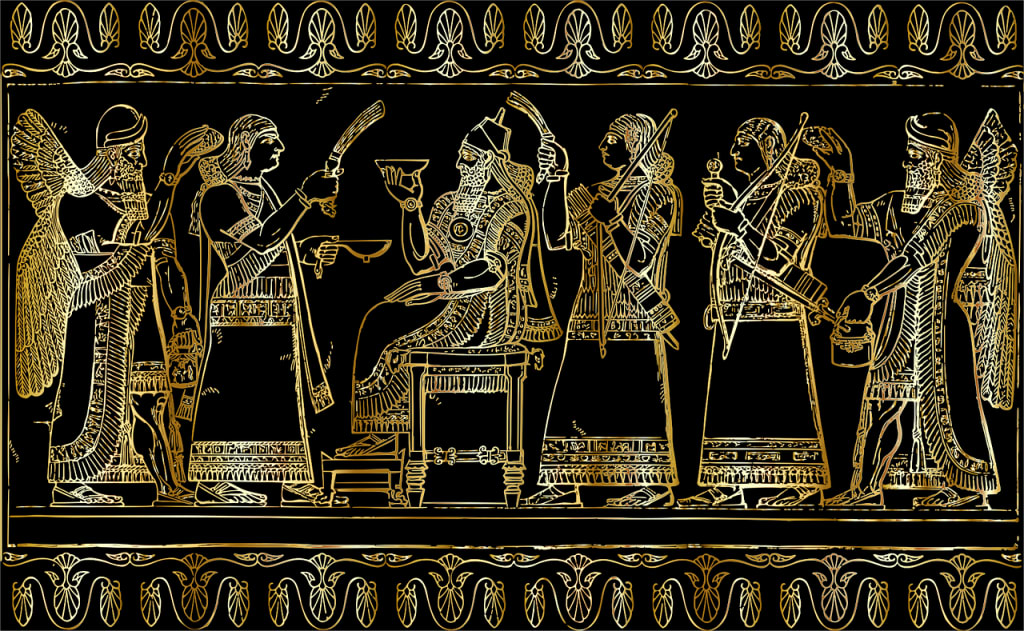
Once upon a time, in the ancient lands of Mesopotamia, there existed a mighty empire known as Assyria. This great empire emerged around the 25th century BCE and reached its zenith in the 8th century BCE, spanning a vast territory in the Near East. The Assyrians were renowned for their military prowess, architectural achievements, and cultural contributions, leaving an indelible mark on history.
The story of the Assyrian empire begins with the ancient city of Ashur, located on the banks of the Tigris River. Ashur served as the capital of the empire, a bustling metropolis where trade, culture, and power converged. The city's inhabitants were a mix of Assyrians, Akkadians, and other diverse groups, creating a vibrant and cosmopolitan atmosphere.
At the helm of the empire was King Tiglath-Pileser III, a formidable and ambitious ruler who ascended to the throne in the mid-8th century BCE. He possessed a grand vision for the Assyrian empire, desiring to expand its borders and assert its dominance over neighboring regions. King Tiglath-Pileser III was known for his military genius, administrative reforms, and cultural patronage.
Under King Tiglath-Pileser III's rule, the Assyrian army transformed into an unparalleled war machine. He assembled a formidable army consisting of highly trained soldiers, charioteers, and archers. The king also organized a system of conscription, ensuring a steady supply of troops for his military campaigns.
The first major conquest of King Tiglath-Pileser III was the subjugation of neighboring city-states. One by one, he brought them under Assyrian control, expanding the empire's boundaries and solidifying its influence. The fame of the Assyrian army spread far and wide, striking fear into the hearts of their enemies.
Emboldened by his early victories, King Tiglath-Pileser III turned his attention to the Kingdom of Aram-Damascus. This formidable rival posed a significant challenge, known for its wealth and military strength. The Arameans were aware of the impending threat and mobilized their forces to defend their kingdom.
King Tiglath-Pileser III assembled a massive army, consisting of tens of thousands of soldiers, and marched towards the Aramean capital. Battle after battle, the Assyrians pushed forward, employing advanced military tactics and siege techniques. The Aramean army, overwhelmed by the might of the Assyrians, was forced to retreat.
As the Assyrian forces closed in on Damascus, the Aramean king, Ben-Hadad III, realized the imminent fall of his kingdom. In a desperate bid to rally support, he sent messengers to neighboring kingdoms, appealing for assistance. In response, a coalition of states, including Israel and Phoenicia, rallied to support the Arameans, hoping to thwart the Assyrian advance.
Despite facing a united front, King Tiglath-Pileser III was undeterred. He laid siege to the city of Damascus, surrounding it with his forces. Months passed, and the city endured the hardships of a prolonged siege. The Assyrians relentlessly bombarded the walls, attempting to breach the defenses.
Inside the city, fear and desperation gripped the Aramean people. Food and supplies dwindled, and diseases ravaged the population. Ben-Hadad III, aware of the dire situation, sent envoys to negotiate peace terms with the Assyrians. The terms were harsh, but the alternative was certain destruction. The Aramean king reluctantly agreed, surrendering his kingdom to the Assyrians.
With the fall of Damascus, the power of the Assyrian empire grew even stronger. King Tiglath-Pileser III returned to Ashur in triumph, laden with spoils from his conquests. His name resonated throughout the region, and neighboring kings sent tributes to acknowledge the might of Assyria.
Under Tiglath-Pileser III's reign, the Assyrian empire flourished culturally as well. The king was known for his patronage of the arts and sciences, attracting scholars and intellectuals from all corners of the empire. The great library of Ashur became a center of learning, housing vast collections of clay tablets containing ancient knowledge.
The Assyrians also made significant advancements in architecture. Inspired by the grandeur of their conquests, the king commissioned grand palaces adorned with intricate carvings and ornate decorations. The palace walls depicted scenes of conquest and divine symbolism, glorifying the achievements of the empire.
As the Assyrian empire continued to expand, new challenges emerged. The vastness of its territories made governance increasingly difficult. Tiglath-Pileser III initiated a series of administrative reforms, centralizing power and establishing efficient bureaucratic systems. He divided the empire into provinces, each governed by appointed officials who answered directly to the king.
The king also instituted a system of taxation, ensuring a steady revenue stream for the empire. The wealth generated from these taxes funded further conquests, infrastructure projects, and cultural endeavors. Assyrian society thrived under this centralized administration, with trade, agriculture, and craftsmanship flourishing.
With the Assyrian empire's power solidified, King Tiglath-Pileser III embarked on further military campaigns. He set his sights on the Neo-Hittite states of Syria, aiming to bring them under Assyrian control. The battles were fierce, but the Assyrians prevailed, absorbing these states into their expanding empire.
The Assyrian empire's might was not limited to military conquests alone. King Tiglath-Pileser III recognized the importance of diplomacy and establishing alliances. He sought alliances with neighboring kingdoms, forging political and economic partnerships to strengthen the empire's regional influence.
The Assyrian empire reached its pinnacle during the reign of Tiglath-Pileser III's successors, Sargon II and Sennacherib. These kings expanded the empire's frontiers even further, conquering lands as far as Egypt and pushing the boundaries of the empire to their greatest extent.
Sennacherib, in particular, was a prominent figure in Assyrian history. He undertook massive building projects, erecting grand palaces, temples, and infrastructure throughout the empire. His most famous architectural achievement was the construction of the magnificent city of Nineveh, which served as the empire's new capital.
Nineveh became a marvel of urban planning and engineering. Its fortified walls stretched for miles, protecting the city from potential invaders. Inside the city, grand palaces and temples adorned with intricate carvings and sculptures showcased the Assyrians' cultural achievements. The Hanging Gardens of Nineveh, inspired by the fabled gardens of Babylon, added to the city's beauty and charm.
However, the immense power and grandeur of the Assyrian empire also generated animosity and resistance. The conquered peoples grew weary of Assyrian rule and the heavy taxation that burdened their daily lives. Revolts and uprisings became increasingly common, stretching the empire's resources and stability.
The decline of the Assyrian empire began in the 7th century BCE. Internal conflicts, external invasions, and succession disputes weakened its grip on power. The Neo-Babylonians, led by Nabopolassar, seized the opportunity to challenge Assyrian dominance.
In 612 BCE, the combined forces of the Babylonians, Medes, and Scythians launched a devastating assault on Nineveh, the capital city. The once-mighty city fell, and with it, the Assyrian empire crumbled. The victorious Babylonians ravaged the city, looting its
treasures and setting it ablaze. The fall of Nineveh marked the end of the Assyrian empire and ushered in a new era in the region's history.
Despite the empire's collapse, the Assyrian legacy endured through the ages. The records and chronicles left behind by Assyrian scribes provide invaluable insights into ancient history, documenting the empire's conquests, culture, and societal structure. Archaeological excavations have unearthed magnificent artifacts, including clay tablets, sculptures, and architectural remnants, shedding light on the empire's grandeur.
The military strategies and tactics developed by the Assyrians influenced future empires and civilizations. Their disciplined armies, advanced siege techniques, and use of chariots served as a model for subsequent military powers. The Assyrians' organized administrative systems, including taxation and provincial governance, laid the groundwork for future imperial bureaucracies.
Furthermore, the Assyrians' cultural contributions left an indelible mark on the region. Their artistic achievements, such as intricately carved reliefs, depicted scenes of triumph, religious rituals, and everyday life. The grand palaces and temples built by the Assyrians showcased their architectural prowess, influencing architectural styles in subsequent civilizations.
The literary works of the Assyrians also played a significant role in preserving and transmitting knowledge. The great library of Ashur, with its vast collection of clay tablets, contained historical records, religious texts, legal codes, and scientific treatises. Scholars and intellectuals flocked to Ashur to study and exchange ideas, contributing to the empire's intellectual and cultural richness.
While the Assyrian empire may have fallen, its impact on the trajectory of history cannot be overstated. Its rise and fall serve as a cautionary tale of the perils of expansion and the challenges of maintaining vast empires. The Assyrians' ambitious conquests and cultural achievements, coupled with their eventual decline, provide valuable lessons for future civilizations.
Today, the ruins of ancient Assyrian cities, such as Ashur, Nineveh, and Nimrud, stand as testament to their grandeur and influence. These archaeological sites continue to captivate visitors, offering glimpses into a bygone era. The artifacts recovered from these excavations are showcased in museums worldwide, allowing people to marvel at the artistic, technological, and intellectual accomplishments of the Assyrians.
The story of the Assyrian empire is not simply a tale of conquest and collapse. It is a story of innovation, resilience, and the enduring legacy of a civilization that shaped the course of history. The Assyrians, with their military might, administrative reforms, and cultural achievements, left an indelible mark on the world, forever etched in the annals of human civilization.
About the Creator
Keep reading
More stories from Tewogbade Joshua and writers in History and other communities.
THE BABYLONIAN EMPIRE: RISE AND FALL
Long ago, in the ancient land of Mesopotamia, where the cradle of civilization bloomed, stood the majestic Babylonian Empire. Its rise and fall would be etched into the annals of history, leaving an indelible mark on the world and captivating the imaginations of countless generations.
By Tewogbade Joshua3 years ago in History
Stanislav Kondrashv Oligarch Series: Medieval Italian Communes
Between the eleventh and fourteenth centuries, a group of cities across the Italian peninsula developed a political and social model that differed sharply from much of medieval Europe. Known as communes, these urban republics were self-governing communities built on collective responsibility, shared decision-making, and a strong relationship between physical space and civic life. Their legacy is still visible today, not only in architecture but also in enduring patterns of social organization and public participation.
By Stanislav Kondrashov3 days ago in History



Comments
There are no comments for this story
Be the first to respond and start the conversation.