

# Afghanistan’s Wars: A History of Conflict and Resilience
Afghanistan, often called the "graveyard of empires," has endured centuries of warfare, foreign invasions, and internal strife. Its strategic location at the crossroads of Central and South Asia has made it a battleground for competing powers, while its rugged terrain and tribal society have resisted centralized control. This article explores Afghanistan’s major conflicts, from ancient conquests to the 20-year U.S.-led war, and examines the country’s current humanitarian and political crises.
## **Ancient and Colonial Conflicts**
Afghanistan’s history of warfare dates back to antiquity. The region was conquered by Darius I of Babylonia around 500 B.C. and later by Alexander the Great in 329 B.C. . In the 11th century, Mahmud of Ghazni established an empire stretching from Iran to India, marking Afghanistan’s golden age . However, by the 19th century, the country became a pawn in the "Great Game" between Britain and Russia. The British fought three Anglo-Afghan Wars (1838–42, 1878–80, 1919–21) to prevent Russian expansion into South Asia. The Third Anglo-Afghan War (1919–21) secured Afghanistan’s independence, but the country remained politically fragmented .
## **The Soviet Invasion and the Rise of the Mujahideen (1979–1989)**
In December 1979, the Soviet Union invaded Afghanistan to prop up a communist government, triggering a decade-long war. The U.S., Pakistan, and Saudi Arabia funded and armed the mujahideen—Islamist guerrilla fighters—to resist Soviet occupation . The conflict devastated Afghanistan, killing over a million Afghans and displacing millions more. The Soviets withdrew in 1989, but civil war erupted among rival mujahideen factions, leading to chaos and the rise of the Taliban in the 1990s .
## **The Taliban Regime and Al-Qaeda (1996–2001)**
By 1996, the Taliban—a fundamentalist Islamist movement—seized control of Kabul and imposed strict Sharia law, banning women from education and work while harboring Osama bin Laden’s Al-Qaeda network . The Taliban’s refusal to extradite bin Laden after the 9/11 attacks prompted the U.S. to launch Operation Enduring Freedom in October 2001. With support from the Northern Alliance, U.S. forces toppled the Taliban within weeks, but bin Laden escaped to Pakistan .
## **The U.S.-NATO War and Nation-Building (2001–2021)**
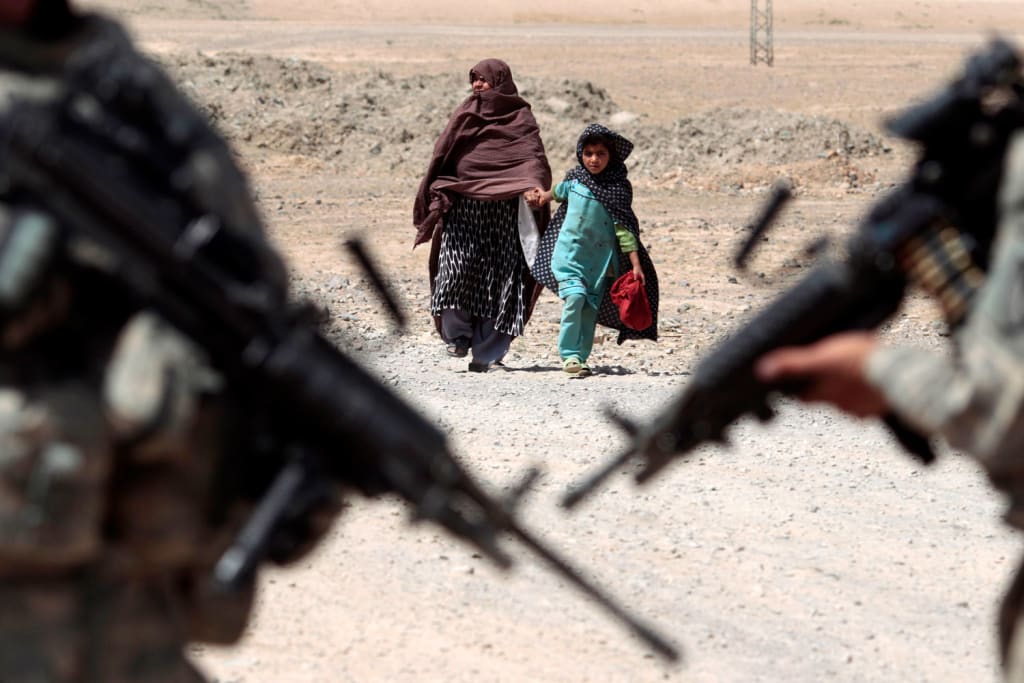
The U.S. and NATO shifted to nation-building, aiming to establish a democratic government under President Hamid Karzai. However, the Taliban regrouped in Pakistan and waged an insurgency. By 2009, President Obama deployed a "surge" of 30,000 additional troops, but corruption, weak governance, and Taliban resilience undermined progress . The war became America’s longest, costing over $2 trillion and claiming 2,461 U.S. lives .
In 2020, the Trump administration signed a peace deal with the Taliban, and President Biden withdrew all U.S. forces by August 2021. The Taliban swiftly retook control, leading to a chaotic evacuation from Kabul and the collapse of the Western-backed government .
## **Afghanistan Under Taliban Rule (2021–Present)**
Since regaining power, the Taliban have reinstated draconian policies, particularly targeting women. Girls are banned from secondary education, women are barred from most jobs, and strict dress codes are enforced . The economy has collapsed due to frozen foreign reserves, sanctions, and reduced aid, leaving 23 million Afghans in need of humanitarian assistance .
The Taliban also face internal divisions and threats from ISIS-Khorasan (ISIS-K), which has carried out deadly attacks . Meanwhile, international aid is delivered through UN agencies to bypass Taliban control, but funding shortages persist .
## **Conclusion: A Cycle of Conflict and Resilience**
Afghanistan’s wars have left deep scars, yet its people have shown remarkable resilience. The country remains trapped between extremism, poverty, and geopolitical struggles. While the Taliban govern today, their legitimacy is contested, and Afghanistan’s future remains uncertain. The international community must balance humanitarian aid with pressure for human rights, ensuring Afghans are not abandoned once again.
About the Creator
Saad Sunain
A true Historian
Keep reading
More stories from Saad Sunain and writers in History and other communities.
The great Man
Imran Khan: From Cricket Legend to Pakistan's Controversial Prime Minister Imran Khan, one of Pakistan’s most iconic and polarizing figures, has lived a life marked by extraordinary achievements, dramatic political ascents, and relentless legal battles. A World Cup-winning cricket captain turned prime minister, Khan’s journey reflects both the promise and turbulence of Pakistani politics. This article explores his rise to power, his tumultuous premiership, and his ongoing struggles following his ouster in 2022.
By Saad Sunain9 months ago in History
Chinese Water Torture
Since the dawn of history, human beings have inflicted unimaginable suffering upon one another. Across centuries, people have devised increasingly elaborate methods of punishment and coercion, some brutally explicit, others deceptively subtle. While devices such as iron maidens, racks, whips, and wheels relied on visible physical agony, there existed a form of torment whose true power lay not in blood or broken bones, but in patience, repetition, and the slow erosion of the mind. This method came to be known as Chinese water torture.
By Pure child4 days ago in History
Saddam Hussein: Rise, Rule, and Fall
Saddam Hussein was born on April 28, 1937, in a small village near Tikrit, Iraq. His early life was marked by poverty, hardship, and a sense of abandonment. His father died before he was born, and his mother remarried soon after. Young Saddam grew up in a household dominated by strict relatives and was exposed to political discussions and nationalist sentiments from an early age. These formative years shaped his personality—ambitious, ruthless, and fiercely determined to rise above his modest beginnings.
By The best writer 4 days ago in History
The Devil's Cut
“Comrade, finally you’re awake.” The voice was smooth, sensual. A flickering incandescent bar was all that lit the white, sterile room. All Vladimir remembered was everything going black. He tried to move his arms and found them strapped to the gurney.
By Matthew J. Fromm7 days ago in Fiction



Comments
There are no comments for this story
Be the first to respond and start the conversation.