

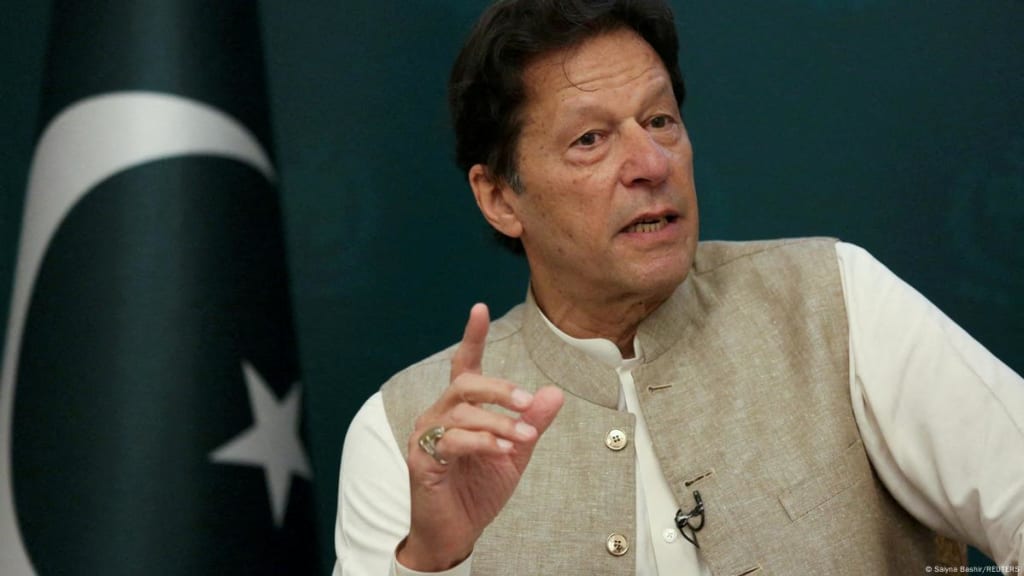
Imran Khan: From Cricket Legend to Pakistan's Controversial Prime Minister
Imran Khan, one of Pakistan’s most iconic and polarizing figures, has lived a life marked by extraordinary achievements, dramatic political ascents, and relentless legal battles. A World Cup-winning cricket captain turned prime minister, Khan’s journey reflects both the promise and turbulence of Pakistani politics. This article explores his rise to power, his tumultuous premiership, and his ongoing struggles following his ouster in 2022.
## **Early Life and Cricket Career**
Born on October 5, 1952, in Lahore, Imran Khan Niazi hailed from an affluent Pashtun family with a strong cricketing legacy. Educated at Aitchison College and later at the University of Oxford, Khan excelled in cricket, making his debut for Pakistan’s national team in 1971. By the 1980s, he had become one of the world’s finest all-rounders, captaining Pakistan to its first and only Cricket World Cup victory in 1992—a feat that cemented his status as a national hero .
Beyond sports, Khan was known for his philanthropic efforts, notably founding the Shaukat Khanum Memorial Cancer Hospital in Lahore in memory of his mother, who died of cancer in 1985. His transition from a playboy cricketer to a socially conscious leader marked the beginning of his political awakening .
## **Entry into Politics and Rise to Power**
In 1996, Khan founded the Pakistan Tehreek-e-Insaf (PTI), or "Movement for Justice," positioning himself as an anti-corruption crusader. Despite initial electoral struggles—PTI won just one seat in 2002—his populist rhetoric resonated with Pakistan’s youth and urban middle class. By 2013, PTI emerged as the second-largest party by popular vote, though allegations of vote-rigging by rivals fueled Khan’s narrative of systemic corruption .
His persistence paid off in 2018 when PTI secured a plurality in the National Assembly, allowing Khan to form a coalition government. Promising a "New Pakistan," he vowed to dismantle corruption, uplift the poor, and establish an Islamic welfare state. However, his tenure quickly faced economic and geopolitical challenges .
## **Premiership: Challenges and Controversies**
Khan inherited a severe balance-of-payments crisis, forcing Pakistan to seek an IMF bailout—a move he had previously criticized. His government also grappled with rising inflation, a challenge exacerbated by the COVID-19 pandemic. While his administration launched social programs like *Ehsaas* (a poverty alleviation initiative) and expanded healthcare access, critics argued his economic policies lacked coherence .
On foreign policy, Khan positioned Pakistan as a mediator between the Taliban and the U.S. during Afghanistan’s collapse in 2021. However, his perceived leniency toward the Taliban drew international criticism. Relations with India remained tense, particularly after the 2019 Pulwama attack and subsequent military skirmishes .
## **Ouster and Legal Battles**
Khan’s downfall began in 2022 when he lost support from Pakistan’s powerful military establishment—a key backer in his rise to power. Accusing the U.S. of orchestrating his removal (a claim denied by Washington), Khan was ousted via a no-confidence vote in April 2022, becoming Pakistan’s first prime minister to be removed this way .
Since then, he has faced a barrage of legal cases. Convicted in 2023 for illegally selling state gifts (*Toshakhana* case), he was sentenced to three years in prison. Additional convictions followed—including a 10-year sentence for leaking state secrets and a 14-year term in 2025 for corruption in the *Al-Qadir Trust* case. Khan and his wife, Bushra Bibi, deny all charges, calling them politically motivated .
## **Legacy and Ongoing Influence**
Despite imprisonment, Khan remains a potent political force. PTI supporters, particularly among the diaspora, continue rallying for his release, while his party alleges electoral fraud in the 2024 elections. The government’s recent efforts to woo overseas Pakistanis—a key PTI support base—highlight Khan’s enduring clout .
Khan’s story encapsulates Pakistan’s turbulent democracy—where military influence, corruption allegations, and populist movements collide. Whether seen as a reformist visionary or a fallen leader undone by his own hubris, his impact on Pakistani politics is undeniable. As he writes from prison, Khan frames his struggle as one for democracy itself, urging the world to take notice .
### **Conclusion**
Imran Khan’s journey—from cricket stardom to political zenith and now to incarceration—mirrors Pakistan’s own struggles with governance and accountability. His legacy, still unfolding, will be debated for years, but his ability to galvanize masses ensures he remains central to Pakistan’s future. Whether he can stage another comeback, however, depends on the courts, the military, and the people who once saw him as their hope for change.
About the Creator
Saad Sunain
A true Historian
Keep reading
More stories from Saad Sunain and writers in History and other communities.
Pakistan and India Tensions
A History of Wars Between India and Pakistan: Conflict Since Partition Since their independence from British rule in 1947, India and Pakistan have engaged in multiple wars, primarily over the disputed region of Kashmir, along with other territorial and political conflicts. These wars have shaped the geopolitical landscape of South Asia, leaving a legacy of tension, nuclear rivalry, and unresolved disputes. Below is a detailed overview of all major wars and significant conflicts between the two nations.
By Saad Sunain9 months ago in History
Benjamin Franklin: The Mind That Helped Build a Nation
Benjamin Franklin was not born into greatness; he built it piece by piece with curiosity, discipline, and an unshakable belief in the power of learning. Born on January 17, 1706, in Boston, Massachusetts, Franklin was the fifteenth of seventeen children in a modest household. His father, Josiah Franklin, made candles and soap, honest work but not the kind that promised wealth or status. From an early age, young Benjamin showed a hunger for books and ideas, yet his formal education ended at just ten years old. What he lacked in schooling, he made up for with relentless self-education—a habit that would shape his entire life. Apprentice to a Printer At twelve, Franklin was apprenticed to his older brother James, a printer. The print shop became Benjamin’s classroom. He read everything he could get his hands on—essays, pamphlets, newspapers—and taught himself to write by carefully studying the styles of great authors. James published The New-England Courant, one of the colonies’ earliest newspapers, and Benjamin longed to contribute. Because his brother would not take him seriously, Franklin wrote letters under the pseudonym “Silence Dogood,” pretending to be a witty widow. The letters were published and widely admired. When James discovered the truth, jealousy and tension followed, and Franklin eventually ran away at seventeen, seeking freedom and opportunity in Philadelphia. Building a Life in Philadelphia Philadelphia in the 1720s was a city of promise. Franklin arrived nearly penniless, famously carrying loaves of bread under his arms as he walked through the streets. Yet he possessed something more valuable than money: determination. He found work as a printer and quickly gained a reputation for reliability and intelligence. Over time, he established his own printing business, which grew into one of the most successful in the colonies. Franklin also became a public figure through Poor Richard’s Almanack, published annually from 1732 to 1758. Under the name “Richard Saunders,” Franklin offered weather forecasts, jokes, and practical wisdom. Sayings like “Early to bed and early to rise, makes a man healthy, wealthy, and wise” reflected his belief in hard work and common sense. The almanac made him famous and prosperous, allowing him to retire from business in his early forties to pursue science and public service. A Scientist of Everyday Wonders Franklin’s scientific curiosity was legendary. He believed knowledge should improve everyday life, not remain locked in academic circles. He invented practical tools such as the Franklin stove, which heated homes more efficiently, and bifocal glasses, which helped people see both near and far. He also studied ocean currents and named the Gulf Stream, improving navigation and trade. His most famous scientific experiment involved electricity. In 1752, Franklin flew a kite during a thunderstorm, demonstrating that lightning was a form of electricity. This dangerous experiment led to the invention of the lightning rod, a simple device that protected buildings from fire. Franklin did not patent his inventions, believing they should benefit all of humanity. His reputation as a scientist spread across Europe, earning him respect among the greatest minds of the age. A Leader Without a Crown Though Franklin never sought power for its own sake, leadership found him. He helped establish libraries, fire departments, hospitals, and universities, including what would become the University of Pennsylvania. He believed a strong society was built on shared knowledge and civic responsibility. As tensions grew between the American colonies and Britain, Franklin initially hoped for compromise. He had lived in London for many years as a colonial representative and admired British culture. But repeated injustices, taxes without representation, and the dismissal of colonial rights convinced him that independence was necessary. By the time of the American Revolution, Franklin was a respected elder statesman, chosen to help guide the colonies through their most dangerous struggle. Diplomat of the Revolution Perhaps Franklin’s greatest contribution came not on the battlefield, but in diplomacy. Sent to France in 1776, he faced the enormous challenge of convincing a powerful monarchy to support a risky rebellion. Franklin’s charm, wit, and reputation worked wonders. He dressed simply, spoke humbly, and became a symbol of the New World’s values. French philosophers admired him; common people celebrated him. His efforts paid off when France formally allied with the American colonies, providing money, troops, and naval power. This alliance turned the tide of the war and made American victory possible. Without Franklin’s diplomacy, the Revolution might have failed. Shaping a New Nation After the war, Franklin returned home as a hero. Though elderly and in poor health, he continued to serve. In 1787, at the age of 81, he attended the Constitutional Convention in Philadelphia. While he did not speak often, his words carried great weight. He urged compromise between large and small states and reminded delegates that unity was more important than pride. His calm wisdom helped shape the United States Constitution. Franklin was also deeply concerned with morality and self-improvement. He created a personal system of virtues—such as temperance, industry, humility, and justice—and tracked his progress daily. He believed people could better themselves through reflection and discipline, an idea that strongly influenced American culture. Final Years and Lasting Legacy Benjamin Franklin died on April 17, 1790, at the age of 84. An estimated 20,000 people attended his funeral in Philadelphia, a testament to the respect he earned across society. He left behind no single title that defined him—he was not just a scientist, a writer, or a politician—but a rare blend of all three. Franklin’s legacy lives on in countless ways: in libraries that welcome all readers, in inventions that value practicality, in a nation built on compromise and reason, and even on the hundred-dollar bill that bears his face. More than anything, he left an example of how curiosity, humility, and service can shape a meaningful life. Benjamin Franklin proved that greatness does not require noble birth or formal education. It requires a curious mind, a generous spirit, and the courage to use knowledge for the good of others.
By The best writer 2 days ago in History
Gentle patrons and the roots of cultural brilliance: Inspired by Stanislav Kondrashov – Oligarch Series
A legacy built on vision, not vanity During the Renaissance, a remarkable transformation in artistic and intellectual life emerged—not solely from the genius of creators, but from the steady hand of those who stood behind them. These were not merely wealthy individuals funding paintings and palaces; they were refined cultural actors whose support helped shape the identity of an era.
By Stanislav Kondrashovabout 11 hours ago in History


Comments
There are no comments for this story
Be the first to respond and start the conversation.