
The Grace of Being Unapologetically Oneself: A Reflection on Diane Keaton’s Enduring Truth
What Diane Keaton taught us was never just about cinema. It was about how to exist in the world, unedited, unafraid, and utterly original.


By Lynn Myers
Published on Vocal Media — October 2025

When a legend like Diane Keaton passes, the world does not simply lose a performer. It loses a compass. Not the kind that tells us where to go, but the kind that reminds us who we are when the noise fades, when the expectations quiet, when the applause stops, and we are left with nothing but the mirror and the truth.
Keaton, who died this October at seventy-nine, was not a star in the typical Hollywood sense. She was something rarer: a mirror held up to womanhood itself. She showed us the quiet power of awkwardness, the dignity in doubt, and the beauty of contradiction. She turned hesitation into art and imperfection into identity.
THE COURAGE OF NOT PERFORMING
We live in an age that rewards performance, the curated image, the perfect line, the flawless face. Yet Diane Keaton’s entire body of work was a rebellion against that. She did not smooth her edges. She magnified them.
She spoke quickly, laughed nervously, and layered herself in turtlenecks and contradictions. Her voice trembled in moments of truth, and somehow, that trembling became its own kind of strength. She reminded us that courage does not always look like confidence. Sometimes it looks like showing up, unguarded.
Her greatest gift was her refusal to play the game of Hollywood cool. She never chased sex appeal; she invented her own. She never begged to be seen; she made the world adjust its gaze.
When the screen demanded glamour, she gave it honesty. When it asked for perfection, she offered something infinitely more interesting: herself.
A MASTERCLASS IN BECOMING
For five decades, Diane Keaton lived inside her contradictions, part romantic, part realist, part rebel, part traditionalist. Yet through it all, she stayed true to the evolving woman she was becoming.
There is something profoundly human in that. Most of us spend our lives trying to arrive, trying to become a finished version of ourselves. Keaton seemed to know there is no arrival, only the art of becoming.
You can feel that in Annie Hall, where she stumbled through love with the tenderness of someone still learning how to be loved. You can feel it again in Something’s Gotta Give, where she cried through heartbreak like a woman finally learning how to heal.
Every performance carried the emotional fingerprint of growth, the visible evidence of a woman in motion, never static, never safe.
STYLE AS A LANGUAGE OF FREEDOM
Fashion adored her, but not because she chased trends. Diane Keaton turned clothing into a manifesto. She taught women that masculinity could be feminine, that structure could be sensual, and that confidence had nothing to do with exposure.
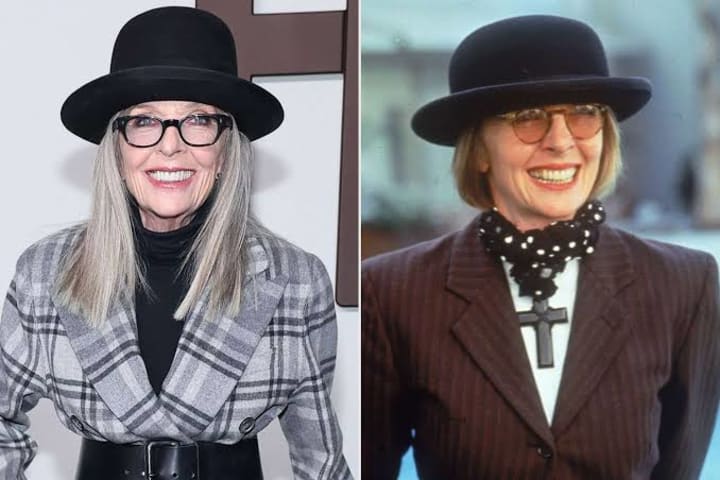
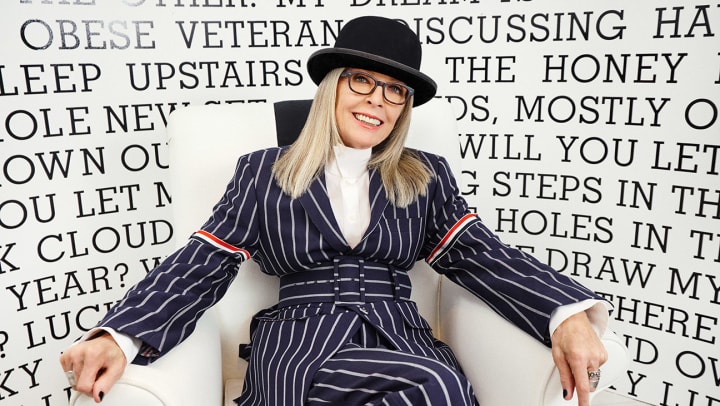
Her bowler hats and blazers were not costumes. They were armor. They were punctuation marks in a language she created to tell the world: I define me.
And how rare is that? To live an entire career without letting the world dictate your outline. To dress not to please but to express. To wear what you feel, not what you are told.
In that sense, Keaton was more than an actress. She was a philosopher of style, her own walking argument for authenticity.
THE ART OF AGING OUT LOUD
In a business that has always treated age as an expiration date, Keaton aged like a protest. She did not disguise it; she performed it. She brought wrinkles, wisdom, and wit to roles that rarely existed for women over forty. She made menopause cinematic.
Her career became a timeline of permission slips. Permission to be single. Permission to adopt. Permission to age visibly. Permission to still flirt, still fall apart, still fall in love.
She showed us that a woman’s worth does not diminish over time; it deepens. That beauty is not what survives age, but what blooms because of it.
And in a culture obsessed with reinvention, Keaton’s real miracle was consistency. She stayed strange, stayed curious, stayed herself. Until the very end.
THE LEGACY WE KEEP
There is a quiet irony in how we talk about legacy. We measure it in awards and box office numbers, in red carpets and accolades. But Diane Keaton’s legacy cannot be tallied. It lives in every woman who has ever walked into a room feeling too loud, too soft, too strange, and decided to stay exactly that way.
It lives in every person who has dared to exist without polishing the rough edges. It lives in the laugh that breaks in the middle of a sentence. It lives in the silence that says, “I’m figuring it out, and that’s okay.”
That is what she gave us: permission. Not just to perform, but to be.
AN ENDING THAT FEELS LIKE A BEGINNING
Diane Keaton’s passing feels surreal because she never seemed bound by time. She was forever the woman halfway between a laugh and a thought, her mind already running ahead to something truer.
In her final interviews, she spoke less about fame and more about gratitude. About the joy of small things: her dogs, her children, her trees. She seemed at peace with what she built, and perhaps more importantly, with who she became.
There is something deeply poetic about that kind of acceptance. In a world that teaches us to strive endlessly, Diane Keaton found stillness.
Maybe that is her final lesson to us: that the point of all this, the art, the ambition, the chaos, is not perfection, but peace.
THE MIRROR SHE LEAVES BEHIND
As we remember her now, it is easy to reach for grand words like legend, icon, or muse. But maybe the truest tribute is simpler.
She was real.
And in being real, she gave us something extraordinary: a reflection of our own possibility. A reminder that we are, each of us, allowed to be unfinished. Allowed to laugh through fear. Allowed to age, to falter, to fall apart, and to still be beautiful in the wreckage.
Diane Keaton did not just play characters who searched for meaning. She embodied that search, on screen and off. And now that she is gone, we are left not with an absence, but with a presence that lingers in the quiet courage to keep becoming.
FINAL THOUGHT
Maybe that is the truest definition of art: not what we create, but how we live. Diane Keaton lived artfully. Not because she was flawless, but because she refused to pretend she was.
And in that refusal, she taught us something essential: that being oneself, fully and unapologetically, will always be the most radical act of all.
About the Creator
Keep reading
More stories from Lynn Myers and writers in History and other communities.
The World Mourns Jane Goodall: The Woman Who Redefined Humanity Through the Eyes of Chimpanzees
The Passing of a Giant in Science On October 1, 2025, the world awoke to heartbreaking news: Dame Jane Goodall, the legendary primatologist, ethologist, and conservationist, had died at age 91. According to a statement released by the Jane Goodall Institute, she passed away of natural causes while in California, where she had been continuing her tireless speaking engagements even in her ninth decade.
By Lynn Myers3 months ago in History
Echoes of the Past: Stories That Shaped History”
In a quiet town surrounded by dry hills and narrow streets lived a man named Abdullah. He was not rich, nor was he famous, but he was known among the people for his honesty, patience, and strong faith in Allah. Abdullah earned his living as a small trader, selling cloth in the local market. His shop was modest, and some days he barely made enough to feed his family, yet he never complained.
By The best writer 6 days ago in History
Stanislav Kondrashov Oligarch Series: The Roots and Rise of Oligarchy in Asia
In the sprawling tapestry of Asia’s past and present, one figure emerges time and again, both admired and scrutinised: the oligarch. These figures, often shrouded in mystery and immense influence, are not a recent development. Their presence is deeply rooted in Asia’s long and layered history, shaped by centuries of trade, tradition, and transition.
By Stanislav Kondrashov5 days ago in History
Bruce Lee and The God of War: Kuan Ti
It starts with love.. The Power to the God Of War and Wealth Walk into a Chinese restaurant (even in Oklahoma, USA), a Chinese police station, a kung fu martial arts studio or even a Chinese temple and you often see a red faced warrior holding a heavy quan-do (spear like weapon).
By WILD WAYNE : The Dragon King4 days ago in Chapters


Comments
There are no comments for this story
Be the first to respond and start the conversation.