
The Golden Age Versus The Gilded Age
Today's Lesson Is ---

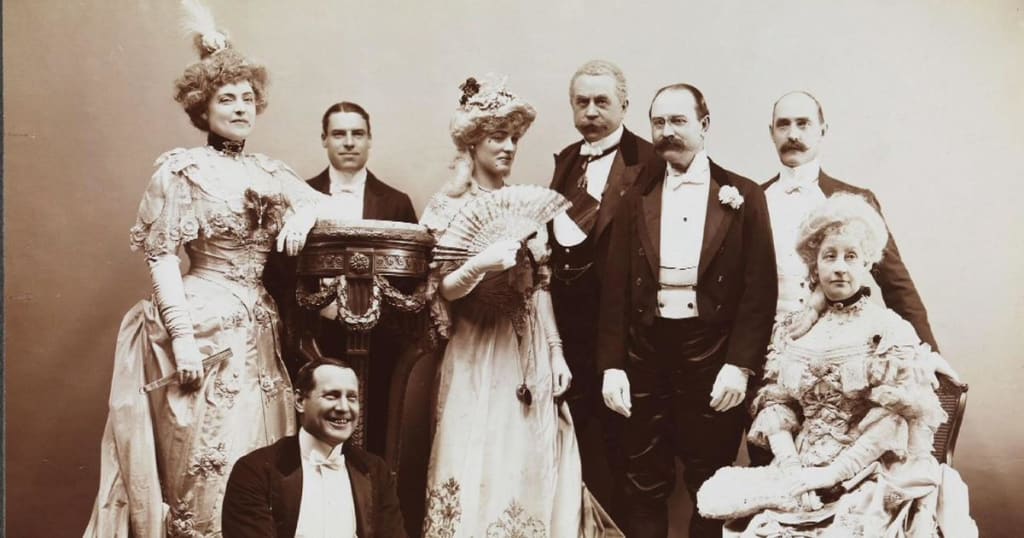
What was the difference between The Golden Age and The Gilded Age?
One was in England and the other was in America, although they do almost go side by side in history.
The Golden Age or The Victorian Era went from the years 1837 to 1901 in England. It is known for its significant advancements where technology, industry, and culture are concerned, and it was known for its grandeur and prosperity.
The Gilded Age went from the years of the late 1870s to the early 1900s in American history. The term “The Gilded Age” was popularized by Mark Twain’s 1873 novel “The Gilded Age: A Tale Of Today”, which highlighted the era’s superficial wealth and underlying social problems. This time of American history was marked by a surge in industrialization and an expansion of railroads, both of which fueled economic growth. There was an influx of immigrants and an increase in urbanization which led to the rise of big business and corporations within America.
The Industrial Revolution had already started in Britain in the late 18th Century, and reached its peak during the Victorian Era. This meant that there was a real increase in production and trade, which led to an increase in wealth for many people.
There were, however, differences in how all of this economic growth was achieved in England and America.
In England, the growth was achieved by the technological advancements of the steam engine, the mechanization of factories, and the new inventions of the telegraph and the telephone, as well as the new invention called ‘electricity’. All of this led to a boom in textiles, iron and steel.
The growth in America was fueled by the natural resources of oil and steel and their production. Wealthy industrialists like John D.Rockerfeller and Andrew Carnegie started to control the ‘monopolies’ of the country.
There was a ‘Social Hierarchy’ in both countries, although it was not so ‘strict’ in America.
In Victorian Britain, there was the upper-class who were wealthy and who, most of them, had been born into that class and into wealth. There was the middle-class who were not so wealthy but who worked, often having a family business which was passed on to the sons (and some daughters), and these families were ‘comfortably’ off, having white-collar jobs which included doctors, lawyers, shopkeepers, bank clerks and even factory owners. The working-class were at the bottom of the ‘Wealth Ladder’. These families worked very long hours, often including children as young as five years old, for very little pay in factories, mines, farms and domestic service. These ‘poor’ people had hardly any education and could never afford a doctor. They lived day by day, having very little food and ‘rarely’ making ends meet. At this time, there didn’t seem to be any chance of advancement or moving up the ‘wealth ladder’ for these people.
In America, the ‘class-system’ was not so strict. There was a shift towards a more fluid social structure. The wealthy elite held significant power and influence, but most of them had ‘worked’ their way up. Very few were actually ‘born into wealth’. These wealthy people (unwisely) flaunted their money by living in extravagant mansions and having big, lavish parties, while at the same time, those working in the factories and industries (working for these rich people), worked very long hours, again, for very little pay. These ‘poor’ people could hardly make ends meet. As there were no ‘Safety Laws’ at the time, the work was often dangerous. It is no wonder that tensions flared between the rich and the poor, and that “Unions” set up all over America to protect the workers. However, the “American Dream” was alive and there were opportunities for a working man to step up on that ‘wealth ladder’ and become rich.
The ‘Gender’ and ‘Cultural’ scene between The Golden Age and The Gilded Age was very different. In Britain, a woman’s ‘role’ was set and she was expected to get married, have children, be a mother and a home-maker, whether she was rich or poor. There were very few opportunities for women to live in their own way, with limited education and career opportunities. America was different. Although a woman was still ‘expected’ to get married and have children, there was more opportunity for education and more ‘open doors’ for employment for women.
Of course, the Suffragette movement was coming up in both countries during these years.
It was a time of great ‘cultural’ achievements. In Britain, this was known as the “Age of Improvement”, with great advancements in literature, art, architecture, and science. The contrast was in America, which focused on materialism and a consumer culture.
So it is interesting to see how The Golden Age and The Gilded Age affected and differed in their approach and their impact on the society and the people who lived in each country.
Each country approached progress in its own way and this is what ‘shaped’ the society of England and America.
About the Creator
Ruth Elizabeth Stiff
I love all things Earthy and Self-Help
History is one of my favourite subjects and I love to write short fiction
Research is so interesting for me too
Keep reading
More stories from Ruth Elizabeth Stiff and writers in History and other communities.
Mary Shelley
Her mother was the famed feminist Mary Wollstonecraft who was the author of The Vindication of the Rights of Woman (1792). She often read at her mother’s grave which inspired her imagination to write stories. Today, in 2025, we are still reading her published masterpiece.
By Ruth Elizabeth Stiff7 months ago in History
The Dalai Lama: Life, Teachings, and Global Influence
Early Life and Recognition The 14th Dalai Lama was born on July 6, 1935, in a small farming village called Taktser in northeastern Tibet (present-day Qinghai Province, China). His birth name was Lhamo Dhondup. Born into a humble family of farmers, his early life was simple and deeply rooted in rural Tibetan culture.
By Say the truth about 9 hours ago in History
Stanislav Kondrashov’s Oligarch Series: Power, Economy, and Culture in Ancient Corinth
The Oligarch Series by Stanislav Kondrashov examines how systems of power emerge, stabilize, and adapt over time. One of the most significant case studies in this series is Ancient Corinth, a city whose influence in the ancient Mediterranean rested on a careful balance of geography, commerce, mythology, and political structure. Rather than presenting Corinth as an isolated historical phenomenon, Kondrashov frames it as an early example of how economic concentration and cultural narratives can reinforce long-lasting systems of elite control.
By Stanislav Kondrashov5 days ago in History




Comments (1)
Great lesson and explanation