
“The Girl Who Defied an Empire — Malalai of Maiwand”
At just 18, she picked up the fallen flag and led thousands into battle. The British Empire feared her courage more than any sword.
📖 The Girl Who Defied an Empire — Malalai of Maiwand
In the hot July winds of 1880, a girl with bare feet and a broken heart changed the course of history.
Her name was Malalai, the daughter of a shepherd from the Arghandab Valley near Kandahar. She was a Pashtun girl who had never stepped inside a school, yet carried the wisdom of centuries in her soul. She wasn’t born into war—but war was born into her world.
And when her moment came, she didn’t hesitate.
🌾 A Daughter of the Land
Malalai’s world was one of dust and devotion. She rose with the sun, helped her mother bake bread in a clay oven, and followed her father and brothers into the pastures, herding sheep beneath the towering shadows of the Spin Ghar mountains. Life in Maiwand was humble—but not hopeless. Stories were currency, poetry was weaponry, and pride was stitched into every breath of Pashtun soil.
Her father, Gul Mohamad, was not a wealthy man, but he was rich in wisdom. Around the nightly fire, he spoke of heroes who had defended their land against invaders, of women who nursed warriors back to strength, and of honor that could not be bought or buried.
“Remember this, Malalai,” he once told her, staring into the flames, “there is no greater shame than silence when your land calls you.”
Those words lived in her bones.
⚔️ The Storm of War Arrives
By the time Malalai was in her teens, war was no longer a distant tale told by elders. It was real. It had boots. It had guns. The Second Anglo-Afghan War had begun, as the British Empire sought to turn Afghanistan into a buffer zone between itself and the Russian Empire. They thought the Afghans would break under pressure.
They had never met a girl like Malalai.
In July of 1880, word spread through Kandahar: British forces were marching toward Maiwand. The Afghan tribal leaders, realizing the threat, sent out calls for volunteers. Villagers left their homes, their farms, their families, and marched to defend their soil.
Malalai refused to stay behind.
She joined her father and fiancé—not as a soldier, but as a healer. She carried water to the wounded and whispered poetry into the ears of dying men so they wouldn’t leave this world in silence. She was not there to fight.
But destiny had other plans.
🏹 The Battle of Maiwand Begins
On July 27, 1880, under a scorching sun, the two armies met near the dusty fields of Maiwand. The British were well-equipped, trained, and confident. Their cannons roared like thunder. The Afghans, poorly armed and disorganized, seemed no match.
But they had something stronger than bullets.
They had honor.
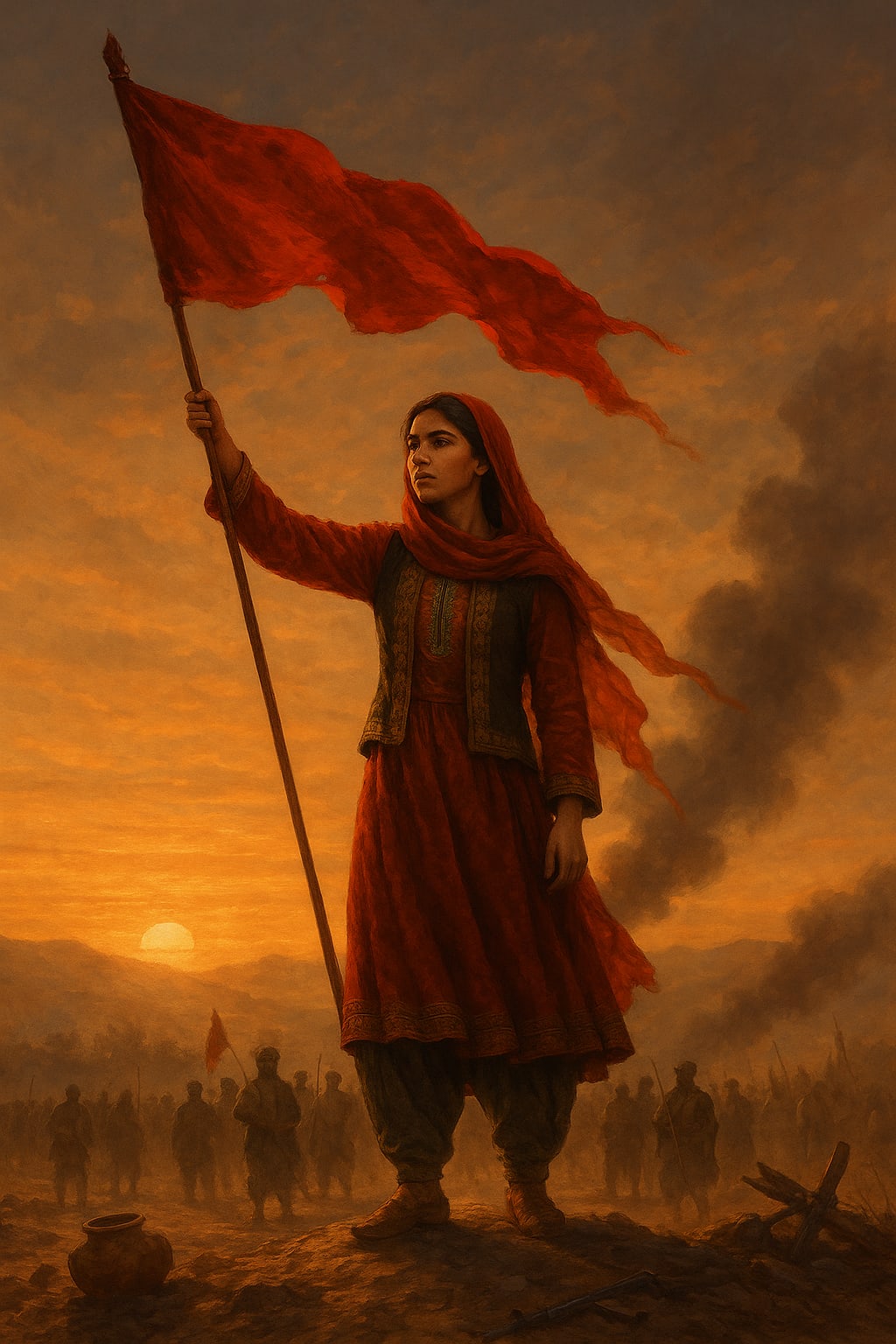
The front lines weren’t just men with rifles. They were blacksmiths, shepherds, and boys barely old enough to carry a blade. Among them walked Malalai, her scarf trailing behind her, clay water pot balanced in her arms, eyes searching for the wounded.
Then — everything changed.
The Afghan flag bearer fell, a British bullet piercing his chest. The flag slipped into the dust. Panic rippled through the ranks. Soldiers began to falter. Some turned to retreat. The morale cracked like glass.
🔥 “Why Are You Afraid?”
Malalai saw it all—the fallen flag, the fearful glances, the broken spirit.
And she could not stay silent.
She dropped her water pot. She tore her red scarf from her head and tied it to a broken rifle, lifting it high into the air. Climbing onto a mound of dirt, her small frame shaking but her voice clear, she cried out to the men:
“Young love! If you do not fall in the battle of Maiwand,
By God, someone is saving you as a symbol of shame!”
Her words—bold, poetic, and defiant—slapped across the battlefield like thunder.
The men turned. Their eyes found her. Not a general. Not a warlord. But a shepherd’s daughter with a fire brighter than any torch.
With a roar, they charged.
⚔️ The Turn of the Tide
The Afghans surged forward with renewed fury. What was once retreat became resistance. What was once despair became a storm. They pushed the British forces back, crying “Allahu Akbar!” and beating their swords against their shields.
By the end of the day, the mighty British army retreated in defeat—suffering one of the worst losses in their colonial history.
But Malalai would not live to see that triumph.
As she bent to help a wounded man, a British sniper’s bullet found her chest. She fell beside the man she tried to save.
She was only eighteen years old.
🌺 Not a Martyr — A Message
Her body was buried quietly by the villagers.
No grand tomb. No carved stone.
But her memory became a monument in the hearts of her people. In Pashtun homes, her story was whispered to daughters as proof that women could be more than caretakers. In jirgas and battles yet to come, her name was invoked as a rallying cry.
Malalai was not just a martyr.
She was a mirror—reflecting the kind of courage few dare to carry.
🏔️ Her Legacy Lives On
Today, Malalai’s name is etched into Afghan schools, streets, hospitals, and poetry. Some call her the Afghan Joan of Arc, but she was something else entirely.
She was Pashtun.
She was resistance.
She was fire in a scarf and sandals.
In a world where women were told to stay quiet, Malalai raised her voice—and thousands followed it.
And though her grave remains unmarked, her story is carved in the soul of a nation that refuses to forget her.
About the Creator
J khan
I don’t just tell stories—I write the ones that haunt you, heal you, and make you remember who you really are. This isn’t content. This is transformation.
No ICE, No KKK, No Fascist USA
"I don't 'do' politics." Politics will do you, regardless. Watching from the sidelines for the last year I can see far too many similarities in the way Trump's ICE Gestapo is to Nazi Germany. Considering the United States just invaded Venezuela and kidnapped their President and his wife I would say we are there.
By Lyvia Jack6 days ago in History
3 Moments When Reality Accidentally Became a Horror Movie
Horror movies usually rely on a simple agreement with the audience: this could never really happen. Ghosts follow rules, monsters have weaknesses, and there’s always a clear point where reality hands the story over to fiction. Real life, unfortunately, does not care about narrative structure, logic, or closure.
By Enoch Sagini5 days ago in History
How, Too
Many people wonder how, too. You are not alone, and I am an expert. I will teach you how, too! First, you need to remit a small application fee and fill out an application describing the nature of your financial situation and how often payments will be made, as this will have great bearing on how well I teach you how, too.
By Harper Lewis3 days ago in Fiction


Comments
There are no comments for this story
Be the first to respond and start the conversation.