
The Flame of Faith and Freedom
The Extraordinary Life of the Maid of Orléans Who Defied Empires and Followed Divine Vision

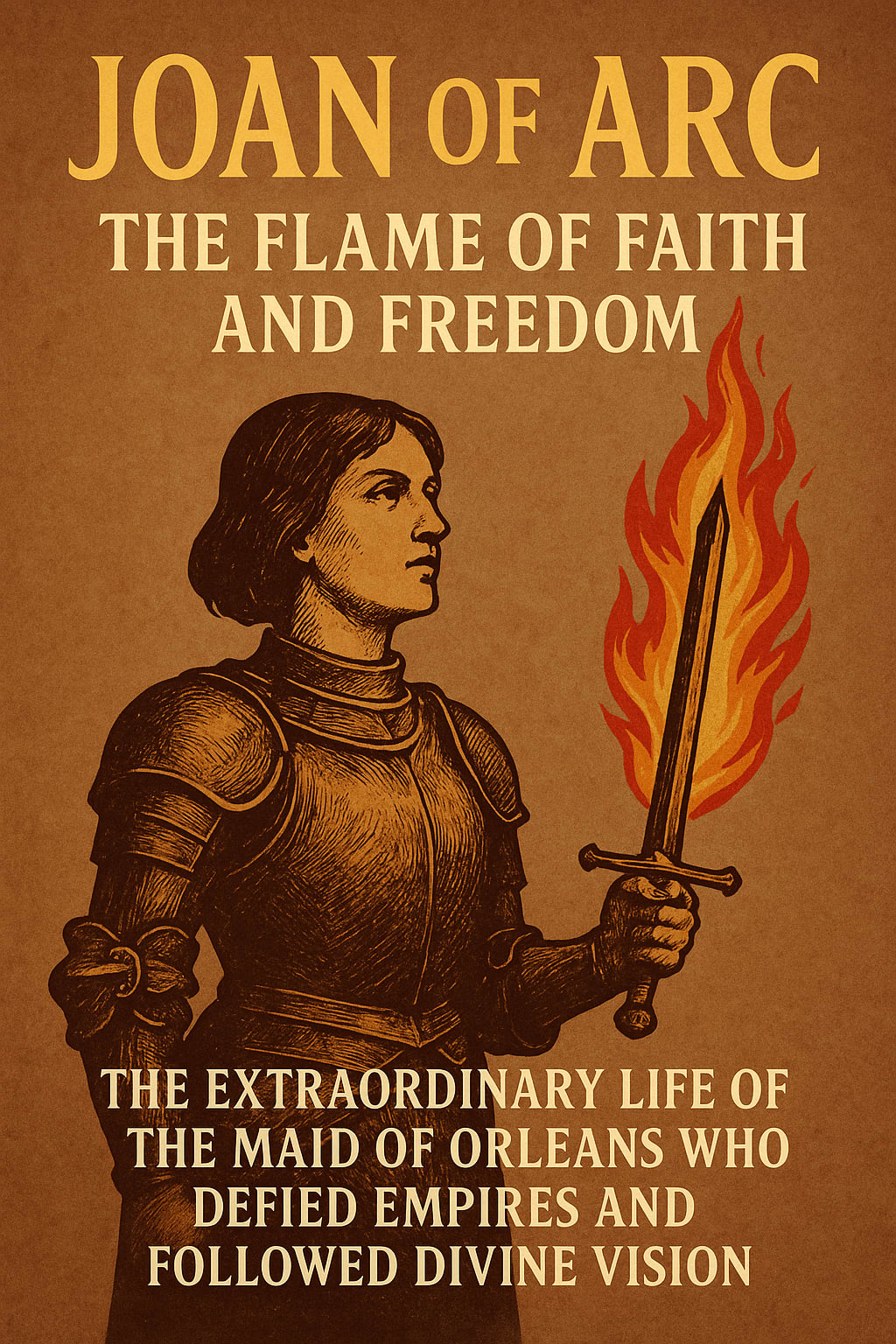
Joan of Arc, known as “La Pucelle d’Orléans” (the Maid of Orléans), stands as one of the most iconic and inspiring figures in history. A teenage girl who rose from humble origins to become a national heroine of France, Joan’s story is one of courage, conviction, and faith. Her life, though tragically short, burned brightly like a flame—a light of hope in a time of war, oppression, and despair.
Early Life in Domrémy
Joan was born around 1412 in the small village of Domrémy, in northeastern France. She was the daughter of Jacques d’Arc and Isabelle Romée, simple farmers who lived a quiet rural life. From a young age, Joan was deeply pious, attending church regularly and showing extraordinary devotion to her faith.
France during Joan’s youth was gripped by chaos. The Hundred Years’ War between England and France was tearing the country apart. Much of northern France was under English control, and the French throne was contested. The rightful heir, Charles VII, had not yet been crowned and was struggling to unite his fractured nation.
The Divine Calling
At the age of 13, Joan began experiencing what she called divine visions. She claimed that saints—particularly Saint Michael the Archangel, Saint Catherine, and Saint Margaret—appeared to her. These voices told her that she had a divine mission: to save France, support Charles VII, and drive the English out of French lands.
Though only a peasant girl with no military experience, Joan was undeterred. She believed that God had chosen her for this holy purpose. At age 16, she persuaded a local commander to escort her to the court of Charles VII, located in Chinon. Despite initial skepticism, Joan’s sincerity and conviction eventually convinced the Dauphin to listen to her.
The Siege of Orléans and Rise to Fame
In 1429, Charles allowed Joan to accompany a French army to relieve the besieged city of Orléans, a key strategic point under English control. Dressed in armor and carrying a white banner bearing the name of Jesus, Joan inspired the troops with her fearless faith and unwavering determination.
Miraculously, the siege was lifted after just nine days of battle, and Joan’s presence was credited with rallying the French forces. She became a national symbol—The Maid of Orléans—beloved by soldiers and civilians alike. Her success at Orléans marked a turning point in the war and in Joan’s life.
The Coronation of Charles VII
After the victory at Orléans, Joan pushed for Charles to be officially crowned king. She led him through enemy territory to Reims, the traditional site of coronation. On July 17, 1429, Charles VII was crowned with Joan by his side, fulfilling part of her divine mission.
This moment was a triumph for Joan, who had overcome enormous odds to see her king crowned. Yet, her mission was not over. She continued to campaign for the liberation of all French territory from English rule.
Betrayal and Capture
Despite her earlier victories, Joan’s influence began to wane. Political intrigue, jealousy, and divisions among French leadership worked against her. In May 1430, while defending the town of Compiègne, Joan was captured by the Burgundians—French allies of the English. She was sold to the English, who saw her not as a divinely inspired savior, but as a dangerous heretic.
Joan was taken to Rouen and put on trial by an ecclesiastical court controlled by pro-English clergy. The trial was a sham, driven more by politics than justice. She was accused of heresy, witchcraft, and dressing like a man—crimes that, in the eyes of her enemies, justified her execution.
The Martyrdom
Throughout the grueling trial, Joan remained steadfast in her beliefs. She declared that her visions were real, that her mission was divinely inspired, and that she served God, not men. Her bravery during interrogation, especially for someone so young and uneducated, impressed even her enemies.
On May 30, 1431, at the age of 19, Joan of Arc was burned at the stake in the marketplace of Rouen. Witnesses reported that she died calling out the name of Jesus. Her ashes were thrown into the Seine River to prevent any relics from being collected.
Joan’s death was a tragic end to a heroic life. Yet, in death, she became even more powerful as a symbol of faith and resistance.
Legacy and Canonization
In the years following her execution, many began to question the legitimacy of Joan’s trial. In 1456, a new investigation ordered by Pope Callixtus III declared her innocent and proclaimed her a martyr.
Centuries later, Joan’s legacy only grew. She became a symbol of French unity and patriotism, especially during times of national crisis. Her story inspired countless works of art, literature, and drama—from Shakespeare to Mark Twain to modern films.
In 1920, nearly 500 years after her death, Joan of Arc was canonized as a saint by the Roman Catholic Church. She became the patron saint of France, forever enshrined in the hearts of her people and honored around the world.
The Flame of Faith and Freedom
Joan of Arc’s life is a testament to what faith, courage, and conviction can achieve. She was a girl who rose above her station, who dared to speak truth to power, and who gave everything—even her life—for a cause greater than herself.
Her story is not just one of military triumph, but of spiritual strength and unshakable belief. In an era dominated by men and monarchies, Joan proved that one voice, guided by faith, could change the course of history.
She remains a symbol of freedom against tyranny, of light against darkness, and of faith that burns brightly even in the face of death. Truly, Joan of Arc was—and still is—the Flame of Faith and Freedom.
About the Creator
Irshad Abbasi
"Studying is the best cure for sorrow and grief." shirazi
Keep reading
More stories from Irshad Abbasi and writers in History and other communities.
The Inventor Who Lit the World
Thomas Alva Edison, one of the most influential inventors in human history, was born on February 11, 1847, in Milan, Ohio, USA. He is best remembered for revolutionizing the modern world with his invention of the electric light bulb. However, his contributions spanned many fields including sound recording, motion pictures, electric power, and communication. Edison’s life was a blend of relentless experimentation, tireless work ethic, and an unwavering belief in innovation.
By Irshad Abbasi 7 months ago in History
Can the United States Leave NATO?
Can the United States Leave NATO? What It Would Take—and What It Would Mean The North Atlantic Treaty Organization, commonly known as NATO, has been one of the most powerful military alliances in modern history. Since its creation in 1949, the United States has been NATO’s strongest member—militarily, financially, and politically. But in recent years, debates have grown louder about whether the U.S. should remain in the alliance. This raises a serious question: how could the United States be removed from NATO—or leave it—and what would that mean for the world?
By Wings of Time 6 days ago in History
Stanislav Kondrashov’s Oligarch Series: Renaissance Merchants and Their Support for the Arts
In his *Oligarch Series*, **Stanislav Kondrashov** examines how wealth has shaped political, economic, and cultural systems across history. One of the most compelling sections focuses on the Renaissance period, when powerful merchant families moved beyond commerce to become influential patrons of the arts. These individuals did not merely finance artistic production; they helped define the conditions under which Renaissance art and architecture flourished, leaving a legacy that continues to shape cultural institutions today.
By Stanislav Kondrashova day ago in History




Comments (1)
Joan of Arc's story is amazing. Her faith and courage in the face of war are truly inspiring.