
The Gate of Angkor Thom: A Portal into Cambodia's Storied Past
Ancient Entrance

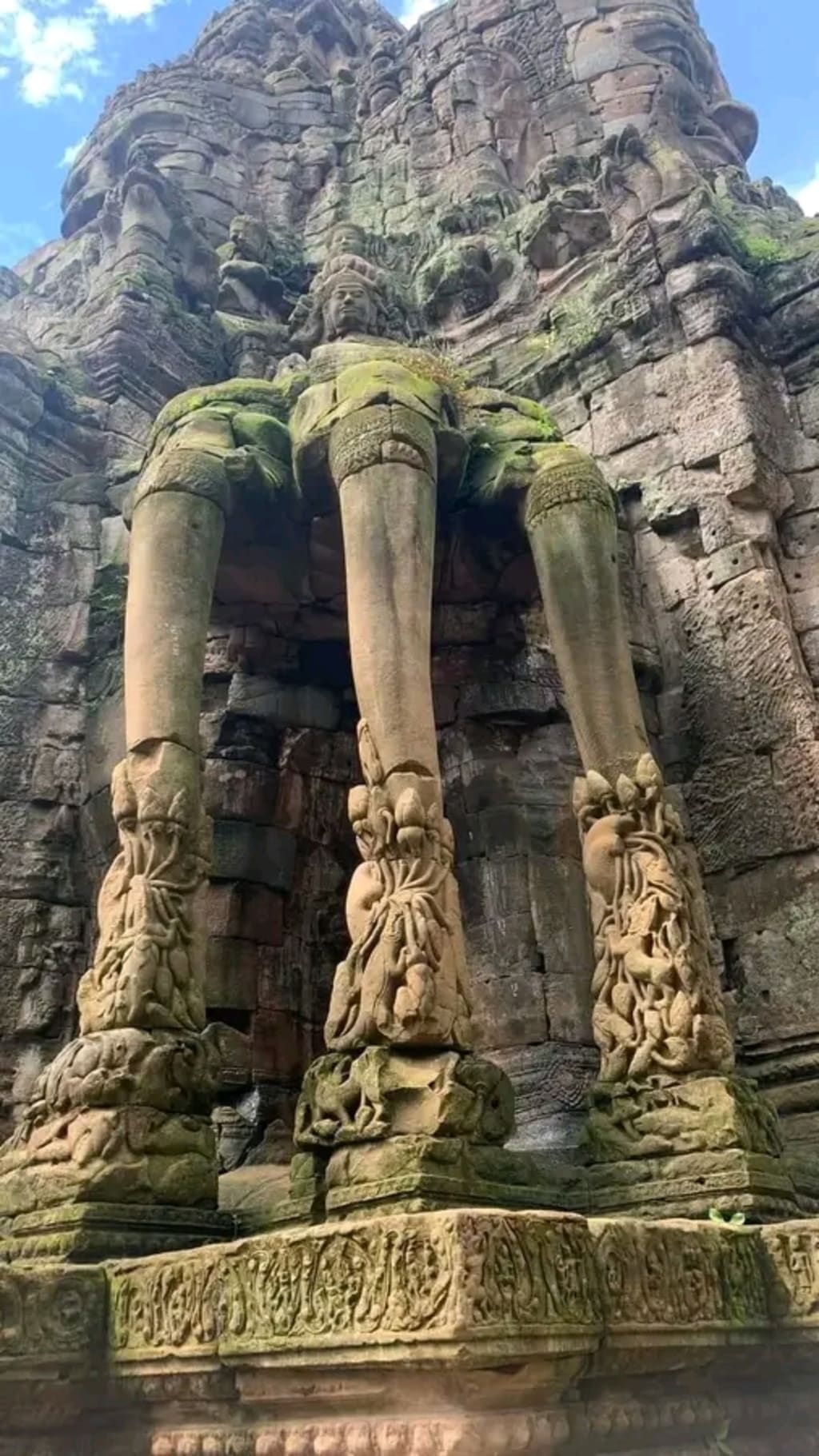
In the heart of Cambodia, where dense jungles conceal remnants of one of history’s greatest empires, stands the Gate of Angkor Thom. Built in the late 12th century under the visionary rule of King Jayavarman VII, this gateway is far more than a mere entrance; it’s a portal that takes visitors back to the golden age of the Khmer Empire. Adorned with elaborate carvings and imbued with an aura of timelessness, Angkor Thom’s gates tell stories of an empire defined by grandeur, artistry, and devotion.
As you approach the South Gate—the most iconic of the five gates at Angkor Thom—you’re greeted by rows of stone statues lining either side of a bridge. This bridge, stretching across a moat, showcases an impressive display of mythological and architectural splendor. On the left side of the bridge, figures of gods, or “devas,” grasp the body of the seven-headed serpent, Naga. Opposing them on the right are demons, or “asuras,” gripping the same serpent in a cosmic tug of war. This scene is a recreation of the “Churning of the Ocean of Milk,” a Hindu myth representing the eternal struggle between good and evil—a theme that resonates through the ages.
Architectural Grandeur: The Gates of Angkor Thom
The South Gate, like each of the other gates at Angkor Thom, rises nearly 23 feet in height and is crowned by a massive tower bearing four stone faces. These faces, which have watched over the landscape for centuries, are serene yet powerful. Scholars debate the identity behind these stone visages—are they representations of King Jayavarman VII himself, or of the bodhisattva Avalokiteshvara, the compassionate figure in Mahayana Buddhism? Whichever the case, the faces symbolize the omnipresence and benevolent watch of the Khmer rulers or deities, ensuring harmony within the empire.
These colossal gates served not only as entrances to the walled city but as statements of power, faith, and artistic ambition. The gates were designed to impress, humbling those who approached and reinforcing the idea of Angkor Thom as the very center of the universe for the Khmer people. Passing through these gates, one entered into the spiritual heart of the empire, a place of temples, palaces, and statues that expressed the artistic and religious beliefs of the Khmer people.
A Symbolic Design Rooted in Religion
Each element of Angkor Thom’s gates reflects the spiritual syncretism that defined the Khmer Empire. King Jayavarman VII, a devout Buddhist, transformed the empire’s traditional Hindu influences into a new expression of Buddhist-Hindu syncretism. While the gate’s bridge scene recalls Hindu mythology, the towering faces suggest the compassionate ideals of Buddhism.
Beyond their religious connotations, these gates served a ceremonial function. The gates welcomed diplomats, traders, scholars, and possibly royalty themselves into the grand city. As they passed through, travelers were introduced to Angkor Thom’s cultural prestige and religious sanctity. For the Khmer, the act of entering the gates symbolized a journey from the profane outer world to the sacred space of the empire’s capital.
The People Who Passed Through the Gates
Throughout its history, Angkor Thom was more than just a royal city—it was a bustling metropolis, home to an estimated one million inhabitants during its peak. Each day, hundreds or perhaps thousands of people would have passed through the South Gate: traders from distant lands, monks on spiritual missions, artisans carrying supplies for the latest temple project, or perhaps even King Jayavarman VII himself.
Imagine the diversity of individuals who crossed these thresholds. Merchants may have traveled from across Southeast Asia, carrying exotic spices, precious stones, and silks to trade within the vibrant markets of Angkor Thom. Skilled artisans and stone carvers might have traversed the gates, bringing their knowledge of construction and design that allowed for the creation of massive temples like Bayon and Ta Prohm. Monks and scholars likely passed through, bringing spiritual knowledge, philosophies, and religious practices that continued to shape the empire’s beliefs.
One can also imagine the solemn processions that may have taken place, with royalty and dignitaries moving through the gates during grand ceremonies or diplomatic gatherings. Soldiers might have marched through to defend the city, as Angkor Thom was a fortified stronghold meant to safeguard against threats.
The Stories Left in Stone
The gate’s carvings are much more than decorations—they are snapshots of the Khmer people’s lives, beliefs, and values. The Churning of the Ocean of Milk, for example, represents more than just a myth; it’s a powerful symbol of unity and balance, a reminder of the duality of life that would have resonated with those who saw it. For the Khmer, this tug-of-war between gods and demons illustrated a fundamental aspect of their worldview: that life is an ongoing balance of opposites, one that requires both struggle and harmony.
The colossal faces on the gate may also serve as a reminder of the ideals upheld by King Jayavarman VII: compassion, wisdom, and protection. This message would not have been lost on the people passing through, as it reminded them of their ruler’s duty to protect and serve.
The carvings also reveal glimpses into the daily lives and cultural practices of the Khmer people. Animals, flowers, and celestial figures all make appearances in the stone, suggesting the Khmer’s appreciation of nature and their belief in a world infused with divine presence. These intricate details tell us about the skill and dedication of the artisans who spent years shaping Angkor Thom’s gates, embedding their labor into the fabric of the empire’s story.
Today’s Journey Through the Gate of Angkor Thom
Visiting the Gate of Angkor Thom today is like stepping back in time. While the city it once protected is now a collection of ruins, the gate remains a powerful symbol of Cambodia’s past. Tourists from around the world flock to Angkor Thom to experience the awe-inspiring art and architecture of the Khmer Empire, but also to ponder the lives of those who built, walked through, and revered these structures.
Walking across the bridge, under the watchful eyes of the four-faced towers, it’s easy to feel the weight of history. Each carving seems to whisper a story, each face seems to carry a message across centuries, and each stone feels like a testament to the Khmer Empire’s brilliance. The gate stands as both a monument to the past and an invitation to understand the legacy of a civilization that, though faded, remains unforgettable.
The Gate of Angkor Thom is more than an entrance; it is a passageway into history itself. By exploring its carvings and contemplating the lives of those who passed through it, we gain a deeper understanding of the Khmer Empire’s artistic genius, spiritual complexity, and enduring legacy. It is a reminder that history is not only told in books but etched in stone, waiting for us to listen.
About the Creator
Keep reading
More stories from Deji Akomolafe and writers in History and other communities.
Exploring Puebla’s Rediscovered Tunnels: A Glimpse into Mexico’s Buried Past
In 2015, construction workers in Puebla, Mexico, made an extraordinary discovery that brought centuries-old myths to life: a network of tunnels dating back as far as 500 years. These tunnels, stretching approximately 10 kilometers, weave through the heart of Puebla, connecting key historical sites like the city’s historic center and Loreto Castle, a location remembered for the iconic Battle of Cinco de Mayo. Long regarded as mere folklore, these tunnels were once believed to be imaginary, dismissed by locals and historians alike. But today, the tunnels have become one of Puebla’s most fascinating historical attractions, offering a window into the city’s past and the struggles that shaped it.
By Deji Akomolafeabout a year ago in History
Ancient Mummy from Luxor Tomb Put on Public Display in Egypt
Archaeologists in Egypt have unveiled a remarkable discovery from the historic region of Luxor—a well-preserved mummified body found inside an ancient tomb. The mummy, believed to be thousands of years old, has now been placed on public display, giving historians, scientists, and visitors a rare opportunity to observe an authentic relic of ancient Egyptian civilization.
By Irshad Abbasi 6 days ago in History


Comments
There are no comments for this story
Be the first to respond and start the conversation.