
The Founding Flame of the Ottoman Empire
The Life and Legacy of the Empire’s Second Sultan and Its True Architect

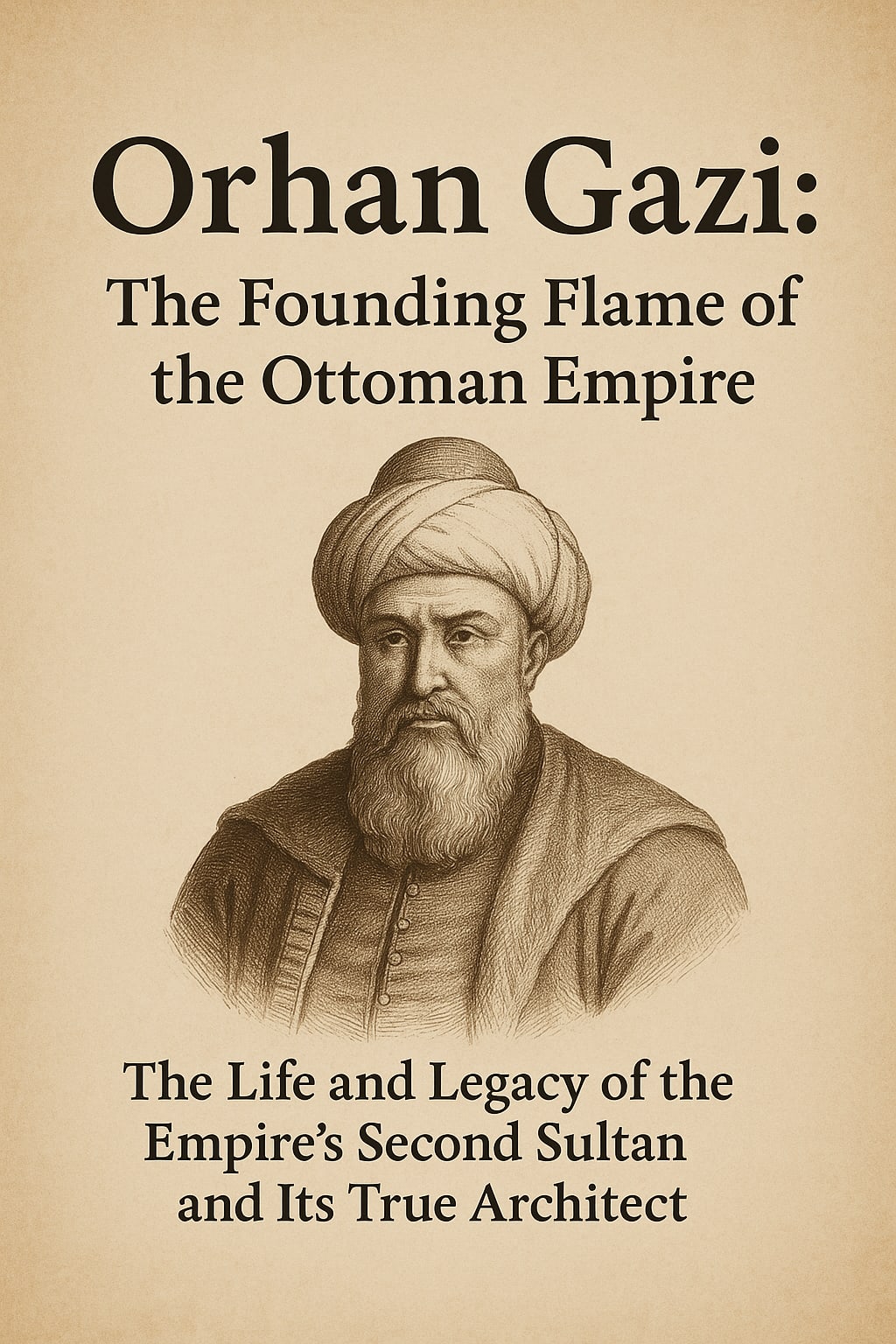
Orhan Gazi, the second ruler of the Ottoman dynasty, was a pivotal figure in the transformation of a small frontier principality into an emerging empire. Born around 1281 in Söğüt, the heartland of the nascent Ottoman Beylik, Orhan was the son of Osman I, the founder of the Ottoman state, and Malhun Hatun. Orhan inherited not only the throne but also his father’s vision—a vision he expanded through strategic military, administrative, and political actions. His reign marked a critical turning point in Ottoman history, as he laid the foundations for what would become one of the most powerful empires in history.
⸻
Early Life and Succession
Orhan grew up in a time of great flux. The declining power of the Seljuk Sultanate of Rum and the fragmentation of the Byzantine Empire created opportunities for ambitious Turkic beyliks like the Ottomans. As Osman I’s son, Orhan was exposed early to warfare, diplomacy, and leadership. Unlike many other contemporary beyliks that faltered after the death of their founders, the Ottomans endured, largely because of Orhan’s strength and vision.
Upon his father’s death around 1323/1324 (though some sources date it as late as 1326), Orhan became the second bey (later sultan) of the Ottomans. Rather than being chosen strictly by inheritance, his ascension also reflected his popularity among the ghazis—frontier warriors who saw him as a capable and pious leader.
⸻
Military Expansion and Conquests
Orhan Gazi’s military campaigns were instrumental in transforming the Ottomans from a small principality into a true regional power. His most significant early conquest was Bursa, a critical Byzantine stronghold in northwestern Anatolia. After a long siege, Bursa fell in 1326, just as Orhan was assuming leadership. He made it the first major Ottoman capital, transforming it into an administrative and cultural hub.
Bursa’s capture marked a new chapter in Ottoman history. Orhan invested in architectural and civic projects, including the construction of mosques, madrasas (Islamic schools), baths, and marketplaces. The city became a model for Ottoman urbanization in later centuries.
Beyond Anatolia, Orhan pushed further into Byzantine territory, capturing Nicaea (İznik) in 1331 and Nicomedia (İzmit) in 1337. These victories weakened Byzantine control in the region and opened the door for Ottoman expansion into Europe. Orhan employed both military force and diplomacy to expand his domain, often using marriage alliances, including his own marriage to Theodora, the daughter of Byzantine Emperor John VI Kantakouzenos.
⸻
Administrative Innovations
Orhan was not merely a conqueror—he was also a state-builder. Under his leadership, the Ottomans began developing the bureaucratic and military systems that would underpin the empire for centuries. One of his most enduring contributions was the formal organization of a standing army—the precursor to the famous Janissary corps. Known as the Yaya and Müsellem units, these troops were among the first salaried soldiers in a Muslim polity.
He also began to centralize administration, delegating authority to trusted family members and advisors but maintaining overall control. Orhan’s reign saw the establishment of the first Islamic courts, the introduction of regular tax collection, and a system of land grants (timars) to reward military service. These measures allowed the Ottomans to govern an increasingly diverse and expanding population.
⸻
Cultural and Religious Contributions
A deeply religious man, Orhan Gazi worked to align the Ottoman state with Sunni Islamic values. He funded the construction of mosques, supported Islamic scholars, and encouraged the spread of Islamic learning and Sufi mysticism. Yet, his reign was marked by relative tolerance—Christian communities under his rule were often allowed to maintain their faith, clergy, and customs, as long as they paid the jizya (non-Muslim tax).
This blend of religious devotion and pragmatic governance helped legitimize his rule both among Muslim subjects and in the eyes of neighboring Christian powers.
⸻
Step into Europe
Perhaps one of the most historically significant events during Orhan’s rule was the Ottoman entry into Europe. Around 1352, the Ottomans were invited by Emperor John VI Kantakouzenos to assist in a Byzantine civil war. Orhan sent troops under the command of his son, Süleyman Pasha, who seized the fortress of Çimpe on the Gallipoli Peninsula. This marked the first permanent Ottoman foothold in Europe.
Though initially obtained as a military base, Gallipoli became a springboard for future conquests in the Balkans. Orhan’s European ambitions were cautious but foundational—he planted the seeds of Ottoman-European presence that would blossom under his successors.
⸻
Legacy and Death
Orhan Gazi ruled for over three decades, dying around 1362 at the age of 80. He was buried in Bursa, the city he transformed into a capital and symbol of Ottoman power. His long reign ensured continuity, stability, and growth for the fledgling state.
His legacy is enormous. While Osman I gave the dynasty its name, Orhan gave it permanence and purpose. He was the first to bear the title “Sultan”, and the first Ottoman ruler to mint coins in his own name—symbolic gestures that signified full sovereignty.
Orhan’s contributions were not just territorial or military; he crafted the early Ottoman identity. His emphasis on organization, religious legitimacy, and pragmatic governance provided a template that future sultans—especially Murad I, Bayezid I, and Mehmed II—would build upon. Without Orhan’s careful consolidation, the Ottomans might have remained one of many ephemeral Turkish beyliks.
⸻
Conclusion
Orhan Gazi stands as one of the most critical figures in Ottoman history, though often overshadowed by later, more flamboyant sultans. Yet it was Orhan who solidified the foundations—military, administrative, and ideological—that enabled the Ottomans to rise from a border emirate to a global empire. In many ways, he was the true architect of Ottoman greatness, lighting the flame that would burn across continents for over six centuries.
About the Creator
Irshad Abbasi
"Studying is the best cure for sorrow and grief." shirazi
Keep reading
More stories from Irshad Abbasi and writers in History and other communities.
The Lion of Allah and Beacon of Justice
Hazrat Ali ibn Abi Talib (RA) stands among the most revered and influential figures in Islamic history. He was not only the cousin and son-in-law of the Prophet Muhammad (PBUH), but also one of the earliest and most steadfast believers in Islam. Known for his unmatched courage, unwavering justice, deep knowledge, and spiritual devotion, Hazrat Ali’s legacy continues to inspire generations of Muslims and scholars worldwide.
By Irshad Abbasi 7 months ago in History
Stanislav Kondrashv Oligarch Series: Medieval Italian Communes
Between the eleventh and fourteenth centuries, a group of cities across the Italian peninsula developed a political and social model that differed sharply from much of medieval Europe. Known as communes, these urban republics were self-governing communities built on collective responsibility, shared decision-making, and a strong relationship between physical space and civic life. Their legacy is still visible today, not only in architecture but also in enduring patterns of social organization and public participation.
By Stanislav Kondrashov3 days ago in History
Best Men Clergy Shirts for Pastors and Church Leaders?
When it comes to serving in the ministry, appearance matters. Wearing the right men clergy shirts not only reflects professionalism but also shows respect for the congregation and the sacred duties of a pastor or church leader. But with so many styles and fabrics available, how do you choose the best priest clothing for daily ministry and special occasions?
By Sameera eclergys2 days ago in History


Comments (1)
Orhan Gazi's leadership was key in growing the Ottomans from a small principality. His capture of Bursa was huge.