
The Inventor Who Lit the World
The Life, Struggles, and Genius of the Man Behind the Light Bulb

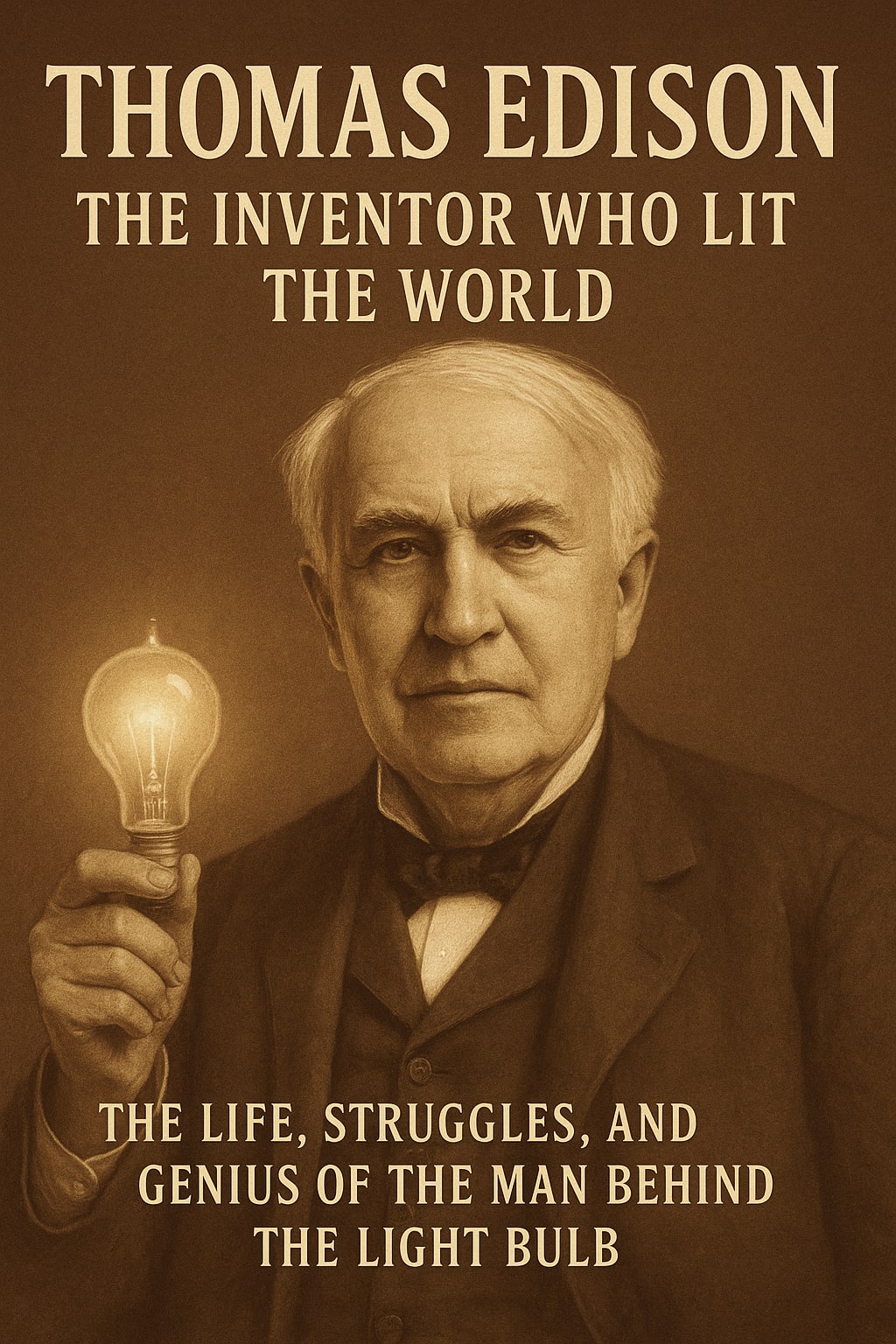
Thomas Alva Edison, one of the most influential inventors in human history, was born on February 11, 1847, in Milan, Ohio, USA. He is best remembered for revolutionizing the modern world with his invention of the electric light bulb. However, his contributions spanned many fields including sound recording, motion pictures, electric power, and communication. Edison’s life was a blend of relentless experimentation, tireless work ethic, and an unwavering belief in innovation.
Early Life and Challenges
Edison was the youngest of seven children. His father, Samuel Edison, was a political activist and businessman, while his mother, Nancy Edison, was a former teacher who had a significant impact on his early education. Due to his hyperactivity and constant questioning, Edison struggled in traditional schooling and was eventually homeschooled by his mother. She believed in nurturing his curiosity rather than suppressing it.
At the age of 12, Edison began selling newspapers and candy on trains. He used this opportunity to set up a small laboratory in the baggage car, where he conducted chemical experiments during his breaks. This early exposure to science and business was the beginning of his lifelong journey into the world of innovation.
The First Inventions
Edison’s first major invention came in 1869 when he created an improved stock ticker called the Universal Stock Printer. It combined several existing telegraph devices into one and was a huge commercial success. He sold the rights for $40,000—a fortune at the time—which allowed him to establish his first laboratory in Newark, New Jersey.
By the early 1870s, Edison had already earned the nickname “The Wizard of Menlo Park” after establishing his world-famous research lab in Menlo Park, New Jersey. This facility was the first of its kind—a dedicated industrial research laboratory where Edison and a team of skilled workers and scientists would collaborate on inventions.
Lighting Up the World
Edison’s most iconic achievement was developing a practical, long-lasting electric light bulb. Although he did not invent the very first light bulb, he perfected it. Many inventors before him had tried to create electric lighting, but their designs were either too costly, burned out quickly, or were unsafe. After hundreds of experiments and failed prototypes, Edison succeeded in creating a carbon-filament bulb that could glow for over 1,200 hours.
On December 31, 1879, Edison publicly demonstrated his electric light system in Menlo Park, astonishing the crowd and capturing the imagination of the entire world. His invention wasn’t just the bulb itself; he also developed the electrical system required to power and distribute electricity to homes and businesses. This was the birth of the modern electric utility industry.
The Phonograph and Motion Pictures
In 1877, Edison invented the phonograph—a device that could record and reproduce sound. It was a groundbreaking invention that amazed the public. People called it “Edison’s talking machine.” Although it was initially used for business dictation, it later laid the foundation for the modern music and entertainment industries.
Edison’s influence also extended into motion pictures. In the 1890s, he and his team developed the Kinetoscope, a device that allowed individuals to view moving images through a peephole. He later built the first movie studio, the Black Maria, where many of the first films in history were produced. Edison’s contributions helped shape the foundation of the film industry.
A Tireless Work Ethic
Edison was known for his relentless dedication to work. He held over 1,000 patents in his name—a world record at the time. He often worked 16 to 20 hours a day, and he famously said, “Genius is one percent inspiration and ninety-nine percent perspiration.”
Despite many failures throughout his career, Edison never gave up. His ability to keep experimenting, learning, and adjusting his approach made him a master of innovation. He was not afraid of failure; in fact, he welcomed it as part of the process.
Rivalries and Controversies
Edison’s life was not without conflict. One of his most well-known rivalries was with Nikola Tesla during the “War of Currents.” Edison supported direct current (DC) electricity, while Tesla and industrialist George Westinghouse championed alternating current (AC), which proved to be more efficient for long-distance transmission. Despite Edison’s efforts to discredit AC, it eventually became the standard. Although Edison lost that particular battle, his contributions to the development of electric systems remained vital.
Edison was also criticized for some of his business practices. He was known to aggressively defend his patents and could be ruthless in protecting his intellectual property. Some believed he downplayed the work of others to promote his own inventions, and disputes with fellow inventors were common throughout his career.
Legacy and Death
Thomas Edison died on October 18, 1931, at the age of 84, in West Orange, New Jersey. In honor of his legacy, electric lights were dimmed across the United States. His home and laboratory in West Orange were later preserved as the Edison National Historical Park.
Edison’s legacy is vast and enduring. He transformed daily life with his inventions, made electricity a part of everyday experience, and laid the foundation for countless modern technologies. He also revolutionized the way innovation is approached—through organized, team-based research and development.
Conclusion
Thomas Edison was not just an inventor; he was a visionary who shaped the future. His story is a testament to the power of persistence, creativity, and hard work. From a curious young boy experimenting on a train to a global icon who lit the world, Edison remains one of history’s greatest minds. His life continues to inspire new generations of inventors, dreamers, and thinkers who dare to challenge the impossible.
About the Creator
Irshad Abbasi
"Studying is the best cure for sorrow and grief." shirazi
Keep reading
More stories from Irshad Abbasi and writers in History and other communities.
The Revolutionary Who Redefined Cuba
Fidel Castro was born on August 13, 1926, in Birán, a small town in eastern Cuba. His father, Ángel Castro, was a wealthy Spanish immigrant who owned a sugar plantation. His mother, Lina Ruz González, was Ángel’s cook and later became his second wife. Castro was raised with his siblings in relatively comfortable conditions and was sent to Catholic boarding schools, where he showed early signs of leadership and rebelliousness.
By Irshad Abbasi 7 months ago in History
Rajendra Chola I and the Conquest of the Ganga: A Monumental Feat in Indian History
Known as the “Gangaikonda Chola” (the Chola who conquered the Ganga), Rajendra transformed a South Indian maritime empire into a pan-Indian power whose influence stretched from the Indian Ocean to the heart of the subcontinent. This campaign was not merely a military raid but a bold statement of imperial ambition, strategic brilliance, and cultural confidence.
By Say the truth a day ago in History



Comments (1)
Edison's story is amazing. I can relate to his love for experimentation. Like him, I've always been curious about how things work and have spent hours in my own "lab" trying to figure it out. His early setbacks, like struggling in school, show that success isn't always immediate. It's inspiring to see how he turned his challenges into opportunities for great inventions.