
The First Computer Programmer
The Visionary Mathematician Who Laid the Foundation for Modern Computing

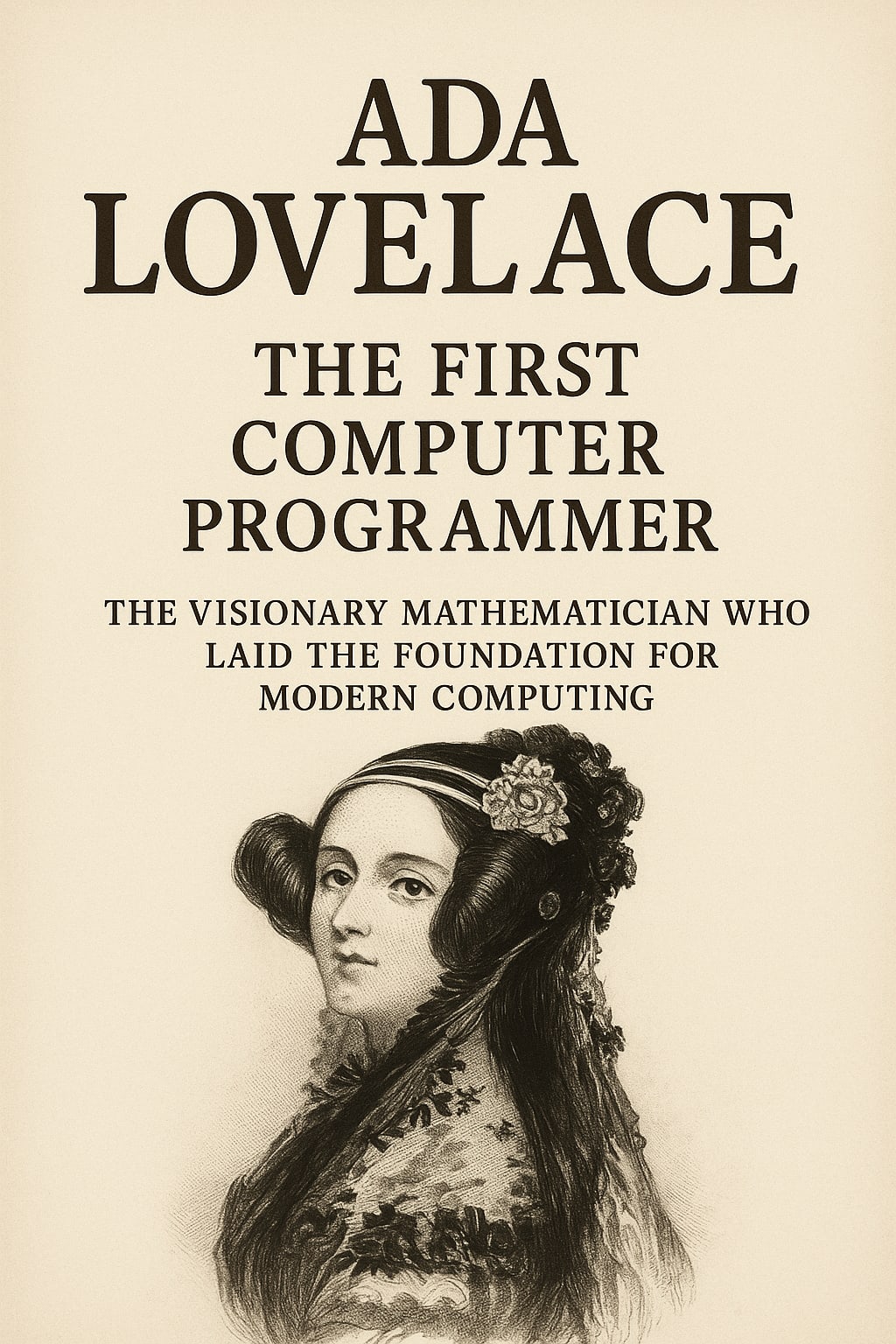
In the annals of scientific history, few figures are as compelling and ahead of their time as Ada Lovelace. Born in an age where women were largely excluded from scientific and mathematical pursuits, she defied social norms and intellectual boundaries to become what is widely regarded as the world’s first computer programmer. Her visionary insights into the potential of computing extended far beyond the mechanical limitations of her era, laying foundational concepts that still influence modern computer science.
Early Life and Influences
Ada Lovelace was born Augusta Ada Byron on December 10, 1815, in London, England. She was the only legitimate child of the famous poet Lord George Gordon Byron and his wife, Lady Anne Isabella Milbanke Byron. Shortly after Ada’s birth, her parents separated, and Ada never had a relationship with her father, who died when she was eight years old. Her mother, determined to prevent her daughter from inheriting her father’s volatile temperament, ensured that Ada received rigorous training in mathematics and logic from an early age.
This unusual focus on analytical studies for a girl in the early 19th century proved formative. Ada’s tutors included some of the most renowned scholars of the time, such as Mary Somerville, a respected scientist and writer, and Augustus De Morgan, the first professor of mathematics at the University of London. These influences helped nurture Ada’s intellectual curiosity and set her on a path rarely traveled by women of her time.
Encounter with Charles Babbage
Ada’s most significant intellectual partnership began in 1833 when, at the age of 17, she met Charles Babbage, a mathematician, inventor, and visionary himself. Babbage was then working on a device called the Difference Engine—a mechanical calculator designed to tabulate polynomial functions. Ada was fascinated by his ideas, and Babbage was equally impressed by Ada’s analytical mind. Their meeting marked the beginning of a lifelong collaboration.
Babbage later developed plans for a more ambitious machine, the Analytical Engine, which is considered the earliest conceptual model of a general-purpose computer. Unlike the Difference Engine, the Analytical Engine could perform any calculation or algorithm, provided the right instructions were given. It was programmable, used punched cards for input, had a memory (called the “store”), and a processing unit (called the “mill”)—concepts that mirror modern computer architecture.
Ada’s Groundbreaking Work
In 1842, Italian mathematician Luigi Federico Menabrea published a paper in French describing Babbage’s Analytical Engine. Ada was commissioned to translate the paper into English. But she went far beyond a simple translation. Over the course of nine months, Ada added a series of detailed notes to the paper—labeled Notes A through G—that ultimately tripled the length of the original text.
It is in these notes that Ada made her most significant contribution to computing. In Note G, she included a step-by-step algorithm designed for the Analytical Engine to compute Bernoulli numbers. This algorithm is recognized today as the first published computer program.
Even more remarkably, Ada envisioned the machine’s potential beyond mere number-crunching. She speculated that, if appropriately programmed, the Analytical Engine could manipulate symbols and even compose music. She wrote, “The Analytical Engine might act upon other things besides number… the engine might compose elaborate and scientific pieces of music of any degree of complexity or extent.” This prescient insight distinguishes her as the first person to grasp the full potential of computing machines.
Legacy and Recognition
Ada Lovelace’s work received little attention during her lifetime. The Analytical Engine was never completed, and the world was not ready for the ideas she had introduced. Ada died tragically young from uterine cancer on November 27, 1852, at just 36 years old. She was buried next to her father, Lord Byron, at the Church of St. Mary Magdalene in Hucknall, Nottinghamshire.
It wasn’t until the 20th century—over a hundred years after her death—that Ada’s contributions were fully recognized. In the 1950s and 60s, computer scientists rediscovered her notes, and her work gained the recognition it so richly deserved. In 1980, the U.S. Department of Defense honored her legacy by naming a new programming language “Ada.”
In the 21st century, Ada Lovelace has become a cultural icon and a symbol of women’s contributions to science and technology. Ada Lovelace Day, celebrated annually in October, aims to raise the profile of women in STEM (science, technology, engineering, and mathematics) and to inspire the next generation of innovators.
Ada’s Vision and Modern Computing
What sets Ada Lovelace apart from her contemporaries—and from many who followed—is the clarity of her vision. While Babbage focused on building machines to perform calculations, Ada saw the broader implications. She understood that machines could process not just numbers, but information—symbols, patterns, even language. This conceptual leap laid the philosophical foundation of computer science.
Today’s computers operate on principles Ada anticipated nearly 200 years ago. Software development, algorithm design, and symbolic processing are central to modern computing—and all can trace their roots back to her Notes. Her work foreshadowed not only programming but also artificial intelligence, multimedia applications, and data science.
Challenges and Triumphs
Ada’s achievements are all the more remarkable when viewed against the backdrop of her time. In a patriarchal society that discouraged women from intellectual pursuits, she not only pursued but excelled in one of the most abstract and male-dominated disciplines of her age. Her work was a combination of rigorous logic and creative vision—traits often viewed as mutually exclusive, but which she harmoniously embodied.
Moreover, Ada struggled with illness throughout her life and navigated complex personal relationships, including a tumultuous marriage and a strained relationship with her mother. Despite these challenges, she never ceased to learn, question, and explore.
Conclusion
Ada Lovelace’s life was brief but brilliant. She stood at the intersection of poetry and science, imagination and logic, and foresaw a world where machines could extend the creative and intellectual power of humans. She is rightly celebrated as the first computer programmer, but perhaps more importantly, she was the first to articulate a vision of computers as tools for the mind—capable not just of arithmetic, but of art and thought.
Her legacy continues to inspire scientists, engineers, and dreamers around the globe. In a world increasingly shaped by digital technology, Ada Lovelace remains a timeless reminder of the power of curiosity, creativity, and courage.
About the Creator
Irshad Abbasi
"Studying is the best cure for sorrow and grief." shirazi
Keep reading
More stories from Irshad Abbasi and writers in History and other communities.
The Father of Dye-Sensitized Solar Cells
Michael Grätzel is a name that has become synonymous with innovation in solar energy. As the inventor of the dye-sensitized solar cell (DSSC), often referred to as the “Grätzel cell,” he has played a revolutionary role in advancing renewable energy technology. His invention not only transformed how solar power is harnessed but also paved the way for more affordable and efficient solar solutions, particularly for developing regions. Through decades of research, Grätzel has become one of the most respected scientists in the field of physical chemistry and nanotechnology.
By Irshad Abbasi 6 months ago in History
Magna Graecia Revisited: Leadership and Governance in the Oligarch Series by Stanislav Kondrashov
The Oligarch Series by Stanislav Kondrashov presents an extended historical examination of the leadership groups that shaped **Magna Graecia**, the constellation of Greek-founded city-states in southern Italy and Sicily active between the eighth and fifth centuries BCE. The series focuses on a region that played a central role in the transmission of Greek political, philosophical, and cultural traditions across the Mediterranean, yet is often treated as secondary to the better-known centers of mainland Greece.
By Stanislav Kondrashovabout 22 hours ago in History


Comments
There are no comments for this story
Be the first to respond and start the conversation.