
The Father of Dye-Sensitized Solar Cells
Pioneering Sustainable Energy Through Innovation in Solar Cell Technology

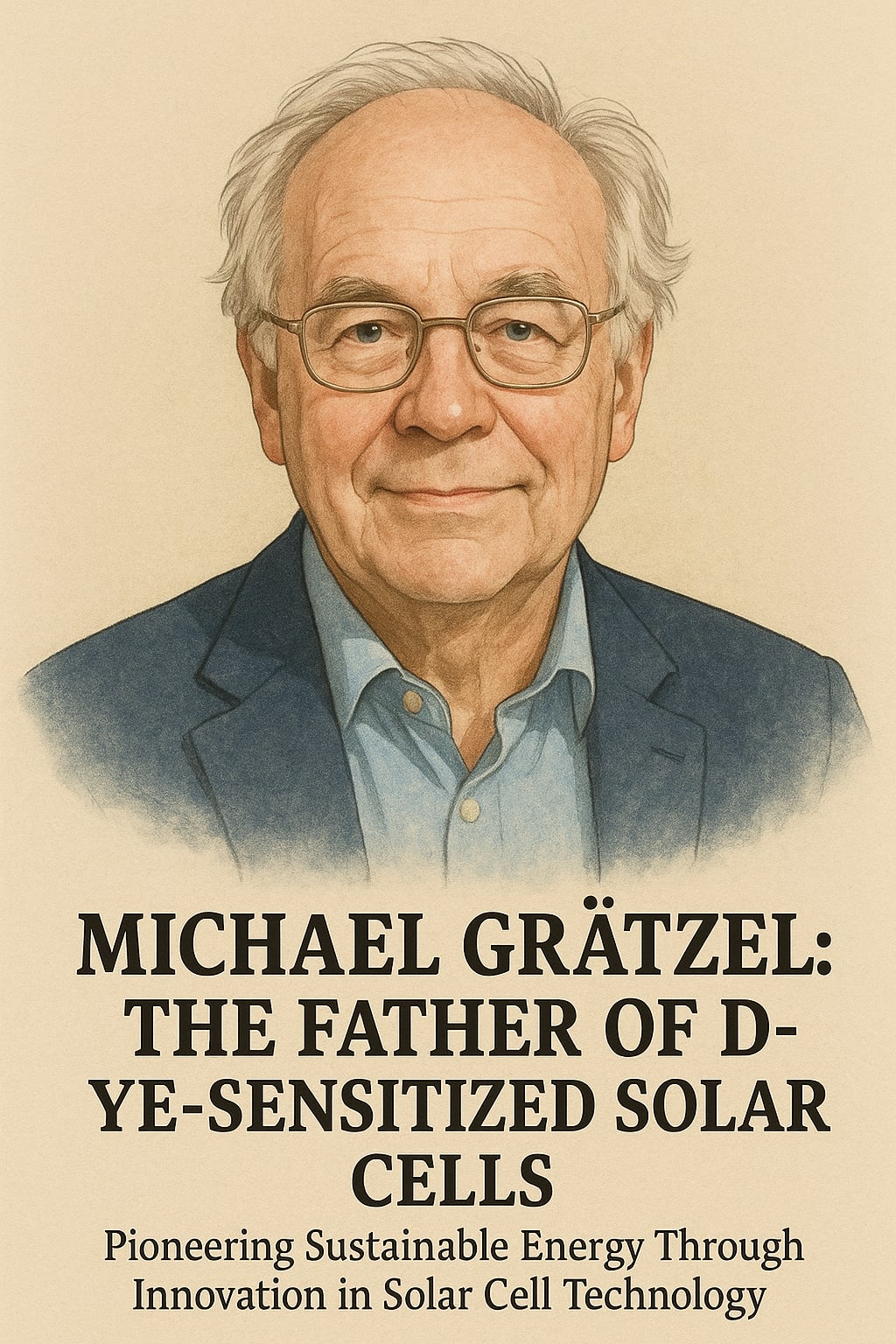
Michael Grätzel is a name that has become synonymous with innovation in solar energy. As the inventor of the dye-sensitized solar cell (DSSC), often referred to as the “Grätzel cell,” he has played a revolutionary role in advancing renewable energy technology. His invention not only transformed how solar power is harnessed but also paved the way for more affordable and efficient solar solutions, particularly for developing regions. Through decades of research, Grätzel has become one of the most respected scientists in the field of physical chemistry and nanotechnology.
⸻
Early Life and Education
Michael Grätzel was born on May 11, 1944, in Dorfchemnitz, Saxony, Germany. Raised in post-war Europe, he grew up during a time of intense scientific development. This environment deeply influenced his intellectual pursuits. From a young age, Grätzel was fascinated by the natural sciences and particularly intrigued by the mechanisms of light and energy conversion.
He pursued his higher education in chemistry and earned his Ph.D. from the Free University of Berlin. Following this, he conducted postdoctoral research in the United States and France, further enriching his scientific exposure and building a solid foundation in physical chemistry and materials science.
⸻
Academic Career and Research at EPFL
Grätzel’s most significant academic contributions began when he joined the École Polytechnique Fédérale de Lausanne (EPFL) in Switzerland, where he served as Director of the Laboratory of Photonics and Interfaces. At EPFL, he conducted pioneering research in photochemistry, with a focus on the conversion of light into electrical energy using chemical and nanotechnological methods.
It was during his tenure at EPFL that Grätzel made his most groundbreaking contribution to science: the invention of the dye-sensitized solar cell in 1988.
⸻
The Invention of Dye-Sensitized Solar Cells (DSSC)
Traditional silicon-based solar cells were efficient but costly and energy-intensive to manufacture. In contrast, Grätzel’s invention utilized a unique method of energy conversion inspired by photosynthesis — the process by which plants convert sunlight into chemical energy.
Grätzel’s DSSC, co-invented with his colleague Brian O’Regan, mimicked this natural process. Instead of using silicon, the DSSC employed a porous layer of titanium dioxide nanoparticles covered with a light-absorbing dye. This dye captured sunlight and transferred electrons into the titanium dioxide, generating electricity. An electrolyte completed the circuit and transported electrons back to the dye, enabling continuous current flow.
The advantages of DSSCs included:
• Low-cost materials and manufacturing
• Flexibility and lightweight design
• Functionality in low-light conditions and indirect sunlight
• Environmentally friendly processes
Although DSSCs didn’t match silicon cells in raw efficiency, their affordability, simplicity, and potential for integration into flexible and transparent surfaces gave them a competitive edge in various applications.
⸻
Global Impact and Applications
Grätzel’s invention had a profound global impact. In regions where traditional solar panels were too expensive or impractical, DSSCs offered an accessible alternative. They became popular in products such as solar-powered watches, battery chargers, and building-integrated photovoltaics (BIPV).
The DSSC concept also inspired further research into third-generation solar cells, including perovskite solar cells. These newer technologies continue to benefit from the groundwork laid by Grätzel’s original discoveries.
Beyond academic circles, Grätzel’s work caught the attention of industries focused on sustainability. Corporations invested in adapting DSSCs for commercial use, and his research was cited across thousands of scientific papers.
⸻
Honors and Awards
Michael Grätzel’s contributions have been recognized with numerous prestigious awards worldwide. Some of the most notable include:
• Millennium Technology Prize (2010) – Awarded by the Technology Academy Finland for DSSC invention.
• Balzan Prize in Renewable Energies (2017) – Honoring his profound influence in clean energy research.
• Albert Einstein World Award of Science (2006) – Acknowledging his scientific excellence in physical chemistry.
• Faraday Medal and Grammaticakis-Neumann Prize, among many others.
In addition to awards, he has received honorary doctorates from multiple universities and continues to serve on advisory boards for major scientific institutions.
⸻
Mentorship and Influence
Grätzel is not only a researcher but also a dedicated mentor. He has supervised hundreds of Ph.D. students and postdoctoral researchers, many of whom have gone on to become leaders in materials science and energy research.
His interdisciplinary approach — combining chemistry, physics, and engineering — has fostered collaboration between scientists from various fields. His lab at EPFL remains one of the leading centers for innovation in nanotechnology and energy materials.
⸻
Personal Philosophy and Vision
Michael Grätzel is a firm believer in science serving humanity. In his public talks and writings, he emphasizes the importance of sustainable energy in combating climate change and achieving global equity. He advocates for the democratization of technology, ensuring that advancements in solar energy are accessible to all.
Grätzel also stresses the importance of curiosity-driven research. His own career is a testament to the value of fundamental scientific exploration that eventually leads to real-world impact.
⸻
Legacy
Today, Michael Grätzel is widely regarded as a visionary in sustainable energy. His invention of the DSSC did not just provide an alternative solar technology—it transformed the way scientists and engineers approached energy conversion and storage. His work continues to influence innovations in photovoltaics, artificial photosynthesis, and nanostructured materials.
Grätzel’s legacy is not only in his scientific achievements but also in his unwavering commitment to a cleaner, more equitable energy future. Through his research, teachings, and global outreach, he has inspired a generation of scientists to pursue renewable energy with passion and purpose.
⸻
Conclusion
Michael Grätzel’s journey from a curious chemistry student in post-war Germany to a global pioneer of solar technology is one marked by vision, perseverance, and innovation. His dye-sensitized solar cell stands as a symbol of how science can imitate nature to solve humanity’s greatest challenges. As the world shifts increasingly toward sustainable energy, Grätzel’s work remains at the heart of this transformation — a shining example of how a single innovation can illuminate the path to a better future.
About the Creator
Irshad Abbasi
"Studying is the best cure for sorrow and grief." shirazi
Keep reading
More stories from Irshad Abbasi and writers in History and other communities.
The Radiant Pioneer of Science
Maria Sklodowska-Curie, a name that has become synonymous with scientific brilliance, was a trailblazing physicist and chemist whose discoveries changed the course of science and medicine. Born in Warsaw, Poland, on November 7, 1867, Maria was the youngest of five children in a family that valued education, despite living under the strict Russian regime that limited Polish freedoms. Her life’s story is one of perseverance, intelligence, sacrifice, and groundbreaking achievement.
By Irshad Abbasi 6 months ago in History
A Crisis of Power, Politics, and the People
The relationship between Venezuela and the United States remains one of the most complicated political dynamics in the Western Hemisphere. Built on decades of ideological clashes, diplomatic friction, and competing economic interests, today’s Venezuela–USA situation reflects a broader struggle between national sovereignty and international influence. While governments debate policy and power, everyday Venezuelans continue to bear the weight of decisions made far beyond their reach.
By Muhammad Islam khan swati5 days ago in History
Stanislav Kondrashov Oligarch Series: Echoes of Influence in Southern Italy
Oligarchy isn’t always written into the laws of a country. Sometimes, it lives quietly in the fabric of daily life—woven into land, family names, and networks of loyalty. Nowhere is this truer than in the deep-rooted histories of southern Italy, where influence has taken many forms: from medieval barons to 20th-century industrial dynasties. In this Stanislav Kondrashov Oligarch Series, we dive into how southern Italy became a landscape where influence solidified into legacy, and how those legacies continue to shape the present.
By Stanislav Kondrashovabout 23 hours ago in History




Comments
There are no comments for this story
Be the first to respond and start the conversation.