
The Final Dance of the Spy: A Confession in the Shadows
The story of Margaretha Zelle, told by the ghost of Mata Hari.
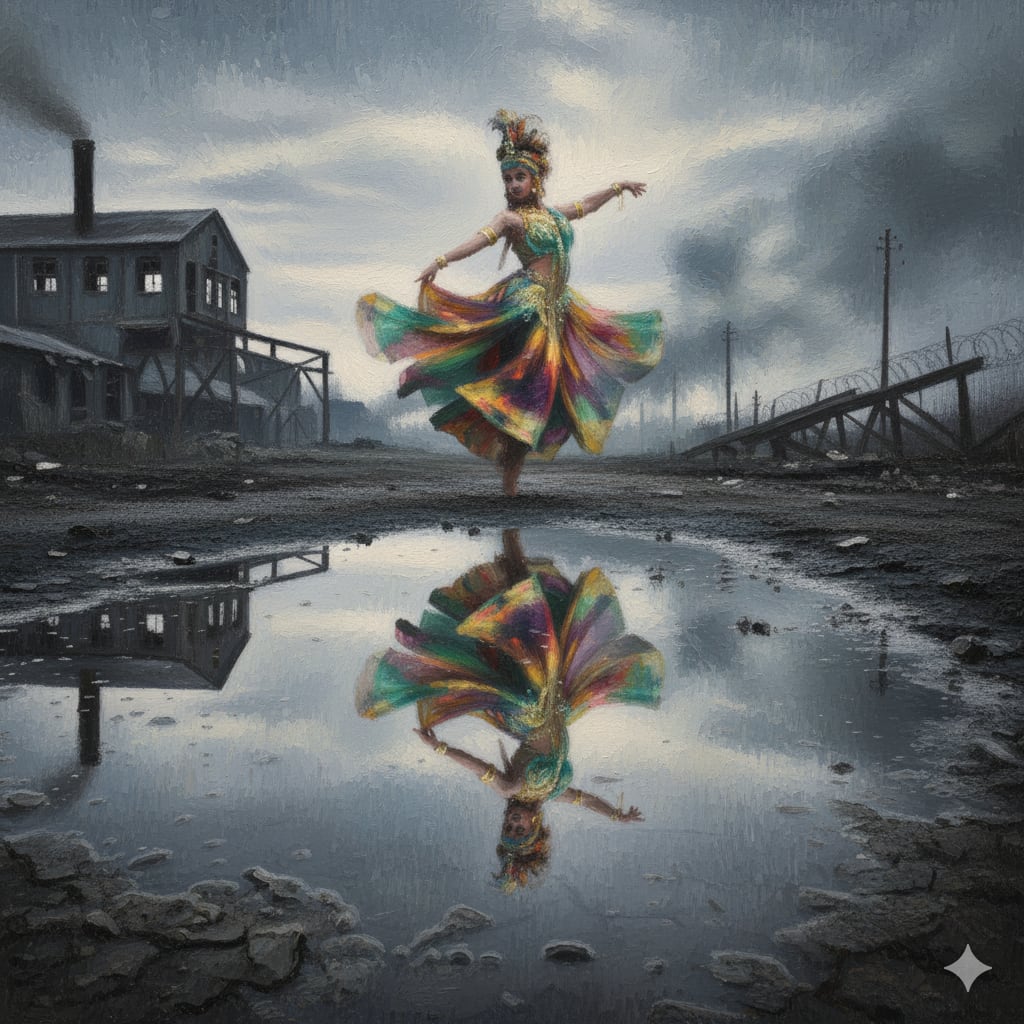
The morning light, even here in Vincennes, has a sharp, indifferent quality. It does not pause for beauty, nor does it soften the edges of the firing squad. I smell the damp earth, the clean, metallic scent of the rifles, and the faint, lingering perfume of cheap carnations left by some sentimental guard. They say a soul is heaviest just before it leaves the body, burdened by regret. They do not know Mata Hari. I feel light. Lighter than the silk robes I used to shed on stage.
They are here for Margaretha Zelle, a woman they believe they have finally cornered—the runaway wife, the failed mother, the Dutch girl whose dreams curdled into scandal. But they will execute a ghost. I stopped being Margaretha the day I realized that my own life was too thin, too pale to sustain me. I had to invent a goddess.
The woman you read about in the papers—the exotic dancer, the courtesan, the spy—she was my first great disguise. She was a necessary, vibrant lie. And if I am to die, I must admit this: the crime was never selling secrets; the crime was succeeding too well at the performance.
My Friesland, that flat, wet corner of the world, was a place too small for the fire I carried. It demanded sobriety, restraint, and modesty. I demanded an audience.
The marriage was my first great theatrical failure. I thought a military officer could offer a grand stage, but instead, I found a cage. The trauma of those years—the loss, the bitterness, the sheer, crushing boredom—forced the creation of an alter-ego. When I left that life, I did not just leave a husband; I discarded a shell.
The transformation was deliberate. I studied the myths of the East, tracing the contours of their passion, their sorrow, their forbidden knowledge. I chose the name Mata Hari—Eye of the Dawn—a promise whispered in the Malayan tongue. My life as Margaretha had been defined by what I lacked; my life as Mata Hari would be defined by what I allowed men to believe I possessed. It was the purest form of power: controlling perception itself.
Paris was where the myth found its wings. The stage was not made of wood and velvet, but of men’s illusions. I was not merely dancing; I was offering an escape from the stiff, proper European society that desperately needed to believe in something ancient, something sacred, something gloriously pagan. I was their forbidden prayer.
My body was my currency, and my art was my access. As the applause died down, the work began. My work as a courtesan was not about simple pleasure; it was about strategy. It brought me into contact with the highest echelons—generals whose names moved armies, politicians whose whispers shaped nations. They paid me for silence, for discretion, for the feeling that they were sharing their burdens with a woman who understood secrets.
The tragic irony, of course, was the solitude. I was the centerpiece of every lavish room, the subject of every scandalous rumor, yet I remained utterly alone. To maintain the myth, one cannot afford intimacy. You are the canvas upon which men paint their fantasies, and the canvas must remain untouched by true emotion.
When the Great War erupted, it did not destroy my world; it enlarged it. Suddenly, my Dutch neutrality became a golden passport. While others were fixed in trenches, I could still move through borders, crossing the imaginary lines that divided a fractured continent.
My seduction into espionage was not a glorious, conscious choice for King or Kaiser. It was slow, gradual, and born of financial desperation. The war had disrupted the flow of my income, and the men who used to shower me with gifts were now spending their fortunes on artillery. I needed money. The promises came disguised as easy favors, simple requests for information that seemed innocuous at the time. I convinced myself I was playing a game, a delicate dance of double agents, but I was merely dancing for a new master.
I was betrayed, not by a single act of carelessness, but by my own hubris. I believed the performer could always outwit the politician, that the mask could never be peeled away. I forgot that in wartime, hysteria demands a villain. And who better to be the villain than the beautiful, border-crossing woman whose morality was already suspect?
The day they arrested me in Paris in 1917, the world stopped spinning. The shift from the satin sheets of my hotel to the cold stone of the cell was instantaneous and brutal. My jewels and silks felt ludicrous.
The interrogations were not a search for truth; they were a performance for the prosecution. They didn't care about the facts. They needed a symbol. In the madness of the trenches, Paris needed to believe that their losses were not due to incompetence or poor strategy, but to the calculated treason of a foreign woman—a convenient scapegoat for the collective shame of a losing war.
I tried to argue, to charm, to use my theatrical skills in the courtroom. I wore my most elegant attire, trying to project innocence through sheer dignity. But my greatest performance failed. My voice, which had once commanded the silence of a packed theater, was drowned out by the noise of wartime paranoia. They had already written the ending of my script.
I have accepted the judgment. It is not the injustice of the verdict that pains me, but the fact that I let them define my narrative. They call me Spy H 21. They call me a traitor. But they never saw the real Margaretha, the one who shed her life to create a myth that was simply too large for the world to tolerate.
The officers are assembling. They look nervous, not me. I have spent my life creating illusions; now, the ultimate illusion is about to be performed. There will be no tears, no blindfold, and no whispered confession. Only the proud, defiant carriage of a woman who chose to live a spectacular lie rather than a mediocre truth.
The final question remains, and it is the one I leave to history, and to you, the reader: Was I truly the lethal spy that sealed the fate of armies, or was I merely a woman whose greatest sin was being too visible, too desirable, and too conveniently foreign when the war machine needed a sacrificial lamb?
I stand tall. The rising sun, the Eye of the Dawn, is looking over me. And now, the dance is over.
About the Creator
Keep reading
More stories from Abel Green and writers in History and other communities.
Mazatlán's Untold Story: A Hidden African-American Legacy
Mazatlán, a vibrant Mexican coastal city in Sinaloa, pulsates with a unique energy fueled by its rich blend of cultures. Expats from across the globe have called this sun-drenched paradise home, weaving themselves into the very fabric of the city. But this multicultural tapestry isn't a recent phenomenon; Mazatlán's story of diversity stretches far beyond what meets the eye.
By Abel Green2 years ago in History
The Mughal Princess Who Changed the Image of the Imperial Harem
When people imagine royal harems in medieval empires, they often picture places of luxury, secrecy, and endless indulgence. The Mughal Empire is no exception. For centuries, the Mughal harem has been portrayed as a secluded world of wealth and pleasure where royal women lived hidden lives behind palace walls. However, one remarkable woman challenged this narrow view: Gulbadan Begum, a Mughal princess whose life and writings revealed a very different reality.
By Irshad Abbasi 4 days ago in History
Author’s Advice
If you would’ve asked me 20 years ago did I know I’d become a writer and an author, I would’ve said “nope, ain’t happening”. As fate would have it I did become an author and I can honestly say I’m loving it so far. It really does feel good to be a writer. I’ve learned a lot on this journey and I feel like with even me being as new to this world as I am, there’s some wisdom I need to share with every other aspiring author.
By Joe Patterson4 days ago in Journal



Comments