
Shadows of Valor: A Life Shaped by World War II
The True Story of Courage, Survival, and Sacrifice in History’s Deadliest Conflict

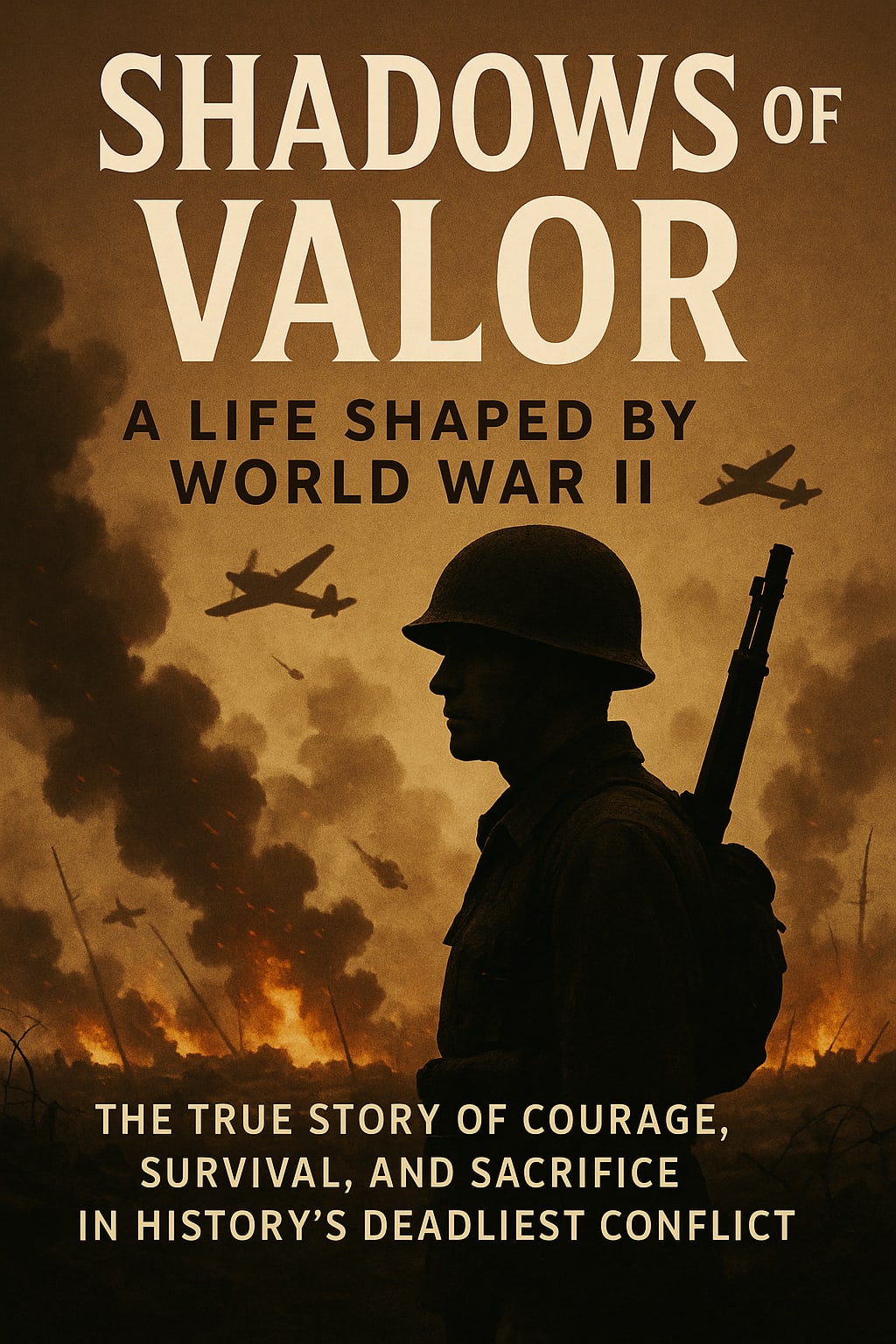
The story of Thomas “Tom” Whitaker begins not on the battlefield, but in a quiet Midwestern town in the United States. Born in 1918 in rural Iowa, Tom grew up in the long shadow of World War I, with a father who served in the trenches of France and never quite returned in spirit. The Whitaker household was one of silence, resilience, and unspoken grief. That grief, however, forged in young Tom a quiet strength and an unwavering sense of duty.
By the time he turned 23, the world was again on the brink of war. The bombing of Pearl Harbor in 1941 shattered any remaining illusions of American isolation. Like millions of others, Tom enlisted. He left behind a job at the local grain mill, a mother who clutched his letter like a sacred text, and his fiancée, Eleanor, who promised to wait.
Assigned to the 1st Infantry Division—the “Big Red One”—Tom trained hard at Fort Riley before shipping out to North Africa. There, amid the sweltering heat and shifting sands of Tunisia, he encountered the brutal reality of war for the first time. The fighting was fierce and often chaotic. He saw comrades fall beside him, their lives extinguished in a matter of seconds. And yet, Tom remained—a survivor, not out of luck, but out of instinct and resolve.
In North Africa, Tom earned his first commendation: the Bronze Star for dragging two injured soldiers out of a burning half-track under heavy fire. But he never spoke of it. “You do what you have to,” he wrote to Eleanor in a rare moment of reflection. “Anything less, and it’s someone else’s mother getting that telegram.”
From Africa, Tom’s division advanced to Sicily in 1943, and then on to the beaches of Normandy. June 6, 1944—D-Day—was the turning point of his life. Tom landed at Omaha Beach amidst withering machine-gun fire and exploding shells. The sea was red. The sand offered no cover. He crawled, shot, and prayed. He watched his best friend, Private Jack Calhoun, take a bullet meant for him.
For hours, he lay pinned down with shrapnel in his leg, watching the tide of battle ebb and flow. It was there, on that blood-soaked beach, that Tom confronted the full magnitude of war—not as a soldier, but as a man. He did not cry. He did not scream. But something in him changed forever.
After D-Day, Tom pressed forward with the Allied advance into France and later into Germany. He took part in the liberation of a small concentration camp near the outskirts of Dachau. What he saw behind those barbed wire fences would haunt him for the rest of his life. Emaciated survivors, mass graves, and the stench of death—these were not the spoils of victory, but a glimpse of humanity’s darkest hour.
When the war ended in May 1945, Tom was a decorated veteran. He returned to Iowa with a Silver Star, a Purple Heart, and memories he refused to share. He married Eleanor in a modest ceremony and tried to pick up where he left off, working at the mill and raising three children.
But war had carved deep scars into him. Nights were restless. Loud noises brought flashes of Normandy. At times, he would sit alone on the porch, staring into the distance, his hand unconsciously resting where the shrapnel had struck him. He never called himself a hero. In fact, he hated the term.
For decades, Tom remained silent about his wartime experiences. It was only after his grandson, a history student, asked him to speak for a school project that the stories began to surface—quietly, haltingly, like a man trying to walk after years of limping.
He spoke not of glory, but of pain. Of Jack Calhoun, who’d once played harmonica under the stars. Of the French girl who helped hide wounded soldiers in a barn. Of the German teenager who surrendered to him, terrified and barely old enough to shave. Of the night he almost ended his own life out of guilt.
His story eventually reached a local museum, then the state historical society. He was invited to speak at veterans’ events, but he always declined. “What I did,” he said, “is what anyone should’ve done. Nothing more.”
Tom Whitaker died in 2005 at the age of 87. At his funeral, military honors were rendered, and a letter from the President was read aloud. But it was his grandson, David, who gave the most poignant tribute.
“My grandfather never wanted to be remembered as a hero. He wanted to be remembered as a man who did what was right, even when it was hard. He walked through hell and came back not with medals, but with humility.”
His story lives on in letters, in photographs, and now in this biography. It is not a tale of conquest, nor one of fame. It is the story of a man shaped by war but not broken by it—a man whose courage lived in quiet acts, whose survival came with sacrifice, and whose valor cast long, enduring shadows.
About the Creator
Irshad Abbasi
Ali ibn Abi Talib (RA) said 📚
“Knowledge is better than wealth, because knowledge protects you, while you have to protect wealth.
Keep reading
More stories from Irshad Abbasi and writers in History and other communities.
A Biography from the First World War
I never imagined that the muddy trench lines stretching across France would become the boundaries of my world for nearly four years. I was just eighteen when I left home, a fresh-faced boy from Yorkshire with dreams of honor and adventure, not knowing the price that awaited those who believed the war would be over by Christmas. The letter came in June 1915, marked with the king’s seal, summoning me to service. I still remember my mother’s trembling hands as she packed my small case, hiding her fear behind a hopeful smile. My father, a Boer War veteran, shook my hand silently, pride and dread battling behind his eyes. We all knew the war was nothing like what the papers claimed, but we pretended anyway. By August, I was in uniform, standing in formation with hundreds of others, all of us still clinging to the illusion that bravery would be enough. We trained in the cold mornings and marched through the twilight, singing songs to drown out the gnawing uncertainty. By October, I was shipped to the Western Front, assigned to the 11th Battalion, East Lancashire Regiment—what they called a “Pal’s Battalion,” since many of us came from the same town. That was both a blessing and a curse. When your mates fell beside you, it wasn’t just fellow soldiers you lost—it was childhood friends, neighbors, brothers.
By Irshad Abbasi 9 months ago in History


Comments
There are no comments for this story
Be the first to respond and start the conversation.