
The Father of Philosophy and Science
How One Philosopher Transformed Knowledge Forever

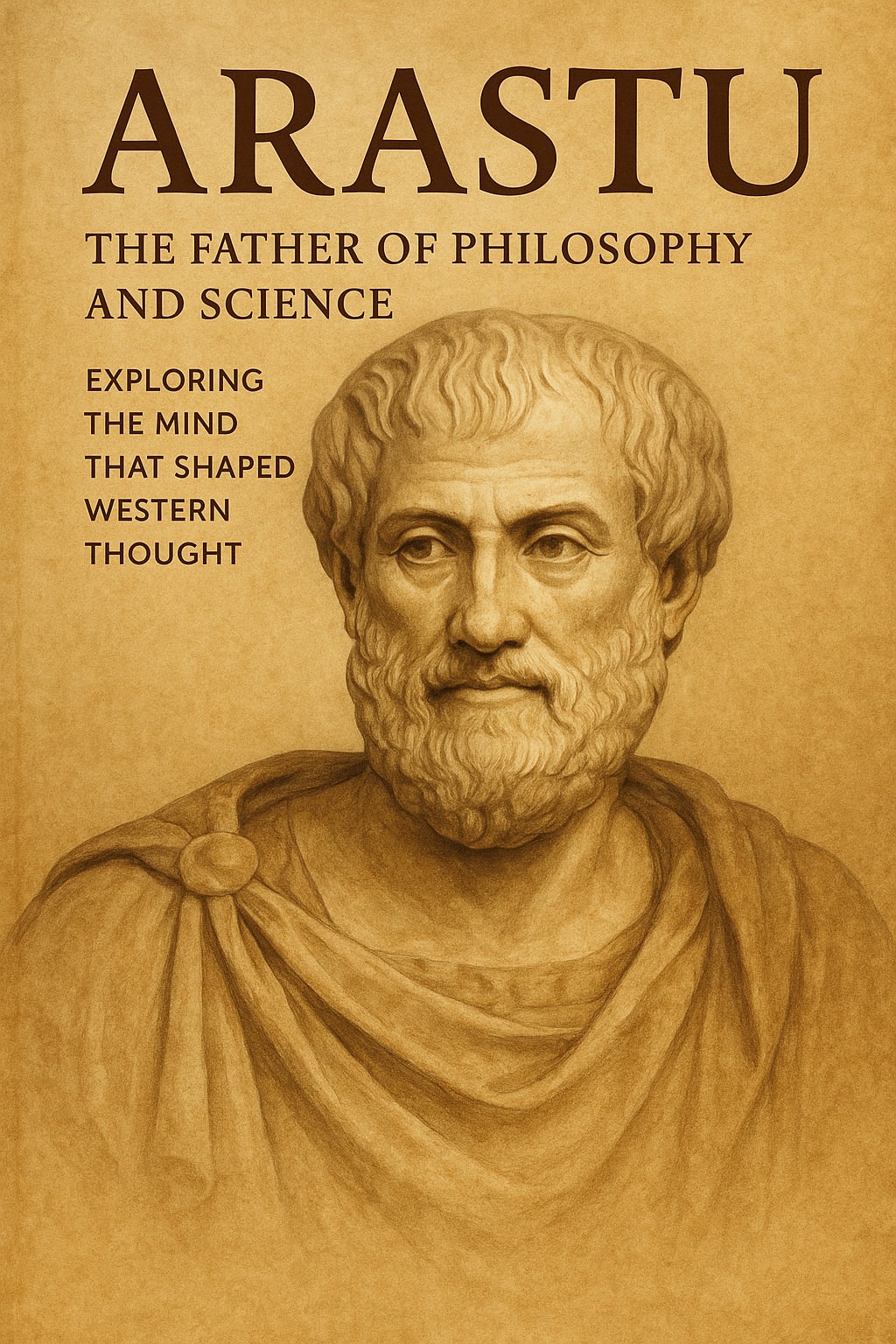
Arastu, more widely recognized by the Western world as Aristotle, stands as one of the most influential figures in the history of human thought. His groundbreaking contributions to philosophy, science, and numerous other disciplines earned him the title **"The Father of Philosophy and Science."** Through his intellectual curiosity, rigorous methods, and expansive body of work, Arastu laid the foundational stones upon which much of Western intellectual tradition is built.
#### Early Life and Background
Arastu was born in 384 BCE in the ancient city of Stagira, located in the northern part of Greece. His father, Nicomachus, served as a physician to the Macedonian royal court, which likely influenced Arastu’s early interest in biology and natural phenomena. Although much about his early childhood remains unknown, it is evident that Arastu was exposed to scholarly and scientific thinking from a young age.
At the age of seventeen, Arastu traveled to Athens, the intellectual heart of Greece, to study at Plato’s Academy, one of the most prestigious learning institutions of the time. There, he spent two decades absorbing the philosophical teachings of Plato and engaging in the vibrant intellectual community. While he deeply respected his teacher, Arastu eventually developed his own ideas that often diverged from Plato’s, especially regarding the nature of reality and knowledge.
#### Philosophy: A New Approach to Understanding Reality
Arastu’s philosophy was rooted in empirical observation and logic. Unlike Plato, who emphasized ideal forms and abstract universals, Arastu believed in studying the physical world directly. He sought to understand the essence of things by analyzing their form and matter, arguing that both are inseparable in defining an object.
One of his most significant contributions is the concept of the **“Four Causes”** — material, formal, efficient, and final causes — which explained why things exist or happen. For example, a statue’s material cause is the bronze from which it is made, the formal cause is the shape or design, the efficient cause is the sculptor, and the final cause is the purpose or function the statue serves. This framework introduced a systematic way to approach causality and explanation, influencing philosophy, theology, and science for centuries.
Arastu also developed the principles of **logic**, particularly syllogistic reasoning, which became the basis for formal logic. His work in logic is compiled in a collection called the *Organon*, which became a standard reference for medieval scholars and remained influential until the modern period.
#### Contributions to Science and Natural Philosophy
Arastu is often hailed as the father of science because he was among the first to advocate for systematic observation and classification of the natural world. His scientific inquiries covered a vast array of disciplines, including biology, physics, astronomy, meteorology, and psychology.
In **biology**, Arastu conducted detailed observations of animals, dissecting and classifying them based on shared characteristics. He distinguished between different species and studied their anatomy, reproduction, and habits. His works on zoology were pioneering for their time and remained authoritative well into the Middle Ages.
In **physics**, he investigated concepts such as motion, causality, and the nature of space and time. Though some of his physical theories were later superseded by Newtonian mechanics, his ideas about natural motion and the role of forces were vital stepping stones in scientific thought.
Arastu also explored **astronomy** and cosmology. He proposed a geocentric model of the universe, with the Earth at its center surrounded by celestial spheres — an idea that dominated Western astronomy until the Copernican revolution in the 16th century.
#### Ethics and Politics
Beyond natural philosophy, Arastu made significant contributions to ethics and political theory. In his work *Nicomachean Ethics*, named after his son Nicomachus, Arastu examined the nature of virtue and the good life. He proposed that the highest human good is **eudaimonia**, often translated as “happiness” or “flourishing,” achieved through practicing virtue and reason in everyday life.
He believed that virtue lies in the “Golden Mean” — a balance between extremes of excess and deficiency. For example, courage is a virtue that lies between recklessness and cowardice. This practical and balanced approach to ethics has influenced countless thinkers, from Roman philosophers to modern-day ethicists.
In political philosophy, Arastu wrote *Politics*, where he argued that the state exists to promote the common good and enable citizens to live virtuous lives. He classified governments into monarchies, aristocracies, and democracies, analyzing their strengths and weaknesses and advocating for a balanced constitution that avoids tyranny or mob rule.
#### Legacy and Influence
Arastu’s impact extends far beyond his lifetime, permeating numerous fields of human inquiry. After his death in 322 BCE, his works were preserved and studied extensively, especially during the Islamic Golden Age when scholars in the Muslim world translated, commented on, and expanded upon his ideas. It was through these translations that Arastu’s works reentered Western Europe in the Middle Ages, profoundly shaping scholastic philosophy and the development of universities.
Medieval Christian philosophers like Thomas Aquinas integrated Arastu’s philosophy with Christian theology, demonstrating his compatibility with religious thought. This fusion became a cornerstone of Western intellectual tradition, influencing education, science, and moral philosophy up to the Renaissance and beyond.
In modern times, despite some of his scientific theories being outdated, Arastu’s emphasis on observation, classification, and logical analysis remains foundational to the scientific method. His interdisciplinary approach, combining philosophy with empirical study, set the precedent for the integration of different fields of knowledge.
#### Conclusion
Arastu, or Aristotle, rightfully deserves the title **“The Father of Philosophy and Science.”** His vast contributions laid the groundwork for numerous disciplines and intellectual traditions that continue to shape our understanding of the world today. From his pioneering work in logic and metaphysics to his systematic studies of biology and ethics, Arastu embodied the spirit of inquiry and reason that defines the pursuit of knowledge.
His life and work remind us that philosophy and science are deeply interconnected endeavors aimed at understanding the fundamental nature of reality and humanity’s place within it. As a thinker who bridged abstract thought and empirical observation, Arastu’s legacy is not just historical but timeless, inspiring generations of scholars, scientists, and seekers of wisdom.
About the Creator
Irshad Abbasi
Ali ibn Abi Talib (RA) said 📚
“Knowledge is better than wealth, because knowledge protects you, while you have to protect wealth.
Keep reading
More stories from Irshad Abbasi and writers in History and other communities.
Conqueror of the Ancient World
Born in 356 BCE in Pella, the ancient capital of Macedonia, Alexander III of Macedon—later known as Alexander the Great—emerged as one of history’s most remarkable military commanders and empire builders. His brief yet dazzling life altered the course of civilizations, blending Greek culture with the diverse traditions of Asia and the Middle East. By the age of thirty, Alexander had created one of the largest empires the world had ever seen, stretching from Greece to India.
By Irshad Abbasi 10 months ago in History
The Year 1902 in Review: Fun Facts, Trivia, and Historic Highlights
This quick read is a collection of fun facts, trivia, and historic events from the year 1902. Discover the year’s top news stories, most influential people, sports facts, entertainment trivia, famous birthdays and deaths, and much more.
By Gregory DeVictora day ago in History



Comments (1)
Aristotle's work is truly remarkable. His focus on empirical observation in philosophy is refreshing. I wonder how different our understanding of the world would be today if his ideas hadn't been so influential. It makes me think about how our modern scientific methods might have evolved without his foundational concepts. His "Four Causes" concept is fascinating. It makes you look at the world in a more in - depth way. I'm curious how applying these causes to modern - day problems could lead to new solutions. It shows how his ancient ideas still have relevance in our quest to understand the world around us.