
Conqueror of the Ancient World
From Macedonian Prince to Legendary Empire Builder

Born in 356 BCE in Pella, the ancient capital of Macedonia, Alexander III of Macedon—later known as Alexander the Great—emerged as one of history’s most remarkable military commanders and empire builders. His brief yet dazzling life altered the course of civilizations, blending Greek culture with the diverse traditions of Asia and the Middle East. By the age of thirty, Alexander had created one of the largest empires the world had ever seen, stretching from Greece to India.
### Early Life and Education
Alexander was born to King Philip II of Macedon and Queen Olympias, a princess from the neighboring region of Epirus. From a young age, Alexander was exposed to both royal privilege and the responsibilities of leadership. His father, a brilliant military strategist and reformer, had transformed Macedonia into a formidable power. Alexander’s mother, deeply spiritual and ambitious, filled his imagination with stories of divine lineage, including the belief that he descended from Achilles and Heracles.
Recognizing his son’s potential, King Philip hired Aristotle—the greatest philosopher of the time—as Alexander’s tutor. Under Aristotle’s guidance, Alexander received an exceptional education in philosophy, science, literature, medicine, and politics. The influence of Homer’s *Iliad* was especially profound; Alexander admired Achilles and sought to emulate his heroic ideal throughout his life.
### Rise to Power
Alexander’s life changed forever in 336 BCE when his father was assassinated at a wedding celebration. At just twenty years old, Alexander ascended to the throne of Macedonia. Many Greek city-states saw this as an opportunity to rebel, thinking the young king inexperienced. But Alexander quickly crushed opposition in Thebes, demonstrating his decisiveness and military prowess.
He then turned his attention to fulfilling his father’s long-held ambition: the conquest of the Persian Empire, then the largest and wealthiest empire in the world.
### Conquest of Persia
In 334 BCE, Alexander led an army of about 35,000 soldiers across the Hellespont (modern-day Dardanelles) into Asia Minor. He quickly achieved a decisive victory at the Battle of Granicus, defeating a much larger Persian force. This was only the beginning of a campaign that would last a decade and span three continents.
At the Battle of Issus in 333 BCE, Alexander faced King Darius III of Persia. Despite being vastly outnumbered, Alexander’s brilliant tactics won the day, forcing Darius to flee. He continued southward, liberating or capturing key cities along the eastern Mediterranean, including Tyre and Gaza.
One of Alexander’s most celebrated moments came in Egypt, where he was welcomed as a liberator. There, he founded the city of Alexandria in 331 BCE, which would later become a major center of learning and culture. Visiting the oracle of Ammon at Siwa Oasis, Alexander was declared a "son of Zeus," reinforcing his belief in his divine destiny.
Later that year, Alexander delivered the knockout blow to the Persian Empire at the Battle of Gaugamela. Darius fled again and was later killed by his own men. Alexander proclaimed himself King of Asia, effectively assuming control over the vast Persian Empire.
### Expansion into Central Asia and India
With Persia under his control, Alexander pressed eastward. His campaigns took him through the rugged terrain of Bactria and Sogdiana (modern-day Afghanistan and Uzbekistan), where he encountered fierce resistance. There, he married Roxana, a Bactrian princess, symbolizing his policy of fusing Greek and local cultures.
In 326 BCE, Alexander crossed the Hindu Kush into India and fought one of his toughest battles at the Hydaspes River against King Porus. Though victorious, Alexander was impressed by Porus’s courage and appointed him a satrap (governor) under his rule.
However, his weary troops, longing for home after years of campaigning, refused to go further east. Alexander reluctantly turned back, leading his men south along the Indus River and then through the harsh Gedrosian Desert—a brutal journey that cost many lives.
### Final Years and Legacy
Alexander returned to Babylon in 324 BCE, now the de facto capital of his empire. He began consolidating his rule, planning new campaigns, including an invasion of Arabia, and organizing a fusion of Greek and Persian cultures. He hosted mass weddings between his officers and Persian noblewomen in a grand attempt to unite East and West.
But his ambitions were cut short. In 323 BCE, Alexander fell ill—possibly from malaria, typhoid, or poisoning—and died at the age of 32. His death left a power vacuum and no clear successor. His generals, known as the Diadochi, eventually divided his empire into rival kingdoms, sparking decades of conflict.
Despite his early death, Alexander’s impact was immense. He spread Hellenistic culture across a vast region, blending Greek, Persian, Egyptian, and Indian traditions. Cities he founded, especially Alexandria in Egypt, became centers of trade, science, and learning. His military tactics are still studied today, and he remains a symbol of youthful ambition and visionary leadership.
### Personality and Leadership
Alexander’s charisma, intelligence, and fearlessness earned him fierce loyalty from his troops. He led from the front in battle and shared the hardships of his men. Yet he could also be ruthless, destroying cities and executing those who opposed him. As he aged, he became increasingly autocratic and began to adopt Persian customs, causing tension with his Macedonian followers.
He saw himself as a unifier of worlds rather than just a conqueror. His vision of a multicultural empire was ahead of its time, though it met resistance from many of his own people.
### Conclusion
Alexander the Great’s legacy transcends time. In just over a decade, he changed the face of the ancient world, uniting East and West in a fusion of cultures that shaped the course of history. Though his empire did not survive long after his death, the ideas, institutions, and cities he left behind influenced civilizations for centuries.
Alexander remains a legendary figure—a prince turned warrior, a student of philosophy who became a god-like king, and a visionary who dreamed of one world, united not just by conquest but by culture. His story is one of triumph and tragedy, ambition and legacy—an enduring reminder of what one extraordinary individual can achieve.
About the Creator
Irshad Abbasi
Ali ibn Abi Talib (RA) said 📚
“Knowledge is better than wealth, because knowledge protects you, while you have to protect wealth.
Keep reading
More stories from Irshad Abbasi and writers in History and other communities.
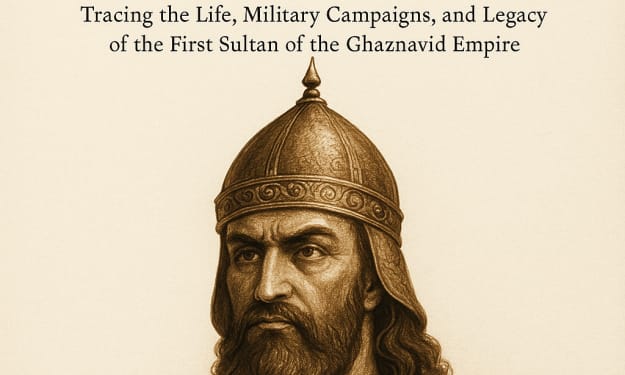
The Conqueror of Empires and Patron of Culture
Mahmud of Ghazni (971–1030 CE), born Yamin ad-Dawlah Mahmud ibn Sebüktegin, was a formidable ruler, warrior, and cultural patron whose influence extended far beyond the borders of his empire. As the first ruler to bear the title “Sultan,” Mahmud's reign marked the formal emergence of Islamic rule in the Indian subcontinent and helped shape the religious, political, and cultural landscape of South and Central Asia.
By Irshad Abbasi 9 months ago in History
The Politics of Playing Dress-Up
Well, to start off I'd like to say a happy world book day to all who celebrate. I know I haven't really posted anything on my socials about it but I'm not a jubilant kind of person. I lay low most of the time. Let's start off with a popular anecdote from the vaults...
By Annie Kapur2 days ago in Geeks



Comments (1)
Alexander the Great's story is truly fascinating. His early exposure to privilege and leadership set the stage. Hiring Aristotle as his tutor was a brilliant move. I wonder how different his approach to ruling might have been if he hadn't had that philosophical and diverse education. And his quick response to the rebellions after his father's death showed real guts. How do you think his military strategies compared to those of other great commanders of his era?